The Battle of Stalingrad was a major battle on the Eastern Front of World War II where Nazi Germany and its allies unsuccessfully fought the Soviet Union for control of the city of Stalingrad in Southern Russia. The battle was marked by fierce close-quarters combat and direct assaults on civilians in air raids, with the battle epitomizing urban warfare. The Battle of Stalingrad was the deadliest battle to take place during the Second World War. Today, the Battle of Stalingrad is universally regarded as the turning point in the European theatre of war, as it forced the Oberkommando der Wehrmacht to withdraw considerable military forces from other areas in occupied Europe to replace German losses on the Eastern Front, ending with the rout of the six field armies of Army Group B, including the destruction of Nazi Germany's 6th Army and an entire corps of its 4th Panzer Army. The victory at Stalingrad energized the Red Army and shifted the balance of power in the favour of the Soviets.

Blitzkrieg is a word used to describe a combined arms surprise attack using a rapid, overwhelming force concentration that may consist of armored and motorized or mechanized infantry formations, together with artillery, air assault and close air support, that has the intent to break through the opponent's lines of defense, then dislocate the defenders, unbalance the enemy by making it difficult to respond to the continuously changing front, and defeat them in a decisive Vernichtungsschlacht: a battle of annihilation.
Nazi Germany was the German state between 1933 and 1945, when Adolf Hitler and the Nazi Party controlled the country, transforming it into a dictatorship. Under Hitler's rule, Germany quickly became a totalitarian state where nearly all aspects of life were controlled by the government. The Third Reich, meaning "Third Realm" or "Third Empire", alluded to the Nazi claim that Nazi Germany was the successor to the earlier Holy Roman Empire (800–1806) and German Empire (1871–1918). The Third Reich, which Hitler and the Nazis referred to as the Thousand-Year Reich, ended in May 1945 after 12 years when the Allies defeated Germany, ending World War II in Europe.
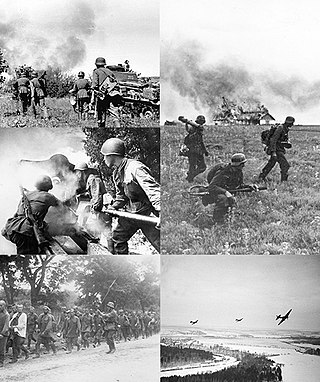
Operation Barbarossa was the invasion of the Soviet Union by Nazi Germany and many of its Axis allies, starting on Sunday, 22 June 1941, during the Second World War. It was the largest land offensive in human history, with over 10 million combatants taking part. The operation, code-named after Frederick Barbarossa, a 12th-century Holy Roman emperor and German king, put into action Nazi Germany's ideological goal of conquering the western Soviet Union to repopulate it with Germans. The German Generalplan Ost aimed to use some of the conquered people as forced labour for the Axis war effort while acquiring the oil reserves of the Caucasus as well as the agricultural resources of various Soviet territories including Ukraine and Byelorussia. Their ultimate goal was to create more Lebensraum for Germany, and the eventual extermination of the indigenous Slavic peoples by mass deportation to Siberia, Germanisation, enslavement, and genocide.
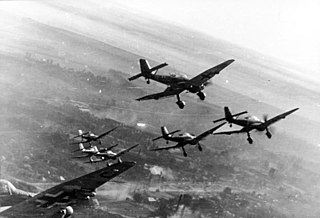
World War II or the Second World War, often abbreviated as WWII or WW2, was a global conflict that lasted from 1939 to 1945. The vast majority of the world's countries, including all of the great powers, fought as part of two opposing military alliances: the Allies and the Axis. Many participants threw their economic, industrial, and scientific capabilities behind this total war, blurring the distinction between civilian and military resources. Aircraft played a major role, enabling the strategic bombing of population centres and the delivery of the only two nuclear weapons ever used in war.

Fritz Erich Georg Eduard von Manstein was a German Field Marshal of the Wehrmacht during the Second World War, who was subsequently convicted of war crimes and sentenced to 18 years imprisonment.

The Battle of Berlin, designated as the Berlin Strategic Offensive Operation by the Soviet Union, and also known as the Fall of Berlin, was one of the last major offensives of the European theatre of World War II.

Friedrich Wilhelm Ernst Paulus was a German field marshal during World War II who is best known for commanding the 6th Army during the Battle of Stalingrad. The battle ended in disaster for the Wehrmacht when Soviet forces encircled the Germans within the city, leading to the ultimate death or capture of most of 265,000 6th Army personnel, their Axis allies and collaborators.

The Third Battle of Kharkov was a series of battles on the Eastern Front of World War II, undertaken by Army Group South of Nazi Germany against the Soviet Red Army, around the city of Kharkov between 19 February and 15 March 1943. Known to the German side as the Donets Campaign, and in the Soviet Union as the Donbas and Kharkov operations, the German counterstrike led to the recapture of the cities of Kharkov and Belgorod.

The European theatre of World War II was one of the two main theatres of combat during World War II. It saw heavy fighting across Europe for almost six years, starting with Germany's invasion of Poland on 1 September 1939 and ending with the Western Allies conquering most of Western Europe, the Soviet Union conquering most of Eastern Europe and Germany's unconditional surrender on 8 May 1945 although fighting continued elsewhere in Europe until 25 May. On 5 June 1945, the Berlin Declaration proclaiming the unconditional surrender of Germany to the four victorious powers was signed. The Allied powers fought the Axis powers on two major fronts as well as in a strategic bombing offensive and in the adjoining Mediterranean and Middle East theatre.

The Eastern Front of World War II was a theatre of conflict between the European Axis powers against the Soviet Union (USSR), Poland and other Allies, which encompassed Central Europe, Eastern Europe, Northeast Europe (Baltics), and Southeast Europe (Balkans) from 22 June 1941 to 9 May 1945. It was known as the Great Patriotic War in the Soviet Union – and still is in some of its successor states, while almost everywhere else it has been called the Eastern Front. In present-day German historiography the name German-Soviet War is typically used.

Kurt Zeitzler was a Chief of the Army General Staff in the Wehrmacht of Nazi Germany during World War II.
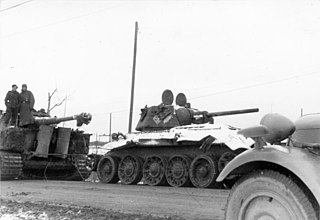
Operation Winter Storm, a German offensive in December 1942 during World War II, involved the German 4th Panzer Army failing to break the Soviet encirclement of the German 6th Army during the Battle of Stalingrad.

Case Blue was the German Armed Forces' plan for the 1942 strategic summer offensive in southern Russia between 28 June and 24 November 1942, during World War II. The objective was to capture the oil fields of Baku, Grozny and Maikop for two purposes: to enable the Germans to re-supply their low fuel stock and also to deny their use to the Soviet Union, thereby bringing about the complete collapse of the Soviet war effort.

Operation Little Saturn was a Red Army offensive on the Eastern Front of World War II that led to battles in Don and Chir rivers region in German-occupied Soviet Union territory in 16–30 December 1942.

The 4th Panzer Army was a German panzer formation during World War II. As a key armoured component of the Wehrmacht, the army took part in the crucial battles of the German-Soviet war of 1941–45, including Operation Barbarossa, the Battle of Moscow, the Battle of Stalingrad, the Battle of Kursk, and the 1943 Battle of Kiev.
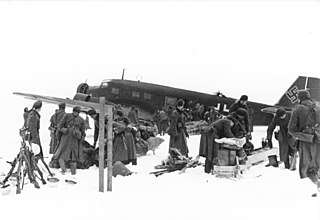
The Demyansk Pocket was the name given to the pocket of German troops encircled by the Red Army around Demyansk, south of Leningrad, during World War II's Eastern Front. The pocket existed mainly from 8 February to 21 April 1942.
David M. Glantz is an American military historian known for his books on the Red Army during World War II and as the chief editor of The Journal of Slavic Military Studies.

The Wehrmacht were the unified armed forces of Nazi Germany from 1935 to 1945. It consisted of the Heer (army), the Kriegsmarine (navy) and the Luftwaffe. The designation "Wehrmacht" replaced the previously used term Reichswehr and was the manifestation of the Nazi regime's efforts to rearm Germany to a greater extent than the Treaty of Versailles permitted.

The 1940 Field Marshal Ceremony refers to a promotion ceremony held at the Kroll Opera House in Berlin in which Adolf Hitler promoted twelve generals to the rank of Generalfeldmarschall on 19 July 1940. It was the first occasion in World War II that Hitler appointed field marshals due to military achievements.