
Franz Monjau (30 January 1903, Cologne - 28 February 1945, KZ Buchenwald) was a German Expressionist painter and art teacher.
Franz Monjau (30 January 1903, Cologne - 28 February 1945, KZ Buchenwald) was a German Expressionist painter and art teacher.
His father, Max Monjau, was a manufacturer from Barmen. His mother Paula, née Meyer, was the daughter of a Jewish wine merchant in Mainz. Both parents were practicing Catholics. Around 1910, the family moved to Düsseldorf where his father became chief representative for the cigarette maker, A. M. Eckstein Söhne. [1] After completing his primary education, he enrolled at the Kunstakademie Düsseldorf, where he studied from 1922 to 1926; originally with Willy Spatz, then as a Master Student of Heinrich Nauen.

As a free-lance painter, he became a member of Young Rhineland and later, the "Rheinischen Sezession". Both associations brought him into contact with members of the Communist Party of Germany (KPD). A major commission at GeSoLei was followed by two paintings for the Department of the History of Science, depicting Albertus Magnus and the witch-hunt opponent, Johann Weyer. His earnings from these projects enabled him to spend several months on a study trip to Paris.
In 1930, he married a gymnastics teacher, Marie Mertens (1903–1997), known as "Mieke", whom he had met the year before at a carnival. From 1931 to 1933, he was a trainee teacher in Duisburg and Düsseldorf. He also attended the University of Cologne, taking classes in educational science and psychology, and giving an occasional art lecture.
In 1933 he, Mieke, and several friends were arrested and briefly imprisoned, as part of a series of actions taken against "leaflet distributors", aimed at the KPD. Based on the provisions of the new Law for the Restoration of the Professional Civil Service, he was released from his teaching positions, prevented from taking the pedagogical examination and ultimately dismissed from the civil service entirely.

From 1936 to 1938, he was a drawing teacher at a private "Jüdischen Volksschule" (Jewish People's School) in Düsseldorf. He also made a few painting trips to the North Sea, Holland and Belgium. In 1941, Meike was sent to work at a hospital in Berlin and he taught illegally at several Jewish schools. He was also retrained and recertified as a draftsman and assigned to work at Alphons Custodis, a chimney construction company. [2]
Not long after that, his mother, Paula, was transported to Theresienstadt and he became fearful for his own safety, as Half-Jews (Mischlings) were subject to a complicated and changing body of laws. Then, on June 12, 1943, his studio in Düsseldorf and most of his works were destroyed by a bombing raid. [3] Finally, in 1944, he was denounced by a co-worker for not responding to a "Heil Hitler". He was arrested and taken to the local Gestapo prison. The following year, he was transported to Buchenwald, where he died in the medical experimentation unit at Ohrdruf.
In 1962, a memorial stone was erected in the Golzheimer Friedhof , honoring Monjau, Julo Levin and Peter Ludwigs. In 1998, following Mieke's death, the "Stiftung Monjau-Levin" was created and a large collection of children's drawings, obtained from her husband and Levin, were given an official place at the Stadtmuseum Düsseldorf . A stolperstein has been placed nearby at their former residence.

Ernst Johannes Fritz Thälmann was a German communist politician, and leader of the Communist Party of Germany (KPD) from 1925 to 1933.
Herbert Eimert was a German music theorist, musicologist, journalist, music critic, editor, radio producer, and composer.
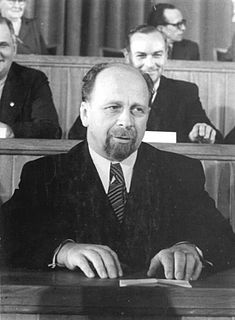
The Ulbricht Group was a group of exiled members of the Communist Party of Germany, led by Walter Ulbricht, who flew from the Soviet Union back to Germany on April 30, 1945. Composed of functionaries from the KPD and ten anti-fascist prisoners of war, their job was to seek out anti-fascist individuals and prepare the groundwork for the re-establishment of communist organizations and unions in postwar Berlin. There were two additional regional groups, the Ackermann Group in Saxony and the Sobottka Group in Mecklenburg. Many of the group's members later became high-level officials in the government of the German Democratic Republic (GDR).

Robert Siewert was a German politician who fought in the German Resistance against National Socialism. He is a survivor of Buchenwald concentration camp, where he helped save the life of Stefan Jerzy Zweig, among others.

Will Lammert was a German sculptor. In 1959 he was posthumously awarded the National Prize of the German Democratic Republic.

Adolf Kober was a rabbi and a historian.

Wilhelm Koenen was a German communist activist and an East German politician. He was married to Emmy Damerius-Koenen and was the father of Heinrich Koenen and Johanna Koenen.
The Association of Revolutionary Visual Artists of Germany was an organization of artists who were members of the Communist Party of Germany. Known primarily by its shortened name, "Asso", it was founded in March 1928. The organization produced posters, placards, propaganda graphics for Communist organizations.

Georg Hornstein was a German-Jewish Resistance fighter during the period of National Socialism (nazism). His acknowledgement of his Jewish heritage, which he made in 1942 during one of his periods of captivity by the Gestapo, has been frequently proclaimed and used as an example of Jewish resistance to the National Socialist regime.
The following is a timeline of the history of the city of Essen, Germany.

Julo Levin, originally Julius was a German Expressionist painter of Jewish ancestry. Most of his surviving works are watercolors and sketches, however his family have some of his paintings. He was murdered in the Holocaust.
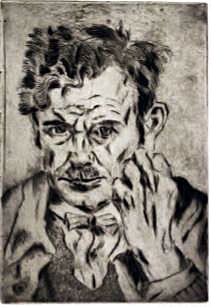
Peter Ludwigs was a German sculptor and Expressionist painter. He is primarily known for his later, Anti-fascist paintings.
Christine Fischer-Defoy is a German woman writer, film director and cultural historian.

Leopold Fleischhacker was a German sculptor and medallist of Jewish ancestry.

Michael Tschesno-Hell was a screenwriter and cultural official of the Deutsche Demokratische Republik.

Karl Gustav Rutz was a German sculptor.
August Bauer was a German sculptor.
Emil Jungblut, also Emil Jungbluth written, was a German sculptor.
Dietrich Meinardus was a German sculptor and stone mason of the historicism in Düsseldorf.

Dr. Theodor Neubauer was a German communist politician, educator, essayist, historian and anti-Nazi resistance fighter.


| General | |
|---|---|
| National libraries | |
| Art research institutes | |
| Biographical dictionaries | |
| Other | |
