Related Research Articles

Altaf Hussain is a British Pakistani politician who is known as the founder of the Muttahida Qaumi Movement. He holds United Kingdom citizenship and has been living in exile in the UK since the start of Operation Clean-up. Since 2015, he has been a fugitive from the Anti Terrorism Court of Pakistan on the charges of murder, targeted killing, treason, inciting violence and hate speech. He went on trial in the UK in January 2022 for promoting terrorism and unrest through hate speech in Pakistan, and was acquitted the next month. He had fled the country in 1992 after a crackdown against his party was launched.
The Geological Survey of India (GSI) is a scientific agency of India. It was founded in 1851, as a Government of India organization under the Ministry of Mines, one of the oldest of such organisations in the world and the second oldest survey in India after the Survey of India, for conducting geological surveys and studies of India, and also as the prime provider of basic earth science information to government, industry and general public, as well as the official participant in steel, coal, metals, cement, power industries and international geoscientific forums.

Rehman Sobhan is a Bangladeshi economist. Regarded as one of the country's top public thinkers, he is the founder of the Centre for Policy Dialogue. Sobhan is an icon of the Bangladeshi independence movement due to his role as a spokesman of the Provisional Government of Bangladesh in the United States during the Bangladesh Liberation War. He was awarded the Independence Day Award, Bangladesh's highest civilian honour, in 2008.

Geological Survey of Pakistan (GSP) is an independent executive scientific agency to explore the natural resources of Pakistan. Main tasks GSP perform are Geological, Geophysical and Geo-chemical Mapping of Pakistan. Target of these mapping are resources exploration, Geo-Engineering assessment, Geo-hazard prediction/prevention and addressing environmental issue.
Women in geology concerns the history and contributions of women to the field of geology. There has been a long history of women in the field, but they have tended to be under-represented. In the era before the eighteenth century, science and geological science had not been as formalized as they would become later. Hence early geologists tended to be informal observers and collectors, whether they were male or female. Notable examples of this period include Hildegard of Bingen who wrote works concerning stones and Barbara Uthmann who supervised her husband's mining operations after his death. Mrs. Uthmann was also a relative of Georg Agricola. In addition to these names varied aristocratic women had scientific collections of rocks or minerals.

Ataur Rahman Khan was a Bangladeshi lawyer, politician and writer, and served as Chief Minister of East Pakistan from 1 September 1956 – March 1958, and as the Prime Minister of Bangladesh from 30 March 1984 to 9 July 1986.

Maharajapuram Seetharaman Krishnan was an Indian Geologist. He was the first Indian to serve as the Director of the Geological Survey of India.

The Geology of Bangladesh is affected by the country's location, as Bangladesh is mainly a riverine country. It is the eastern two-thirds of the Ganges and Brahmaputra river delta plain stretching to the north from the Bay of Bengal. There are two small areas of slightly higher land in the north-centre and north-west composed of old alluvium called the Madhupur Tract and the Barind Tract, and steep, folded, hill ranges of older (Tertiary) rocks along the eastern border.
Mukarram Hussain Khundkar was a Bangladeshi scientist and educationist. He served as a professor at the Department of Chemistry of University of Dhaka. He was one of the founding fellows of Bangladesh Academy of Sciences.
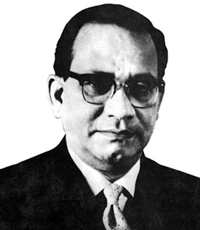
Abul Kashem Khan was a Bangladeshi lawyer, industrialist and politician. In 1945, he founded A K Khan & Company, one of Pakistan's leading conglomerates until 1971, when it became one of Bangladesh's leading conglomerates. Khan served as a member of the Constituent Assembly of India and the Constituent Assembly of Pakistan. He was a federal minister of Pakistan and member in the Pakistan National Assembly.
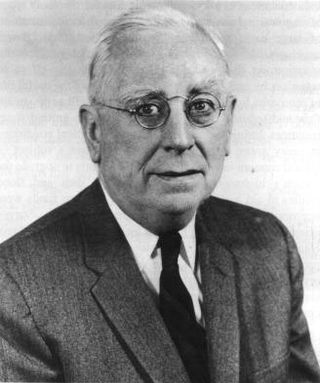
Thomas Brennan Nolan was an American geologist who was director of the United States Geological Survey (USGS) from 1956 to 1965. The mineral nolanite is named in his honor and he was an elected member of the American Academy of Arts and Sciences, the United States National Academy of Sciences, and the American Philosophical Society. He was generally known as Tom Nolan.
Professor Somnath Dasagupta was the vice-chancellor of Assam University till 13 November 2015 and professor of metamorphic geology at Indian Institutes of Science Education and Research, Kolkata.

Mirza Nurul Huda was an economist and academic who served as the 3rd Vice President of Bangladesh. He served as the governor of East Pakistan and the finance minister of Bangladesh.
Mihir Kumar Bose (1933–2009) was an Indian geologist and a professor at the Presidency College, Kolkata. He was known for his studies on igneous petrology and was an elected fellow of the Geological Survey of India, Indian National Science Academy, and the Indian Academy of Sciences. The Council of Scientific and Industrial Research, the apex agency of the Government of India for scientific research, awarded him the Shanti Swarup Bhatnagar Prize for Science and Technology, one of the highest Indian science awards for his contributions to Earth, Atmosphere, Ocean and Planetary Sciences in 1976.

Subir Kumar Ghosh was an Indian structural geologist and an emeritus professor at Jadavpur University. He was known for his studies on theoretical and experimental structural geology and was an elected fellow of the Indian National Science Academy, and the Indian Academy of Sciences. The Council of Scientific and Industrial Research, the apex agency of the Government of India for scientific research, awarded him the Shanti Swarup Bhatnagar Prize for Science and Technology, one of the highest Indian science awards for his contributions to Earth, Atmosphere, Ocean, and Planetary Sciences in 1977.
Kamruddin Ahmed (1912-1982) was a Bangladeshi diplomat, lawyer and politician.
Ahmed Ali Enayetpuri was a Bengali writer, journalist, and politician.
Noazesh Ahmed was a Bangladeshi geneticist and photographer.
Mesbahuddin Ahmed was a Bangladeshi educationalist and geologist.
Anarchism in Bangladesh has its roots in the ideas of the Bengali Renaissance and began to take influence as part of the revolutionary movement for Indian independence in Bengal. After a series of defeats of the revolutionary movement and the rise of state socialist ideas within the Bengali left-wing, anarchism went into a period of remission. This lasted until the 1990s, when anarchism again began to reemerge after the fracturing of the Communist Party of Bangladesh, which led to the rise of anarcho-syndicalism among the Bangladeshi workers' movement.
References
- ↑ Lollino, Giorgio; Giordan, Daniele; Marunteanu, Cristian; Christaras, Basiles; Yoshinori, Iwasaki; Margottini, Claudio (2014). Engineering Geology for Society and Territory - Volume 8: Preservation of Cultural Heritage. Springer. p. 222. ISBN 9783319094083.
- ↑ Memoirs of the Geological Survey of Pakistan: Palaeontologia Pakistan. Geological Survey of Pakistan. 1966. p. 3.
- ↑ "References" (PDF). users.physics.harvard.edu. Archived from the original (PDF) on 18 January 2018. Retrieved 17 January 2018.
- 1 2 3 Chowdhury, Sifatul Quader. "Khan, Fyaz Hussain". Banglapedia. Retrieved 17 January 2018.
| International | |
|---|---|
| National | |
| Other | |
