
The Large Magellanic Cloud (LMC) is a dwarf galaxy and satellite galaxy of the Milky Way. At a distance of around 50 kiloparsecs (163,000 light-years), the LMC is the second- or third-closest galaxy to the Milky Way, after the Sagittarius Dwarf Spheroidal (c. 16 kiloparsecs (52,000 light-years) away) and the possible dwarf irregular galaxy called the Canis Major Overdensity. Based on the D25 isophote at the B-band (445 nm wavelength of light), the Large Magellanic Cloud is about 9.86 kiloparsecs (32,200 light-years) across. It is roughly one-hundredth the mass of the Milky Way and is the fourth-largest galaxy in the Local Group, after the Andromeda Galaxy (M31), the Milky Way, and the Triangulum Galaxy (M33).

A supernova remnant (SNR) is the structure resulting from the explosion of a star in a supernova. The supernova remnant is bounded by an expanding shock wave, and consists of ejected material expanding from the explosion, and the interstellar material it sweeps up and shocks along the way.

A pulsar wind nebula, sometimes called a plerion, is a type of nebula sometimes found inside the shell of a supernova remnant (SNR), powered by winds generated by a central pulsar. These nebulae were proposed as a class in 1976 as enhancements at radio wavelengths inside supernova remnants. They have since been found to be infrared, optical, millimetre, X-ray and gamma ray sources.

Cassiopeia A (Cas A) is a supernova remnant (SNR) in the constellation Cassiopeia and the brightest extrasolar radio source in the sky at frequencies above 1 GHz. The supernova occurred approximately 11,000 light-years (3.4 kpc) away within the Milky Way; given the width of the Orion Arm, it lies in the next-nearest arm outwards, the Perseus Arm, about 30 degrees from the Galactic anticenter. The expanding cloud of material left over from the supernova now appears approximately 10 light-years (3 pc) across from Earth's perspective. It has been seen in wavelengths of visible light with amateur telescopes down to 234 mm (9.25 in) with filters.

W49B is a nebula in Westerhout 49 (W49). The nebula is a supernova remnant, probably from a type Ib or Ic supernova that occurred around 1,000 years ago. It may have produced a gamma-ray burst and is thought to have left a black hole remnant.

IC 443 is a galactic supernova remnant (SNR) in the constellation Gemini. On the plane of the sky, it is located near the star Eta Geminorum. Its distance is roughly 5,000 light years from Earth.

A radio-quiet neutron star is a neutron star that does not seem to emit radio emissions, but is still visible to Earth through electromagnetic radiation at other parts of the spectrum, particularly X-rays and gamma rays.

RX J0852.0−4622 is a supernova remnant. The remnant is located in the southern sky in the constellation Vela ("sail"), and sits inside the much larger and older Vela Supernova Remnant. For this reason, RX J0852.0−4622 is often referred to as Vela Junior. There have been a minority of suggestions that the remnant may be a spurious identification of a complicated substructure within the larger and better studied Vela SNR, but most studies accept that G266.2−1.2 is a SNR in its own right. Indeed, its detection in the high energy Teraelectronvolt range by the High Energy Stereoscopic System in 2005 is strong confirmation of such.
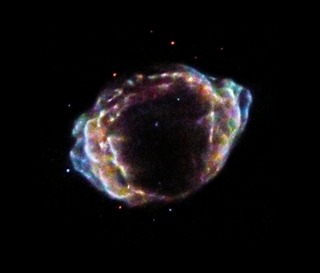
G1.9+0.3 is a supernova remnant (SNR) in the constellation of Sagittarius. It is the youngest-known SNR in the Milky Way, resulting from an explosion the light from which would have reached Earth some time between 1890 and 1908. The explosion was not seen from Earth as it was obscured by the dense gas and dust of the Galactic Center, where it occurred. The remnant's young age was established by combining data from NASA's Chandra X-ray Observatory and the VLA radio observatory. It was a type Ia supernova. The remnant has a radius of over 1.3 light-years.
The Central Molecular Zone or CMZ is a region of the Milky Way Galaxy rich in an estimated 60 million solar masses (M☉) of gas within a complex of giant molecular clouds. It spans the centre of the Milky Way, and as such is in the Sagittarius constellation, between galactic longitude 1.7° and -0.7°, and latitudes -0.2° and +0.2°.

NGC 4388 is an active spiral galaxy in the equatorial constellation of Virgo. It was discovered April 17, 1784 by Wilhelm Herschel. This galaxy is located at a distance of 57 million light years and is receding with a radial velocity of 2,524km/s. It is one of the brightest galaxies of the Virgo Cluster due to its luminous nucleus. NGC 4388 is located 1.3° to the west of the cluster center, which translates to a projected distance of ≈400 kpc.
Laura A. Lopez is an associate professor of astronomy at Ohio State University studying the life cycle of stars. She was awarded the Annie Jump Cannon Award in Astronomy in 2016, which is awarded by the American Astronomical Society (AAS) for outstanding research and promise for future research by a postdoctoral woman researcher.

NGC 4424 is a spiral galaxy located in the equatorial constellation of Virgo. It was discovered February 27, 1865 by German astronomer Heinrich Louis d'Arrest. This galaxy is located at a distance of 13.5 million light years and is receding with a heliocentric radial velocity of 442 km/s. It has a morphological class of SB(s)a, which normally indicates a spiral galaxy with a barred structure (SB), no inner ring feature (s), and tightly-wound spiral arms (a). The galactic plane is inclined at an angle of 62° to the line of sight from the Earth. It is a likely member of the Virgo Cluster of galaxies.

NGC 4636 is an elliptical galaxy located in the constellation Virgo. It is a member of the NGC 4753 Group of galaxies, which is a member of the Virgo II Groups, a series of galaxies and galaxy clusters strung out from the southern edge of the Virgo Supercluster. It is located at a distance of about 55 million light years from Earth, which, given its apparent dimensions, means that NGC 4636 is about 105,000 light years across.

G290.1-0.8 is a supernova remnant in the constellation Carina. It is located in the Galactic plane of the galaxy in the Carina arm.
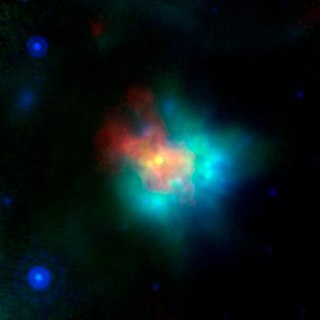
SNR G054.1+00.3, also called G54.1+0.3, 2E 4258 and 2E 1928.3+1846 is a supernova remnant located in the constellation Sagittarius. It was identified as a supernova remnant in a study of the galactic plane in the radio continuum at wavelengths of 21 and 11 cm.
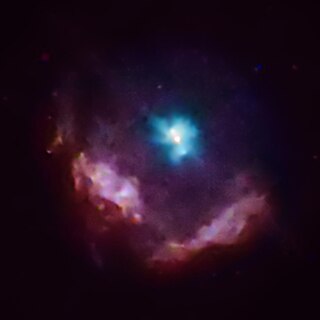
Kesteven 75, abbreviated as Kes 75 and also called SNR G029.7-00.3, G29.7-0.3 and 4C -03.70, is a supernova remnant located in the constellation Aquila.

3C 392 is a supernova remnant located in the constellation Aquila. It was discovered by Gart Westerhout in 1958 as part of a study of continuous radiation in the Milky Way at a frequency of 1390 MHz.

CTB 1, also known as G116.9+00.1 and AJG 110, is a supernova remnant located in the constellation Cassiopeia. It was discovered as a radio source in 1960 in a study of galactic radiation carried out at a frequency of 960 MHz.
