Geba | |
|---|---|
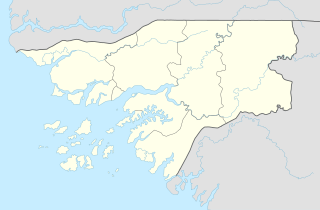  Geba Location in Guinea-Bissau | |
| Coordinates: 12°09′26″N14°45′37″W / 12.15722°N 14.76028°W | |
| Country |  Guinea-Bissau Guinea-Bissau |
| Admin. Region | Bafatá Region |
Geba is a village in Guinea-Bissau, on the north bank of the eponymous Geba river.
Geba | |
|---|---|
| Geba Location in Guinea-Bissau | |
| Coordinates: 12°09′26″N14°45′37″W / 12.15722°N 14.76028°W | |
| Country | Guinea-Bissau |
| Admin. Region | Bafatá Region |
Geba is a village in Guinea-Bissau, on the north bank of the eponymous Geba river.
The name 'Geba' originated from the Biafada term 'bejébi', meaning 'fresh water'. [1]
The Geba region was originally inhabited by the Biafada people, though they were progressively displaced by the Mandinka of the Kaabu federation. [2] The town was established by Portuguese traders in the early 16th century, and it quickly became one of the most important ports in Portuguese Guinea, shipping thousands of slaves to the Americas every year. [3] By the 1640s the town had become increasingly Africanized and, dominated by the Kaabu province of Ganadu, hard for Portuguese authorities to control. In 1644, they forced the town's merchants to move to Cacheu and Farim. [4]
The decline of the slave trade and the Soninke-Marabout Wars of the 19th century dramatically curtailed trade in Geba. Efforts by the Portuguese colonial governors to sideline the powerful and independent merchants of the town also continued. [5] The collapse of Kaabu and the rise of Fuladu further weakened Geba's commercial position. [6] The town also became a center of creole resistance to the extension of Portuguese hegemony in the area. [7]
By the early 1900s, the population of the town had dwindled to a few hundred. [8] The presidio of Geba was transferred to nearby Bafatá in 1912. [9] The catholic parish headquarters also moved in 1944, around the time Geba lost its last administrative status. [10] Amilcar Cabral's father Juvenal taught at the Geba school. [7]
Some of the inhabitants of Geba are commonly known as 'Kriston', a term derived from Portuguese "cristão", meaning "Christian", and the town still boasts a Catholic church. [1]

Guinea-Bissau, officially the Republic of Guinea-Bissau, is a country in West Africa that covers 36,125 square kilometres (13,948 sq mi) with an estimated population of 2,026,778. It borders Senegal to its north and Guinea to its southeast.
The region now known as Guinea-Bissau, in West Africa, has been inhabited by humans for thousands of years. During the 13th century CE, it was a province of the Mali Empire which later became independent as the empire of Kaabu. The Portuguese Empire claimed the region during the 1450s, but its control was limited to several forts along the coast during most of this period; it gained control of the mainland after a series of "pacification campaigns" from 1912 to 1915, which used military forces to violently crush local resistance. The offshore Bijagos Islands were not colonized until 1936. Guinea-Bissau gained independence from Portugal in 1974. The introduction of multi-party politics in 1991 led to the first multi-party elections in 1994. A civil war broke out in 1998, which lasted until the following year.

The economy of Guinea-Bissau comprises a mixture of state-owned and private companies. Guinea-Bissau is among the world's least developed nations and one of the 10 poorest countries in the world, and depends mainly on agriculture and fishing. Cashew crops have increased remarkably in recent years, and the country ranked ninth in cashew production for the year 2019.

Bissau is the capital and largest city of Guinea-Bissau. As of 2015, it had a population of 492,004. Bissau is located on the Geba River estuary, off the Atlantic Ocean, and is Guinea-Bissau's largest city, major port, its administrative and military center.

The Mandinka or Malinke are a West African ethnic group primarily found in southern Mali, The Gambia, southern Senegal and eastern Guinea. Numbering about 11 million, they are the largest subgroup of the Mandé peoples and one of the largest ethnolinguistic groups in Africa. They speak the Manding languages in the Mande language family, which are a lingua franca in much of West Africa. Virtually all of Mandinka people are adherent to Islam, mostly based on the Maliki jurisprudence. They are predominantly subsistence farmers and live in rural villages. Their largest urban center is Bamako, the capital of Mali.
Articles related to Guinea-Bissau include:

Buba is the largest city in southern Guinea-Bissau and the capital of the Quinara region. Itlies on the extreme end of the Rio Grande de Buba, near the Contanhez National Park, and has a population 6,815.
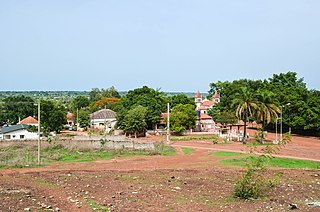
Bafatá is the second-largest city in Guinea-Bissau, known as the birthplace of Amílcar Cabral. The town has a population of 22,501. It is the capital of Bafatá Region as well as the seat of the Roman Catholic Diocese of Bafatá, which was established in March 2001 with Carlos Pedro Zilli as bishop.

Cacheu is a town in northwestern Guinea-Bissau lying on the Cacheu River, capital of the eponymous region. Its population was estimated to be 9,849 as of 2008.
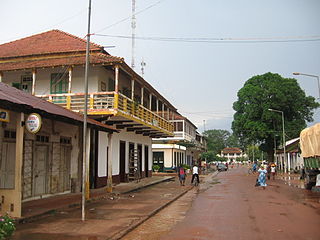
Gabu is the largest city in eastern Guinea-Bissau, the second most populated city in Guinea-Bissau and capital of the Gabu Region.

The Corubal, also known as the Rio Corubal or Tomine, is a river of West Africa, a major tributary of the Geba River. For a short distance, it forms the international border between Guinea and Guinea-Bissau. It has a length of approximately 560 kilometres (350 mi).

Farim is a town of northern Guinea-Bissau. It sits on the north bank of the Farim/Cacheu River, about 215 km up the river from Cacheu. Population 8,661.
The lançados were settlers and colonizers of Portuguese origin in Senegambia, Cabo Verde, Guinea, Sierra Leone, and other areas on the coast of West Africa. Many were Jews—often New Christians—escaping persecution from the Portuguese Inquisition.
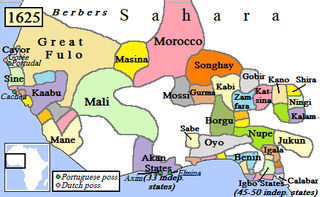
Kaabu (1537–1867), also written Gabu, Ngabou, and N'Gabu, was a federation of Mandinka kingdoms in the Senegambia region centered within modern northeastern Guinea-Bissau, large parts of today's Gambia, and extending into Koussanar, Koumpentoum, and the Casamance in Senegal.
The Bainuk people are an ethnic group that today lives primarily in Senegal as well as in parts of Gambia and Guinea-Bissau.
The Battle of Kansala or Turban Keloo was the siege of the capital of the Kaabu federation by the Imamate of Futa Jallon, allied with rebellious Fula people from Kaabu itself. The battle, which saw the town completely destroyed, ended Mandinka hegemony over Africa’s Atlantic coast begun by the Mali Empire.
Crispina Peres was a "Senhora" slave trader, natural from Geba, nowadays Guinea-Bissau.

Bissau-Guinean nationality law is regulated by the Constitution of Guinea-Bissau, as amended; the Bissau-Guinean Nationality Regulation, and its revisions; and various international agreements to which the country is a signatory. These laws determine who is, or is eligible to be, a national of Guinea-Bissau. The legal means to acquire nationality, formal legal membership in a nation, differ from the domestic relationship of rights and obligations between a national and the nation, known as citizenship. Nationality describes the relationship of an individual to the state under international law, whereas citizenship is the domestic relationship of an individual within the nation. Bissau-Guinean nationality is typically obtained under the principle of jus soli, i.e. by birth in Guinea-Bissau, or jus sanguinis, i.e. by birth in Guinea-Bissau or abroad to parents with Bissau-Guinean nationality. It can be granted to persons with an affiliation to the country, or to a permanent resident who has lived in the country for a given period of time through naturalization.
Guinala or Quinara was an important Biafada kingdom in pre-colonial Guinea-Bissau situated between the Geba and Rio Grande de Buba rivers. The main port town, also called Guinala, was located on a tributary of the Buba, with the capital Bruco a short distance inland.
The Soninke-Marabout Wars were a series of 19th-century civil wars across southern Senegambia pitting the traditional ruling classes of various states, mostly animist or only nominally Muslim, against Islamic reformers led by the marabout class. French and British forces frequently became involved in these conflicts, providing them an opportunity to extend colonial power into the hinterland.