The House of Lords, also known as the House of Peers, is the upper house of the Parliament of the United Kingdom. Membership is granted, respectively ruled, by appointment, heredity or official function. Like the House of Commons, it meets in the Palace of Westminster. Officially, the full name of the house is the Right Honourable the Lords Spiritual and Temporal of the United Kingdom of Great Britain and Northern Ireland in Parliament assembled.

The House of Commons is the lower house of the Parliament of the United Kingdom. Like the upper house, the House of Lords, it meets in the Palace of Westminster. Officially, the full name of the house is the Honourable the Commons of the United Kingdom of Great Britain and Northern Ireland in Parliament assembled. Owing to shortage of space, its office accommodation extends into Portcullis House.

The United Nations member states are the 193 sovereign states that are members of the United Nations (UN) and have equal representation in the UN General Assembly. The UN is the world's largest intergovernmental organization.
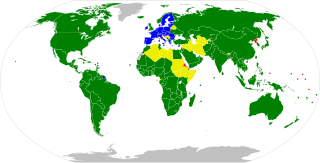
The World Trade Organization (WTO) is an intergovernmental organization that is concerned with the regulation of international trade between nations. The WTO officially commenced on 1 January 1995 under the Marrakesh Agreement, signed by 124 nations on 15 April 1994, replacing the General Agreement on Tariffs and Trade (GATT), which commenced in 1948. It is the largest international economic organization in the world.
A member of parliament (MP) is the representative of the voters to a parliament. In many countries with bicameral parliaments, this category includes specifically members of the lower house, as upper houses often have a different title. Member of Congress is an equivalent term in other jurisdictions.
The Right Honourable is an honorific style traditionally applied to certain persons and collective bodies in the United Kingdom, Canada, Australia, New Zealand, Fiji, some other Commonwealth realms, the Anglophone Caribbean, Mauritius, Zimbabwe and occasionally elsewhere. The term is predominantly used today as a style associated with holding certain senior government offices in the United Kingdom, Canada, and New Zealand.

The Rajya Sabha or Council of States is the upper house of the Parliament of India. Membership of Rajya Sabha is limited by the Constitution to a maximum of 250 members and current laws have provision for 245 members. Most of the members of the House are indirectly elected by the members of States and union territories of India state and territorial legislatures using single transferable votes, while the President can appoint 12 members for their contributions to art, literature, science, and social services. Members sit for staggered terms lasting six years, with a third of the members up for election every two years.
A Member of the European Parliament (MEP), also called a Eurodeputy is a person who has been elected to serve as a popular representative in the European Parliament.

The Lok Sabha is the lower house of India's bicameral Parliament, with the upper house being the Rajya Sabha. Members of the Lok Sabha are elected by adult universal suffrage and a first-past-the-post system to represent their respective constituencies, and they hold their seats for five years or until the body is dissolved by the President on the advice of the council of ministers. The house meets in the Lok Sabha Chambers of the Sansad Bhavan in New Delhi.

A limited liability company (LLC) is the US-specific form of a private limited company. It is a business structure that can combine the pass-through taxation of a partnership or sole proprietorship with the limited liability of a corporation. An LLC is not a corporation under state law; it is a legal form of a company that provides limited liability to its owners in many jurisdictions. LLCs are well known for the flexibility that they provide to business owners; depending on the situation, an LLC may elect to use corporate tax rules instead of being treated as a partnership, and, under certain circumstances, LLCs may be organized as not-for-profit. In certain U.S. states, businesses that provide professional services requiring a state professional license, such as legal or medical services, may not be allowed to form an LLC but may be required to form a similar entity called a professional limited liability company (PLLC).

The Speaker of the House of Commons is the presiding officer of the House of Commons, the United Kingdom's nominally lower, but more influential, chamber of Parliament. John Bercow was elected Speaker on 22 June 2009, following the resignation of Michael Martin. He was since re-elected, unopposed, three times, following the general elections in 2010, 2015 and 2017.
The Parliament of India is the supreme legislative body of the Republic of India. It is a bicameral legislature composed of the President of India and the two houses: the Rajya Sabha and the Lok Sabha. The President in his role as head of legislature has full powers to summon and prorogue either house of Parliament or to dissolve Lok Sabha. The president can exercise these powers only upon the advice of the Prime Minister and his Union Council of Ministers.

NCAA Division I (D-I) is the highest level of intercollegiate athletics sanctioned by the National Collegiate Athletic Association (NCAA) in the United States. D-I schools include the major collegiate athletic powers, with larger budgets, more elaborate facilities and more athletic scholarships than Divisions II and III as well as many smaller schools committed to the highest level of intercollegiate competition.
A and Puducherry Legislative Assembly.

The European Union (EU) consists of 28 member states. Each member state is party to the founding treaties of the union and thereby subject to the privileges and obligations of membership. Unlike members of most international organisations, the member states of the EU are subjected to binding laws in exchange for representation within the common legislative and judicial institutions. Member states must agree unanimously for the EU to adopt policies concerning defence and foreign policy. Subsidiarity is a founding principle of the EU.

The United States House of Representatives is the lower chamber of the United States Congress, the Senate being the upper chamber. Together they compose the legislature of the United States.

The Commonwealth of Nations, normally known as the Commonwealth, is a unique political association of 53 member states, nearly all of them former territories of the British Empire. The chief institutions of the organisation are the Commonwealth Secretariat, which focuses on intergovernmental aspects, and the Commonwealth Foundation, which focuses on non-governmental relations between member states.

The Treaty of Lisbon is an international agreement that amends the two treaties which form the constitutional basis of the European Union (EU). The Treaty of Lisbon was signed by the EU member states on 13 December 2007, and entered into force on 1 December 2009. It amends the Maastricht Treaty (1993), known in updated form as the Treaty on European Union (2007) or TEU, and the Treaty of Rome (1957), known in updated form as the Treaty on the Functioning of the European Union (2007) or TFEU. It also amends the attached treaty protocols as well as the Treaty establishing the European Atomic Energy Community (EURATOM).

The Public Broadcasting Service (PBS) is an American public broadcaster and television program distributor. It is a nonprofit organization and the most prominent provider of educational television programming to public television stations in the United States, distributing series such as American Experience, America's Test Kitchen, Antiques Roadshow, Arthur, Downton Abbey, Finding Your Roots, Frontline, The Magic School Bus, Masterpiece, Mister Rogers' Neighborhood, Nature, Nova, the PBS NewsHour, Sesame Street, and This Old House.

The Organisation for Economic Co-operation and Development is an intergovernmental economic organisation with 36 member countries, founded in 1961 to stimulate economic progress and world trade. It is a forum of countries describing themselves as committed to democracy and the market economy, providing a platform to compare policy experiences, seek answers to common problems, identify good practices and coordinate domestic and international policies of its members. Most OECD members are high-income economies with a very high Human Development Index (HDI) and are regarded as developed countries. As of 2017, the OECD member states collectively comprised 62.2% of global nominal GDP and 42.8% of global GDP at purchasing power parity. OECD is an official United Nations observer.