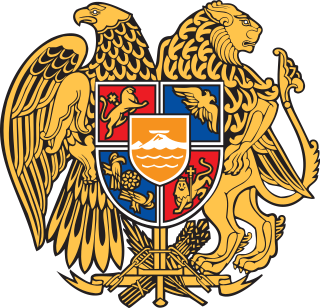
The politics of Armenia take place in the framework of the parliamentary representative democratic republic of Armenia, whereby the President of Armenia is the head of state and the Prime Minister of Armenia the head of government, and of a multi-party system. Executive power is exercised by the President and the Government. Legislative power is vested in both the Government and Parliament.

Fine Gael is a liberal-conservative political party in Ireland. Fine Gael is currently the governing and largest party in Ireland in terms of members of the Oireachtas and Irish members of European Parliament. The party has a membership of 35,000, and is the senior partner governing in a minority coalition with several independent politicians, with party leader Leo Varadkar serving as Taoiseach. Varadkar succeeded Enda Kenny as party leader on 2 June 2017 and as Taoiseach on 14 June; Kenny had been leader since 2002, and Taoiseach since 2011.
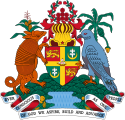
The politics of Grenada takes place in a framework of a parliamentary representative democracy, whereby the Prime Minister is the head of government. Grenada is an independent Commonwealth realm. It is governed under a multi-party parliamentary system whose political and legal traditions closely follow those of the United Kingdom; it has a prime minister and a cabinet, and a bicameral Parliament with an elected House of Representatives and an appointed Senate. Executive power is exercised by the government. Legislative power is vested in both the government and parliament. Constitutional safeguards include freedom of speech, press, worship, motion, and association. Grenada is a member of the eastern Caribbean court system. The Judiciary is independent of the executive and the legislature. Jurisprudence is based on English common law.

The politics of Malta takes place within a framework of a parliamentary representative democratic republic, whereby the President of Malta is the constitutional head of state. Executive Authority is vested in the President of Malta with the general direction and control of the Government of Malta remaining with the Prime Minister of Malta who is the head of government and the cabinet. Legislative power is vested in the Parliament of Malta which consists of the President of Malta and the unicameral House of Representatives of Malta with the Speaker presiding officer of the legislative body. Judicial power remains with the Chief Justice and the Judiciary of Malta. Since Independence, the party electoral system has been dominated by the Christian democratic Nationalist Party and the social democratic Labour Party.

The politics of Papua New Guinea takes place in a framework of a parliamentary representative democratic multi-party system, whereby the Prime Minister is the head of government. Papua New Guinea is an independent Commonwealth realm, with a governor-general, nominated by the National Parliament, acting as head of state. Executive power is exercised by the government. Legislative power is vested in both the government and parliament.

Romania's political framework is a semi-presidential representative democratic republic where the Prime Minister is the head of government and the President is the head of state. Executive power is exercised by the President of the republic and the government. Romania has a multi-party system, with legislative power vested in the government and the two chambers of Parliament: the Chamber of Deputies and the Senate. The judiciary is independent of the executive and the legislature. Until 1989, the communist rule political structure took place in the framework of a one-party socialist republic governed by the Romanian Communist Party as its only legal party.

Italy elects, at the national level, a Parliament consisting of two houses: the Chamber of Deputies with 630 members; and the Senate of the Republic with 315 elected members, plus a few senators for life. The President of the Republic is elected for a seven-year term by the two houses of Parliament in joint session.

Elections in Zambia take place within the framework of a multi-party democracy and a presidential system. The President and National Assembly are simultaneously elected for five-year terms.

A constitutional referendum on electoral reform took place in Turkey on 21 October 2007. After the aborted attempt to elect the next president in May 2007, the government of Recep Tayyip Erdoğan introduced substantial electoral reforms in parliament which were then passed with the votes of Erdoğan's Justice and Development Party and the opposition Motherland Party.

The Republic of Niger has had seven constitutions, two substantial constitutional revisions, and two periods of rule by decree since its independence from French colonial rule in 1960. The current "Seventh Republic" operates under the Constitution of 2010.
Electoral reform is change in electoral systems to improve how public desires are expressed in election results. That can include reforms of:
The Alliance for European Integration was the centre-right anti-communist ruling coalition in Moldova from the July 2009 election until it lost a no confidence vote on February 13, 2013. It was succeeded by the anti-communist Pro-European Coalition.
A constitutional referendum was held in Saint Vincent and the Grenadines on 25 November 2009. Voters were asked whether they approved of a new constitution which would have replaced the constitution in force since independence in 1979. The proposal was supported by only 43.13% of voters in the referendum, well short of the required two-thirds threshold. If approved, the proposed constitution would have abolished the monarchy of Saint Vincent and the Grenadines, headed by Queen Elizabeth II, and would have given more power to the opposition. The referendum was the first of its kind to be held by a member of the Organisation of Eastern Caribbean States.
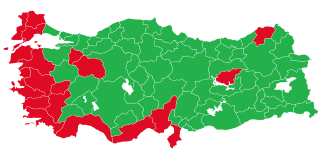
A constitutional referendum on a number of changes to the constitution was held in Turkey on 12 September 2010. The results showed the majority supported the constitutional amendments, with 58% in favour and 42% against. The changes were aimed at bringing the constitution into compliance with European Union standards. Supporters of Turkish EU membership hope constitutional reform will facilitate the membership process.

The Parliamentary Voting System and Constituencies Act 2011(c. 1) is an Act of the Parliament of the United Kingdom that made provision for the holding of a referendum on whether to introduce the Alternative Vote system in all future general elections to the UK Parliament and also made provision on the number and size of Parliamentary Constituencies. The Bill for the Act was introduced to the House of Commons on 22 July 2010 and passed third reading on 2 November by 321 votes to 264. The House of Lords passed the Bill, with amendments, on 14 February 2011, and after some compromises between the two Houses on amendments, it received Royal Assent on 16 February.
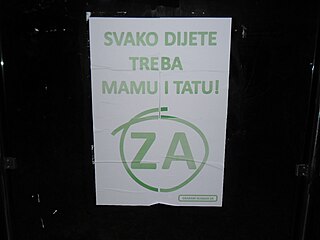
A constitutional referendum was held in Croatia on 1 December 2013. The proposed amendment to the constitution would define marriage as being a union between a man and a woman, which would create a constitutional prohibition against same-sex marriage. 37.9% of eligible voters voted. After processing all of the ballots, the State Election Commission announced that 65.87% voted yes, 33.51% no and 0.57% of ballots were disregarded as invalid.
A constitutional referendum was held in Armenia on 6 December 2015. Its amendments to the constitution put the country on a course from having a semi-presidential system to being a parliamentary republic, with the changes beginning to take place during the 2017–18 electoral cycle. The referendum passed with 66.2% of voters supporting it. Voter turnout was 50.8%, passing the 33% threshold to validate the results.
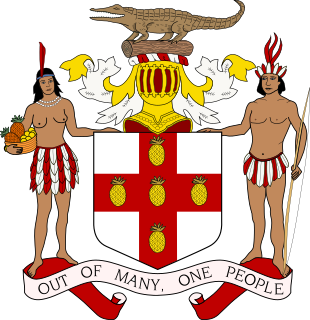
Republicanism in Jamaica is a position which advocates that Jamaica's system of government be changed from a constitutional monarchy to a republic. Both major political parties – the Jamaica Labour Party and the People's National Party – subscribe to the position, and the current Prime Minister of Jamaica, Andrew Holness, has announced that transitioning to a republic will be a priority of his government.

A constitutional referendum was held in Antigua and Barbuda on 6 November 2018, the first referendum in the country's history. The proposed constitutional amendment, which ultimately failed to pass, would have made the Caribbean Court of Justice the final court of appeal, replacing the London-based Judicial Committee of the Privy Council. A quorum of 66.6 % of the valid votes in favour was required for the amendment to be approved.

A constitutional referendum was held in Grenada on 6 November 2018. The proposed constitutional amendment, which voters ultimately rejected, would have made the Caribbean Court of Justice (CCJ) the final court of appeal, replacing the British Judicial Committee of the Privy Council, and renamed the Supreme Court. A slightly different proposal was previously made in a 2016 referendum, but was also rejected by voters.