
Since its independence in 1961, Kuwait maintained strong international relations with most countries, especially nations within the Arab world. Its vast oil reserves gives it a prominent voice in global economic forums and organizations like the OPEC. Kuwait is also a major ally of ASEAN, a regional ally of China, and a major non-NATO ally.
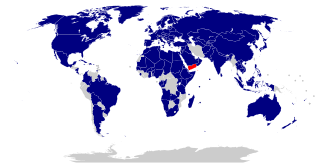
The foreign relations of Yemen are the relationships and policies that Yemen maintains with other countries. It is a member of the United Nations, the Arab League, and the Organisation of Islamic Cooperation. Yemen participates in the nonaligned movement. The Republic of Yemen accepted responsibility for all treaties and debts of its predecessors, the YAR and the PDRY. Additionally, Yemen has acceded to the Nuclear Non-Proliferation Treaty and has stressed the need to render the Middle East region free of nuclear and other weapons of mass destruction.

The Organisation of Islamic Cooperation, formerly the Organisation of the Islamic Conference, is an intergovernmental organization founded in 1969, consisting of 57 member states, with 48 being Muslim-majority countries. The organisation states that it is "the collective voice of the Muslim world" and works to "safeguard and protect the interests of the Muslim world in the spirit of promoting international peace and harmony".

The Cooperation Council for the Arab States of the Gulf, also known as the Gulf Cooperation Council, is a regional, intergovernmental, political, and economic union comprising Bahrain, Kuwait, Oman, Qatar, Saudi Arabia, and the United Arab Emirates. The council's main headquarters is located in Riyadh, the capital of Saudi Arabia. The Charter of the GCC was signed on 25 May 1981, formally establishing the institution.

Adel Al-Jubeir is a Saudi diplomat who is the former Saudi Minister of Foreign Affairs and the current Saudi Minister of State for Foreign Affairs. He is the second person not belonging to the House of Saud to hold the office, after Ibrahim bin Abdullah Al Suwaiyel. He previously served as the Saudi Ambassador to the United States from 2007 to 2015, and was also a foreign policy advisor to King Abdullah.
The Organization of Arab Petroleum Exporting Countries (OAPEC) is a multi-governmental organization headquartered in Kuwait which coordinates energy policies among oil-producing Arab nations. OAPEC's primary objective is safeguarding the cooperation of numerous members in various aspects of economic activity within the oil industry as well as maintaining strong relations among themselves; to provide legitimate means to preserve the members' individual and collective efforts within the industry; unite on-going efforts for the procurement of oil; provide access to consumer markets on fair and reasonable terms; and provide conditions, adequate capital, and experience of investors in the oil industry.

Arab League–Iran relations refer to the political, economic, and cultural ties between the League of Arab States and the Islamic Republic of Iran. The former is a regional organization composed of 22 Arab states in MENA with a combined majority of Sunni Muslims, whereas the latter is a country in Western Asia with a majority of Shia Muslims.
For further details see the "Energy crisis" series by Facts on File.
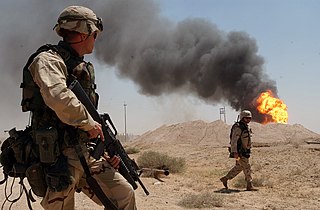
United States foreign policy in the Middle East has its roots in the 19th-century Barbary Wars that occurred shortly after the 1776 establishment of the United States as an independent sovereign state, but became much more expansive in the aftermath of World War II. With the goal of preventing the Soviet Union from gaining influence in the region during the Cold War, American foreign policy saw the deliverance of extensive support in various forms to anti-communist and anti-Soviet regimes; among the top priorities for the U.S. with regards to this goal was its support for the State of Israel against its Soviet-backed neighbouring Arab countries during the peak of the Arab–Israeli conflict. The U.S. also came to replace the United Kingdom as the main security patron for Saudi Arabia as well as the other Arab states of the Persian Gulf in the 1960s and 1970s in order to ensure, among other goals, a stable flow of oil from the Persian Gulf. As of 2023, the U.S. has diplomatic relations with every country in the Middle East except for Iran, with whom relations were severed after the 1979 Islamic Revolution, and Syria, with whom relations were suspended in 2012 following the outbreak of the Syrian Civil War.

Saudi Arabia is not known to have a nuclear weapons program. From an official and public standpoint, Saudi Arabia has been an opponent of nuclear weapons in the Middle East, having signed the Treaty on the Non-Proliferation of Nuclear Weapons, and is a member of the coalition of countries demanding a Nuclear-weapon-free zone in the Middle East. Studies of nuclear proliferation have not identified Saudi Arabia as a country of concern. Nuclear technology company IP3 International was formed in June 2016 to transfer nuclear technology from the United States to Saudi Arabia.
The 2007 Arab League Summit, also called the 2007 Riyadh Summit, refers to a convention of leaders from 21 members of the Arab League who gathered in Riyadh for the 19th Arab summit in March 2007. The summit convened on the 28 March 2007 and was preceded by a set of preparatory meetings starting on 24 March 2007. United Nations Secretary General Ban Ki-moon and the European Union's foreign policy chief Javier Solana also attended the summit. The main goal of the conference was to re-launch the Arab Peace Initiative.

Iran and Saudi Arabia have had no diplomatic relations following the attack on the Saudi embassy in Tehran in January 2016 after Saudi Arabia executed Sheikh Nimr al-Nimr, a Shia cleric. Bilateral relations between the countries have been strained over several geopolitical issues such as the interpretations of Islam, aspirations for leadership of the Islamic world, oil export policy and relations with the United States and other Western countries.

Saudi Arabia and Turkey relations have long fluctuated between cooperation and alliance to enmity and distrust. Since the 19th century, the two nations have always had a complicated relationship. While Turkey and Saudi Arabia are major economic partners, the two have a tense political relationship, deemed from the historic enmity.

Israel–Saudi Arabia relations refer to the bilateral ties between the State of Israel and the Kingdom of Saudi Arabia. The two countries have never established diplomatic relations; in 1947, Saudi Arabia voted against the United Nations Partition Plan for Palestine, which aimed to split the territory of British Palestine into an Arab state and a Jewish state. As part of the Arab–Israeli conflict, Saudi Arabia has not recognized Israel since the latter's independence in 1948. Traditionally, the official Saudi policy towards the Israeli–Palestinian conflict has been supportive of the Palestinian Arabs and against Israel. However, reports have surfaced in recent years indicating extensive behind-the-scenes cooperation in the areas of diplomacy, intelligence, and security. Warming relations between the two sides are a direct result of the Arab–Israeli alliance, which came to fruition in light of the Iran–Israel proxy conflict and the Iran–Saudi Arabia proxy conflict, though it remains unofficial in nature. At the same time, the Saudi relationship with the Palestinian National Authority has been deteriorating.

The Arab League boycott of Israel is a strategy adopted by the Arab League and its member states to boycott economic and other relations between Arabs and the Arab states and Israel and specifically stopping all trade with Israel which adds to that country's economic and military strength. A secondary boycott was later imposed, to boycott non-Israeli companies that do business with Israel, and later a tertiary boycott involved the blacklisting of firms that do business with other companies that do business with Israel.

The Iran–Saudi Arabia proxy conflict, sometimes also referred to as the Middle Eastern Cold War, is the ongoing struggle for influence in the Middle East and other Muslim regions between Iran and Saudi Arabia. The two countries have provided varying degrees of support to opposing sides in nearby conflicts, including the civil wars in Syria and Yemen; and disputes in Bahrain, Lebanon, Qatar, and Iraq. It also extends to disputes or broader competition in other regions such as Nigeria, Pakistan, Afghanistan and other parts of North and East Africa, South Asia, Central Asia, Southeast Asia, the Balkans, and the Caucasus.
The timeline of the Gulf War details the dates of the major events of the 1990–1991 war. It began with the Iraqi invasion of Kuwait on 2 August 1990 and ended with the Liberation of Kuwait by Coalition forces. Iraq subsequently agreed to the United Nations' demands on 28 February 1991. The ground war officially concluded with the signing of the armistice on 11 April 1991. However, the official end to Operation Desert Storm did not occur until sometime between 1996 - 1998. Major events in the aftermath include anti-Saddam Hussein uprisings in Iraq, massacres against the Kurds by the regime, Iraq formally recognizing the sovereignty of Kuwait in 1994, and eventually ending its cooperation with the United Nations Special Commission in 1998.
The Qatar diplomatic crisis was a diplomatic incident in the Middle East that began on 5 June 2017 when Saudi Arabia, the United Arab Emirates, Bahrain and Egypt severed diplomatic relations with Qatar and banned Qatar-registered planes and ships from utilising their airspace, land and sea routes, along with Saudi Arabia blocking Qatar’s only land crossing, as a de facto blockade. The crisis ended in January 2021 following a resolution between Saudi Arabia and Qatar.

The Qatar–Saudi Arabia diplomatic conflict refers to the ongoing struggle for regional influence between Qatar and the Kingdom of Saudi Arabia (KSA), both of which are members of the Gulf Cooperation Council (GCC). It is sometimes called the New Arab Cold War. Bilateral relations are especially strained since the beginning of the Arab Spring, that left a power vacuum both states sought to fill, with Qatar being supportive of the revolutionary wave and Saudi Arabia opposing it. Both states are allies of the United States, and have avoided direct conflict with one another.
The Arab–Israeli alliance, sometimes called the Israeli–Sunni alliance, refers to an unofficial security coalition comprising Israel and various Arab countries. Formed in the interest of the Gulf Cooperation Council, it is primarily focused on deterring the political and military ambitions of Iran, and has been actively promoted by the United States since the February 2019 Warsaw conference. It has also notably paved the way for Arab–Israeli normalization, as seen with the Abraham Accords and other follow-up agreements.


 Saudi Arabia
  Qatar,
  United Arab Emirates,
  Oman,
Oman,  Bahrain,
  Kuwait