Martin Glacier is a glacier, 3 nautical miles (6 km) wide and 9 nautical miles (17 km) long, which flows west and then northwest from the south side of Mount Lupa to the southeast corner of Rymill Bay where it joins Bertrand Ice Piedmont, on the west coast of Graham Land, Antarctica. It was first surveyed in 1936 by the British Graham Land Expedition (BGLE) under John Riddoch Rymill, and was resurveyed in 1948–1949 by the Falkland Islands Dependencies Survey. The glacier was named for James H. Martin, a member of the British Australian and New Zealand Antarctic Research Expedition (1929–1931) under Sir Douglas Mawson, and first mate of the Penola during the BGLE.
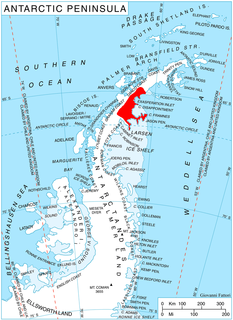
Ishmael Peak is a conspicuous detached rock peak in eastern Voden Heights, 4 miles (6.4 km) south of Spouter Peak, which marks the north side of the mouth of Leppard Glacier, on the east coast of Graham Land, Antarctica. It was surveyed by the Falkland Islands Dependencies Survey in 1947 and 1955, and was named by the UK Antarctic Place-Names Committee after Ishmael, the narrator of Herman Melville's story Moby-Dick.

Explorers Range is a large mountain range in the Bowers Mountains of Victoria Land, Antarctica, extending from Mount Bruce in the north to Carryer Glacier and McLin Glacier in the south. Named by the New Zealand Antarctic Place-Names Committee (NZ-APC) for the northern party of New Zealand Geological Survey Antarctic Expedition (NZGSAE), 1963–64, whose members carried out a topographical and geological survey of the area. The names of several party members are assigned to features in and about this range. All of the geographical features listed below lie situated on the Pennell Coast, a portion of Antarctica lying between Cape Williams and Cape Adare.
Alencar Peak is a 1,555-metre (5,100 ft) peak at the head of Lind Glacier, standing 6 nautical miles (11 km) east of Cape Perez on the west side of Graham Land in Antarctica. It was discovered by the French Antarctic Expedition of 1908–10 under Jean-Baptiste Charcot and was named by him for Admiral Alexandrino Faria de Alencar, a Brazilian Navy Minister at the time.
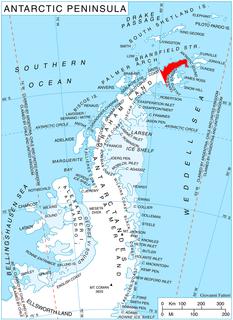
Andrew Glacier is a glacier 3 nautical miles (6 km) long, flowing northeast into Ognen Cove in Charcot Bay immediately west of the Webster Peaks on Trinity Peninsula, northern Graham Land. It was charted in 1948 by the Falkland Islands Dependencies Survey (FIDS) who named the feature for Dr. James Darby Andrew, medical officer at the FIDS Hope Bay station in 1946–47.
Buzfuz Rock is a rock 1.5 nautical miles (3 km) west of Snubbin Island in the Pitt Islands, northern Biscoe Islands. It was named by the UK Antarctic Place-Names Committee in 1971 after Sergeant Buzfuz, a character in Charles Dickens' The Pickwick Papers.

Caulfeild Glacier is the northern of two glaciers flowing into Hugi Glacier west of Dodunekov Peak, on the west coast of Graham Land. It was photographed by Hunting Aerosurveys Ltd in 1955–57 and mapped from these photos by the Falkland Islands Dependencies Survey. It was named by the UK Antarctic Place-Names Committee in 1959 for Vivian Caulfeild (1874–1958), English pioneer ski instructor, one of the greatest authorities on technique.
Clark Knoll is an ice-covered knoll 4 nautical miles (7 km) southwest of Mount Dane in the western part of Radford Island, Marshall Archipelago. It was mapped by the United States Antarctic Service (1939–41) and by the United States Geological Survey from surveys and from U.S. Navy air photos (1959–65). It was named by the Advisory Committee on Antarctic Names for Elton G. Clark, utilitiesman, U.S. Navy, at Byrd Station in 1967.
Sumner Glacier is a short, broad tributary glacier that flows northeast into the lower reaches of Weyerhaeuser Glacier, close west of Mount Solus, in southern Graham Land. Sketched from the air by D.P. Mason of Falkland Islands Dependencies Survey (FIDS) in August 1947. The lower reaches only were surveyed from the ground by FIDS in December 1958. Named by United Kingdom Antarctic Place-Names Committee (UK-APC) after Thomas H. Sumner (1807–76), American sailor who, in 1837, introduced the position line method of navigation, since developed into standard practice at sea and in the air.
Earnshaw Glacier is a glacier 10 nautical miles (19 km) long, flowing northward to the east of Norwood Scarp and entering Maitland Glacier to the south of Werner Peak, in the eastern Antarctic Peninsula. It was photographed from the air by the United States Antarctic Service on September 28, 1940. It was surveyed by the Falkland Islands Dependencies Survey in January 1961, and was named by the UK Antarctic Place-Names Committee after Thomas Earnshaw, an English watchmaker who made innovations leading to the modern marine chronometer.
Mount Paulcke is a mountain, at least 915 m, standing west of Huitfeldt Point, Barilari Bay, on the west coast of Graham Land. Photographed by Hunting Aerosurveys Ltd. in 1956-57, and mapped from these photos by the Falkland Islands Dependencies Survey (FIDS). Named by the United Kingdom Antarctic Place-Names Committee (UK-APC) in 1959 for Wilhelm Paulcke (1873–1949), German pioneer exponent of skiing who, with three companions, demonstrated the possibilities of long distance ski-mountaineering for the first time.
Mouillard Glacier is a glacier flowing into the southeast corner of Brialmont Cove, on the west coast of Graham Land, Antarctica. It was photographed by the Falkland Islands and Dependencies Aerial Survey Expedition in 1956–57, and mapped from these photos by the Falkland Islands Dependencies Survey. The glacier was named by the UK Antarctic Place-Names Committee in 1960 for Louis P. Mouillard, a French pioneer of gliding flight.
Mikado Glacier is a glacier on the north side of Mahler Spur, flowing west-northwest into Sullivan Glacier near the junction with Gilbert Glacier in northern Alexander Island, Antarctica. The glacier was so named by the UK Antarctic Place-Names Committee in 1977 in association with nearby Gilbert Glacier and Sullivan Glacier, after the operetta The Mikado.
Locator Island is the highest of the Roca Islands, lying 0.2 nautical miles (0.4 km) north of the largest island in the group, in the Wilhelm Archipelago, Antarctica. It was mapped by the Falkland Islands Dependencies Survey from photos taken by Hunting Aerosurveys Ltd in 1956–57 and from the helicopter of HMS Protector in March 1958. The island was so named by the UK Antarctic Place-Names Committee because this distinctive island provides a useful mark for locating one's position when navigating French Passage.
The Llanquihue Islands are a group of islands to the east of Larrouy Island, extending northward for 9 nautical miles (17 km) from the west coast of Graham Land, Antarctica. They were charted by the British Graham Land Expedition under John Rymill, 1934–37. The name appears on a Chilean government chart of 1947 and is after Llanquihue Province in Chile.
Herald Reef is a reef 1 nautical mile (2 km) southwest of Petermann Island, lying on the north side of French Passage in the Wilhelm Archipelago, Antarctica. It was first charted by the French Antarctic Expedition, 1908–10, under Jean-Baptiste Charcot. It was so named by the UK Antarctic Place-Names Committee in 1959 because this reef heralds the approach to French Passage from the east.
The Hennessy Islands are a group of small islands 2 nautical miles (4 km) in extent, lying 4 nautical miles (7 km) southeast of Jurva Point, the southeast end of Renaud Island, in the Biscoe Islands of Antarctica. The main islands in the group were first accurately shown on an Argentine government chart of 1957. The group was named by the UK Antarctic Place-Names Committee in 1959 for Jack Hennessy (1885–1954), Deputy Marine Superintendent of the (British) Meteorological Office, 1940–54, who collected and published reports on sea ice observations in Antarctic waters, 1902–53.

Hole Rock is the largest of several rocks lying close north of North Foreland, the northeastly cape of King George Island, in the South Shetland Islands. It was charted in 1937 by Discovery Investigations personnel on the Discovery II and so named because a conspicuous hole extends through it.

Régnard Peaks is a group of rounded, snow-covered peaks probably over 1,220 metres (4,000 ft), standing 3 nautical miles (5.6 km) north of Mount Peary on Kiev Peninsula, on the west coast of Graham Land. They were discovered and named by the French Antarctic Expedition under J.B. Charcot, 1908-10.
Rink Point is a rocky point on the northwest coast of James Ross Island, 2 nautical miles (3.7 km) east of Carlson Island. The name arose because, during a visit by a Falkland Islands Dependencies Survey (FIDS) party in August 1952, the point was surrounded by a large area of slippery, snow-free sea ice resembling a skating rink.