Related Research Articles
Halakha, also transliterated as halacha, halakhah, and halocho, is the collective body of Jewish religious laws that are derived from the Written and Oral Torah. Halakha is based on biblical commandments (mitzvot), subsequent Talmudic and rabbinic laws, and the customs and traditions which were compiled in the many books such as the Shulchan Aruch. Halakha is often translated as "Jewish law", although a more literal translation might be "the way to behave" or "the way of walking". The word is derived from the root which means "to behave". Halakha not only guides religious practices and beliefs; it also guides numerous aspects of day-to-day life.
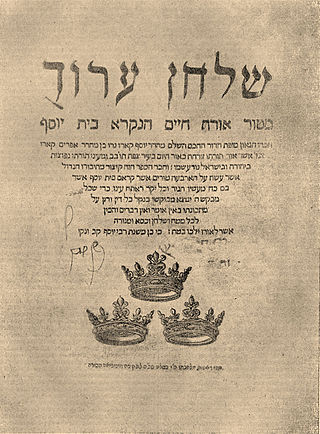
The Shulchan Aruch, sometimes dubbed in English as the Code of Jewish Law, is the most widely consulted of the various legal codes in Judaism. It was authored in Safed, Ottoman Syria by Joseph Karo in 1563 and published in Venice two years later. Together with its commentaries, it is the most widely accepted compilation of halakha or Jewish law ever written.

The Mishnah Berurah is a work of halakha by Rabbi Yisrael Meir Kagan. It is a commentary on Orach Chayim, the first section of the Shulchan Aruch which deals with laws of prayer, synagogue, Shabbat and holidays, summarizing the opinions of the Acharonim on that work.

The Shulchan Aruch HaRav is especially a record of prevailing halakha by Rabbi Shneur Zalman of Liadi (1745–1812), known during his lifetime as HaRav and as the first Rebbe of Chabad. Within the Chabad community the work is known as the Alter Rebbe's Shulchan Aruch.
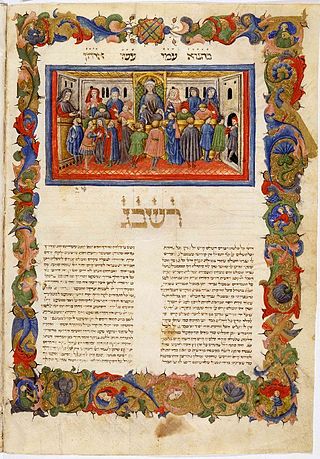
Arba'ah Turim, often called simply the Tur, is an important Halakhic code composed by Yaakov ben Asher. The four-part structure of the Tur and its division into chapters (simanim) were adopted by the later code Shulchan Aruch. This was the first book to be printed in Southeast Europe and the Near East.

Yechiel Michel ha-Levi Epstein (24 January 1829 – 25 March 1908), often called "the Aruch haShulchan" after his magnum opus, Aruch HaShulchan, was a Rabbi and posek in Lithuania.
Avraham Danzig was a rabbi, posek and codifier, best known as the author of the works of Jewish law called Chayei Adam and Chochmat Adam. He is sometimes referred to as "the Chayei Adam".

Moses Isserles, also known by the acronym Rema, was an eminent Polish Ashkenazi rabbi, talmudist, and posek. He is considered the "Maimonides of Polish Jewry."
David ha-Levi Segal, also known as the Turei Zahav after the title of his significant halakhic commentary on the Shulchan Aruch, was one of the greatest Polish rabbinical authorities.

Orach Chayim, is a section of Rabbi Jacob ben Asher's compilation of Halakha, Arba'ah Turim. This section addresses aspects of Jewish law pertinent to the Hebrew calendar. Rabbi Yosef Karo modeled the framework of the Shulkhan Arukh, his own compilation of practical Jewish law, after the Arba'ah Turim. Many later commentators used this framework, as well. Thus, Orach Chayim in common usage may refer to another area of halakha, separate from Rabbi Jacob ben Asher's compilation.
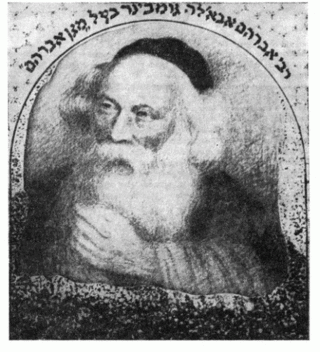
Abraham Abele Gombiner, known as the Magen Avraham, born in Gąbin (Gombin), Poland, was a rabbi, Talmudist and a leading religious authority in the Jewish community of Kalisz, Poland during the seventeenth century. His full name is Avraham Abele ben Chaim HaLevi from the town of Gombin. There are texts that list his family name as Kalisz after the city of his residence. After his parents were killed in 1655 during the aftermath of the Chmielnicki massacres of 1648, he moved to live and study with his relative in Leszno, Jacob Isaac Gombiner. From there he moved to Kalisz where he was appointed as Rosh Yeshiva and judge in the tribunal of Rabbi Israel Spira.
Yaakov ben Yaakov Moshe Lorberbaum of Lissa (1760-1832) was a rabbi and posek. He is most commonly known as the "Ba'al HaChavas Da'as" or "Ba'al HaNesivos" for his most well-known works, or as the "Lissa Rav" for the city in which he was Chief Rabbi.

Elijah Spira (1660–1712) was son of Benjamin Wolf Spira. He was a brother-in-law of Rabbi Yaakov Reischer, Rabbi David Oppenheim and a student of Rabbi Avraham Gombiner. He was rabbi at Tiktin, and afterward preacher and director of a large Talmudic academy in his hometown of Prague. He died at Prague April 14, 1712.
David Solomon Eibeschutz was born in Ozeriany, Polish–Lithuanian Commonwealth in 1755.
Ephraim Zalman Margulies was a Galician rabbi born in Brody, brother of Chaim Mordechai Margulies.
Solomon ben Judah Aaron Kluger, known as the Maggid of Brody, was chief dayyan and preacher of Brody, Galicia. He was successively Rabbi at Rava-Ruska (Galicia), Kulikow (Galicia), and Józefów (Lublin), preacher at Brody, and Rabbi at Brezany (Galicia) and, again, at Brody. He died at Brody on June 9, 1869.
Yisroel ben Shmuel Ashkenazi of Shklov was a Lithuanian Jewish Talmudist, one of a group of Talmudical scholars of Shklov who were attracted to Vilna by Rabbi Elijah ben Solomon Zalman, known as the Vilna Gaon (1720–97). He was one of "the last arrivals," and attended upon the Gaon as a disciple for less than a year.
Abraham Tzvi Hirsch ben Jacob Eisenstadt of Byelostok (1812–1868) served as rabbi in Utyan (Utena), government of Kovno, and died in Königsberg in 1868.

Sifrei Kodesh, commonly referred to as sefarim, or in its singular form, sefer, are books of Jewish religious literature and are viewed by religious Jews as sacred. These are generally works of Torah literature, i.e. Tanakh and all works that expound on it, including the Mishnah, Midrash, Talmud, and all works of Musar, Hasidism, Kabbalah, or machshavah. Historically, sifrei kodesh were generally written in Hebrew with some in Judeo-Aramaic or Arabic, although in recent years, thousands of titles in other languages, most notably English, were published. An alternative spelling for 'sefarim' is seforim.
In Jewish law, a posek is a legal scholar who determines the application of halakha, the Jewish religious laws derived from the written and Oral Torah, in cases of Jewish law where previous authorities are inconclusive, or in those situations where no clear halakhic precedent exists.
References
- ↑
 This article incorporates text from a publication now in the public domain : Singer, Isidore; et al., eds. (1901–1906). "Margolioth". The Jewish Encyclopedia . New York: Funk & Wagnalls. Jewish Encyclopedia bibliography: Ir Dubno we-Rabbaneha, p. 26, Cracow, 1902; Steinschneider, Cat. Bodl. No. 4698; Fürst, Bibl. Jud. ii.327.
 - ↑ Not to be confused with an ethical work by the same name authored by Yonah Gerondi.
- ↑ "Sha'arei Teshuvah and Pit-hei Teshuvah", Professor Eliezer Segal
- 1 2 "Sha'arei Teshuvah on Shulchan Arukh, Orach Chayim", at sefaria.org

| International | |
|---|---|
| National | |

 | This biographical article about a Polish rabbi is a stub. You can help Wikipedia by expanding it. |