Sources
 This article incorporates text from a publication now in the public domain : Herbermann, Charles, ed. (1913). "Hebron". Catholic Encyclopedia . New York: Robert Appleton Company.
Hebron was an episcopal see during the Crusader period.
Eusebius [1] (fourth century) calls Hebron merely as a large hamlet. It contains the tomb of the patriarchs, mentioned by Josephus, [2] by Eusebius, [3] and by the Pilgrim of Bordeaux in 333.
Crusaders took the town in 1100, and the sanctuary became the church of Saint Abraham, also called the church of the Holy Cave (Sancta Caverna or Spelunca, ’ágion spelaîon). The town itself is often styled by the chroniclers of that period Castel Saint-Abraham, Præsidium or Castellum ad Sanctum Abraham. A priory of Canons Regular of St. Augustine was installed to take charge of the basilica. [4]
In 1167 Hebron became a Latin see; its first titular was Rainaldus (1167–1170), nephew of the patriarch Foucher. [5]
A letter of Pope Clement IV, dated 1 June 1267, orders the Patriarch of Jerusalem to supply the church of Hebron with a priest. [6] After Geoffrey (Gaufridus), O.P., 1273–1283, the bishops of Hebron were merely titulars, and a great confusion existed in their list. [7] [8]
As a residential see, Hebron enjoyed a very brief existence. However it survived the triumph of Saladin in 1187, and the march of the Khwarezmians in 1244. Saladin, after the victory at Hattin (4 July 1187), and that at Ascalon (5 September), hastened, before marching on Jerusalem, to occupy Hebron, and to associate the sanctuary of Abraham with the worship of Islam. The Khwarezmians destroyed the town, but did not touch the sanctuary. [9]
The Greeks, after the departure of the Latins, retained for a time a residing bishop in Hebron. Lequien [10] mentions one of these bishops, Joannikios, whose name appears with that of Christodoulos of Gaza in the Acts of the Council of Jerusalem in 1672 [11] under the title of Ioannikíou toû theophilestátou ’archiepiskópou toû ‘agíon spelaíon (Joannikios, most holy Archbishop of the holy Cave).
In modern times, it was revived as a titular see; Cardinal Mermillod and Michele Petkoff, Vicar Apostolic of the Uniat Bulgarians in Thrace, were titular bishops.[ citation needed ]
 This article incorporates text from a publication now in the public domain : Herbermann, Charles, ed. (1913). "Hebron". Catholic Encyclopedia . New York: Robert Appleton Company.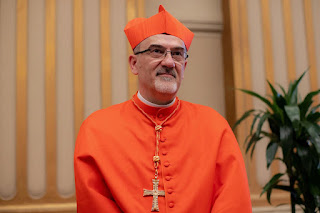
The Latin Patriarchate of Jerusalem is the Latin Catholic ecclesiastical patriarchate in Jerusalem, officially seated in the Church of the Holy Sepulchre. It was originally established in 1099, with the Kingdom of Jerusalem encompassing the territories in the Holy Land newly conquered by the First Crusade. From 1374 to 1847 it was a titular see, with the patriarchs of Jerusalem being based at the Basilica di San Lorenzo fuori le Mura in Rome. Pope Pius IX re-established a resident Latin patriarch in 1847.

The Kingdom of Jerusalem, one of the Crusader states that was created in 1099, was divided into a number of smaller seigneuries. According to the 13th-century jurist John of Ibelin, the four highest crown vassals in the kingdom proper were the count of Jaffa and Ascalon, the prince of Galilee, the lord of Sidon, and the lord of Oultrejordain.
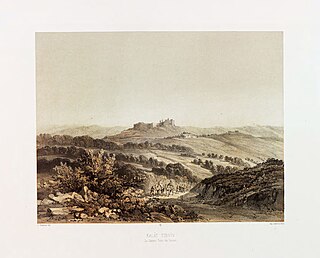
Toron, now Tibnin or Tebnine in southern Lebanon, was a major Crusader castle, built in the Lebanon mountains on the road from Tyre to Damascus. The castle was the centre of the Lordship of Toron, a seigneury within the Kingdom of Jerusalem, actually a rear-vassalage of the Principality of Galilee.

The principality of Galilee was one of the four major seigneuries of the crusader Kingdom of Jerusalem, according to 13th-century commentator John of Ibelin, grandson of Balian. The direct holdings of the principality centred around Tiberias, in Galilee proper, but with all its vassals, the lordship covered all Galilee and southern Phoenicia. The independent Lordship of Sidon was located between Galilee's holdings. The principality also had its own vassals: the Lordships of Beirut, Nazareth, and Haifa.
The See of Tyre was one of the most ancient dioceses in Christianity. The existence of a Christian community there in the time of Saint Paul is mentioned in the Acts of the Apostles. Seated at Tyre, which was the capital of the Roman province of Phoenicia Prima, the bishopric was a metropolitan see. Its position was briefly challenged by the see of Berytus in the mid-5th century; but after 480/1 the metropolitan of Tyre established himself as the first (protothronos) of all those subject to the Patriarch of Antioch.

Zoara, called Zoar/Tzoar or Bela in the Hebrew Bible, Segor in the Septuagint, and Zughar by medieval Arabs, was an ancient city located in the Dead Sea basin in the Transjordan.

Livias was a city in Transjordan in Classical Antiquity. In the writings of Josephus (English translation), the name is presented as Julias.
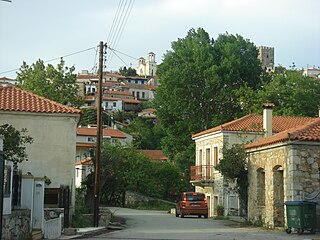
Avlonari is a village and a community (unit) of the Municipality Kymi-Aliveri, in the eastern part of the Aegean island of Euboea, Greece. It was the seat of the municipality of Avlon, and the medieval town and bishopric of Aulon, which remains a Latin Catholic titular see.
Germanicopolis was an ancient town in Bithynia, also known as Caesarea in Bythinia (not to be confused with Caesarea Germanica, as such a former bishopric and present Latin Catholic titular see.
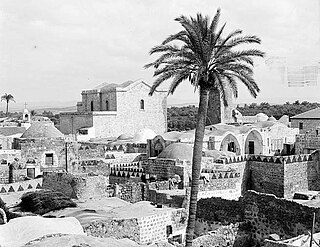
Diocese of Lydda (Lod) is one of the oldest bishoprics of the early Christian Church in the Holy Land. Suppressed under Persian and Arab-Islamic rule, it was revived by the Crusaders and remains a Latin Catholic titular see.
The Metropolis of Corinth, Sicyon, Zemenon, Tarsos and Polyphengos is a metropolitan see of the Church of Greece in Corinthia, Greece. Since the Middle Ages it has also existed as a Roman Catholic titular see. The current metropolitan is Dionysios Mantalos.
The Metropolis of Thebes and Livadeia is a metropolitan see of the Church of Greece in Boeotia, Greece. Since the Middle Ages it has also existed as a Roman Catholic titular see. The current metropolitan is Georgios Mantzouranis.
Eudocia was a town in ancient Lycia.
Meloë was a town in ancient Lycia, located near Cape Kilidonia.
The Metropolis of Larissa and Tyrnavos is a Greek Orthodox metropolitan see in Thessaly, Greece.

Justinianopolis in Armenia also known as Iustinianopolis was a Roman and Byzantine era city and bishopric in Lesser Armenia. It has been identified with modern Erzincan, Turkey. It was one of several ancient sites renamed in late Antiquity after Byzantine emperor Justinian I. The city also known as Acilisene and Keltzene.
The Holy Metropolis of Tricca, Gardiki and Pyli, is a metropolis under the jurisdiction of the Church of Greece. The metropolis is centered on the cities of Trikala and Kalabaka located in Thessaly, in central Greece.
Vasada was a city of ancient Lycaonia and later of Isauria, Asia Minor. It was located a little to the southwest of Laodiceia. In the acta of church councils attended by its bishop, the name appears variously as Usada or Ousada (Οὔσαδα) or Aasada (Ἀάσαδα).
The Latin or Roman Catholic Archbishopric of Neopatras is a titular see of the Catholic Church. It was established briefly as a residential episcopal see at Neopatras in Central Greece, after the Fourth Crusade, in place of the Greek Orthodox Metropolis of Neopatras. The area was recovered by the Epirote Greeks in c. 1218, but came again under Latin rule in 1319 as the Duchy of Neopatras, leading to the restoration of the see until the Ottoman conquest. The archbishopric was restored as a titular see in 1933. Its last incumbent died in 1967.
The diocese of Marash was an ecclesiastical jurisdiction in eastern Cilicia with its seat in the city of Marash. By the sixth century, it was an autocephalous archbishopric, but it fell into desuetude after the Arab conquest in the seventh century. The archdiocese was never revived.