
The Birmingham Small Arms Company Limited (BSA) was a major British industrial combine, a group of businesses manufacturing military and sporting firearms; bicycles; motorcycles; cars; buses and bodies; steel; iron castings; hand, power, and machine tools; coal cleaning and handling plants; sintered metals; and hard chrome process.

The Triumph Motor Company was a British car and motor manufacturing company in the 19th and 20th centuries. The marque had its origins in 1885 when Siegfried Bettmann of Nuremberg formed S. Bettmann & Co. and started importing bicycles from Europe and selling them under his own trade name in London. The trade name became "Triumph" the following year, and in 1887 Bettmann was joined by a partner, Moritz Schulte, also from Germany. In 1889, the businessmen started producing their own bicycles in Coventry, England.

The Standard Motor Company Limited was a motor vehicle manufacturer, founded in Coventry, England, in 1903 by Reginald Walter Maudslay. For many years, it manufactured Ferguson TE20 tractors powered by its Vanguard engine. All Standard's tractor assets were sold to Massey Ferguson in 1959. Standard purchased Triumph in 1945 and in 1959 officially changed its name to Standard-Triumph International and began to put the Triumph brand name on all its products. A new subsidiary took the name The Standard Motor Company Limited and took over the manufacture of the group's products.

The Triumph TR4 is a sports car produced by the Triumph Motor Company from 1961 to 1965. Successor to the TR3A, the TR4's chassis and drivetrain are closely related to those of its predecessor, but with an updated body designed by Michelotti.

Excelsior, based in Coventry, was a British bicycle, motorcycle and car maker. They were Britain’s first motorcycle manufacturer, starting production of their own ‘motor-bicycle’ in 1896. Initially they had premises at Lower Ford Street, Coventry, and 287-295 Stoney Stanton Road, Hillfields, Coventry, Warwickshire before moving to Kings Road, Tyseley, Birmingham in 1921.

The Swallow Doretti is a British sports car built on Swallow's own custom chassis using Triumph TR2 mechanicals, made between 1954 and 1955. It was intended for the US market, as a more refined two-seater than what was available there at that time.

Swallow Sidecar Company, Swallow Sidecar and Coachbuilding Company, and Swallow Coachbuilding Company were trading names used by Walmsley & Lyons, partners and joint owners of a British manufacturer of motorcycle sidecars and automobile bodies in Blackpool, Lancashire, before incorporating a company in 1930 to own their business, which they named Swallow Coachbuilding Company Limited.
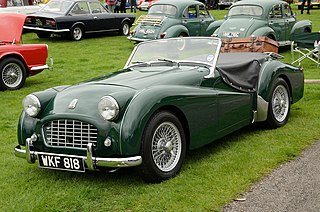
The Triumph TR3 is a British sports car produced from 1955 to 1962 by the Standard Motor Company of Coventry, England. A traditional open two-seater, the TR3 is an evolution of the company's earlier TR2 model, with greater power and improved braking. Updated variants, popularly but unofficially known as the "TR3A" and "TR3B", entered production in 1957 and 1962 respectively. The TR3 was succeeded by the mechanically similar, Michelotti-styled Triumph TR4.
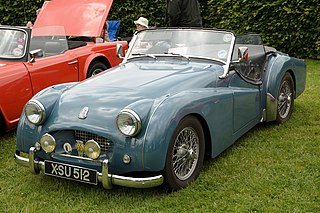
The Triumph TR2 is a sports car produced by the Standard Motor Company in the United Kingdom from 1953 to 1955. It was most commonly available in open two-seater form.
SS Cars was a British manufacturer of sports saloon cars from 1934 until wartime 1940, and from March 1935 of a limited number of open 2-seater sports cars. From September 1935, their new models displayed a new name: SS Jaguar. By then, its business, which was founded in 1922, was run by and largely owned by William Lyons. Lyons had been partner with 1922 co-founder William Walmsley until Walmsley sold his shareholding in January 1935.

Sir Ivan Arthur Rice Stedeford GBE, was a British industrialist and philanthropist.

The Triumph TR range of cars was built between 1953 and 1981 by the Triumph Motor Company in the United Kingdom. Changes from the TR2 to the TR6 were mostly evolutionary, with a change from a live axle to independent rear suspension in 1965 and a change from a four-cylinder engine to a six-cylinder engine in 1967. An all-new TR7, with a unit body, an overhead camshaft four-cylinder engine, and a live rear axle, was introduced in late 1974. The TR8, a development of the TR7 with a Rover V8 engine, was introduced in 1979 and was sold alongside the TR7 until TR production ended.
Sir John Paul Black held several senior positions in the British motor industry including chairman of Standard-Triumph.

The Triumph Mayflower is a small, upscale family car built from 1949 until 1953 by the British Standard Motor Company and sold by their Triumph Motor Company subsidiary. It has a 1+1⁄4-litre engine and was noted for its razor-edge styling. It was announced at the October 1949 British International Motor Show, but deliveries did not commence until the middle of 1950.
Henry George Webster, CBE was a British automotive engineer. He is best known for his work at the Triumph Motor Company throughout the 1950s and 1960s.
The Triumph 20TS was a prototype sports car shown by Standard-Triumph in October 1952 at the London Motor Show. Extensive development of the 20TS led to the introduction of the Triumph TR2 in March 1953 at the Geneva Motor Show, after which the 20TS was unofficially referred to as the Triumph TR1. Only one example of this car was ever made by Triumph.

National Express West Midlands (NXWM) is bus operator in the West Midlands of England. It is a subsidiary of Mobico Group and is the largest bus operator in the region, as well as one of the single largest in Britain.

A scooter is a motorcycle with an underbone or step-through frame, a seat, a transmission that shifts without the operator having to operate a clutch lever, a platform for their feet, and with a method of operation that emphasizes comfort and fuel economy. Elements of scooter design were present in some of the earliest motorcycles, and motor scooters have been made since at least 1914. More recently, scooters have evolved to include scooters exceeding 250cc classified as Maxi-scooters.

The Standard wet liner inline-four engine was an inline four cylinder petrol engine produced by the Standard Motor Company. Originally developed concurrently for passenger car use and for the Ferguson TE20 tractor, it was widely used for Standard passenger cars of the 1950s, most notably the Vanguard. Later it was successfully used in Standard's popular early generation Triumph TR series sports cars.


