Related Research Articles

A swimsuit is an item of clothing designed to be worn by people engaging in a water-based activity or water sports, such as swimming, diving and surfing, or sun-orientated activities, such as sun bathing. Different types may be worn by men, women, and children. A swimsuit can be described by various names, some of which are used only in particular locations, including swimwear, bathing suit, swimming costume, bathing costume, swimming suit, swimmers, swimming togs, bathers, cossie, or swimming trunks for men, besides others.
Speedo International Ltd. is a distributor of swimwear and swim-related accessories based in Nottingham, England. They have roots in Australia but are no longer manufactured in Australia. Founded in Sydney, Australia, in 1914 by Alexander MacRae, a Scottish emigrant, the industry-leading company is now a subsidiary of the British Pentland Group. Today, the Speedo brand can be found on products ranging from swimsuits and goggles to wristwatches. The Speedo brand was previously manufactured for and marketed in North America as Speedo USA by PVH under an exclusive perpetual licence, who acquired prior licensee Warnaco Group in 2013. As of January 2020, the Pentland Group purchased back the rights from PVH for $170 million in cash subject to regulatory approval.

Competitive swimwear refers to the swimsuit, clothing, equipment, and accessories used in the aquatic sports of swimming, diving, synchronized swimming, triathlon, and water polo.

Arena S.p.A. is an Italian manufacturing company of competitive swimwear created in 1973 by Horst Dassler. The company is currently headquartered in Tolentino, Italy. In 1990, Arena was sold by Adidas to Japanese corporation Descente Ltd., which still commercialises its products.
Aquapel is a technical racing swimsuit designed by Tyr Sport, Inc. It has a unique creation process that gives it a high-speed design, turbulence reduction and advanced compression biochemics. The suit fits snugly and uniformly across all parts of the body. The suit also sports strangely placed seams that together make-up what TYR calls hydrodynamic flow panels. These flow panels have been specially designed to reduce turbulence, and aid in the smooth control of water flow. In 2005, these suits ranged in price from roughly $55 for a racer to $220 for a bodyskin.
Aquashift is a high-end technical swimsuit made by American swimwear company TYR which was released in early 2004. It incorporates years of research that TYR performed with the Center for Research and Education in Special Environments (CRESE), at the University at Buffalo. The suit sports the "Tripwire", a feature unique to TYR and the Aquashift suit, that reportedly reduces drag by a very large percentage. The suits are made of a blend of 74% polyester and 26% Lycra. The line of suits offers a bodyskin for both men and women, a kneeskin for men and women, and a regular women's suit. The price range for these suits is roughly $120 for a pair of jammers to about $380 for a bodyskin.
The 2009 World Aquatics Championships or the XIII FINA World Championships were held in Rome, Italy from 18 July to 2 August 2009. The 2009 Championships featured competition in all 5 aquatics disciplines: diving, swimming, open water swimming, synchronised swimming and water polo.
The swimming competitions at the 2008 Summer Olympics took place from 9 to 17 August 2008 at the Beijing National Aquatics Centre. The newly introduced open water marathon events (10 km) were held on 20 and 21 August 2008 at Shunyi Olympic Rowing-Canoeing Park.
Dolfin Swimwear is an American company that manufactures and sells competitive and recreational swimwear. The brand is well known for its "Dolfin Uglies" product line, which features brightly colored swimsuits in a wide range of designs. In 2015, Dolfin released the Titanium Technical swimsuit, a high-tech competition swimsuit designed for elite racing. Other products include apparel, swimming accessories, water aerobics gear and beach swimwear.

The LZR Racer is a line of competition swimsuits manufactured by Speedo using a high-technology swimwear fabric composed of woven elastane-nylon and polyurethane. The swimsuits are made in body-length; they compress the body and trap air for buoyancy. The LZR Pro and LZR Elite were launched on 13 February 2008; the higher-priced LZR Elite was replaced by the LZR Elite 2 in early 2014. The LZR X, the most recent addition to Speedo's competition suit lineup, was launched in early 2015. The technology is patented in Italy, and protected worldwide.

A swim brief or racing brief is any briefs-style male swimsuit such as those worn in competitive swimming, diving and water polo. The popularity of the Australian Speedo brand racing brief has led to the use of its name in many countries around the world to refer to any racing brief, regardless of the maker. Occasionally, the Speedo genericized trademark also applies to square cut swimsuit, but in general the generic term is used in reference to swim briefs. Swim briefs are also referred to as competition briefs, swimming trunks, bathers, togs, racer bathers, posing briefs, racing briefs, and colloquially in Australia as "budgie smugglers".

The bikini has spawned many stylistic variations. A regular bikini is a two-piece swimsuit that together covers a female's crotch, buttocks, and breasts. Some bikini designs cover larger portions of the wearer's body while other designs provide minimal coverage. Topless variants are still sometimes considered bikinis, although they are technically not a two-piece swimsuit.
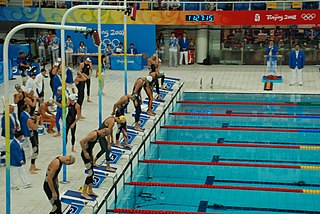
Swimming is an individual or team racing sport that requires the use of one's entire body to move through water. The sport takes place in pools or open water. Competitive swimming is one of the most popular Olympic sports, with varied distance events in butterfly, backstroke, breaststroke, freestyle, and individual medley. In addition to these individual events, four swimmers can take part in either a freestyle or medley relay. A medley relay consists of four swimmers who will each swim a different stroke, ordered as backstroke, breaststroke, butterfly and freestyle.
Fiona Fairhurst, born in 1971, is accredited with the design of the Speedo Fastskin swimsuit. Fairhurst herself was a competitive swimmer until the age of 16 and this provided her with some background within the swimming industry. Fairhurst studied MSc textile technology at the University of Huddersfield, BA (Hons) at Leeds University and an MA at Central St Martins London. At Speedo, she had been working in the role Product Manager Research and Development, before moving on to the Speedo Fastskin, which has been considered the “silver bullet” in professional swimming and has led to numerous title and Olympic medals.

Arena X-Glide is a swimsuit from the Arena brand, made of pure polyurethane that causes a swimmer to slide through water faster when swimming. One notable example of the efficacy of this suit design is that of Paul Biedermann of Germany who wore the suit in the 2009 World Championships, breaking two world records. The design of the suit covers basically the whole torso and the legs with the impermeable polyurethane, thereby exposing less skin to the water and improving the swimmer's buoyancy and streamlined shape. This significantly reduces the drag a swimmer experiences as he or she moves through the water.

Competitive swimming in Britain started around 1830, mostly using breaststroke. Swimming was part of the first modern Olympic games in 1896 in Athens. In 1908, the world swimming association, Fédération Internationale de Natation (FINA), was formed.
Technology doping is the practice of gaining a competitive advantage using sports equipment. The World Anti-Doping Agency (WADA) considers prohibiting technologies if they are "performance-enhancing" or "being against the spirit of the sport". In 2006, WADA initiated a consultation on technology doping which is now officially recognised as a threat, whilst the decision to allow or ban a new technology, specifically relating to sports equipment, is the responsibility of each sport’s own governing body.

The history of competitive swimwear has been dominated by concerns over public nudity in the first half of the 20th century and by efforts to reduce water drag in the second half. Those efforts initially lead swimmers to reduce the early sagging one-piece swimsuits down to briefs only. With the development of new materials that tightly fit the body and offered lower resistance to water than human skin, this trend was reversed to a complete body coverage from heels to neck and wrists. FINA banned full-body suits from competition effective from 1 January 2010, stating that it "wishes to recall the main and core principle is that swimming is a sport essentially based on the physical performance of the athlete".
Bruce Robert Mason OAM is a leading Australian sports scientist in the field of biomechanics. Between 1982 and 2014, he made a significant contribution to the Australian Institute of Sport (AIS) in the area of biomechanics, particularly in the sport of swimming.
History of swimwear traces the changes in the styles of men's and women's swimwear over time and between cultures, and touches on the social, religious and legal attitudes to swimming and swimwear.
References
- 1 2 3 4 5 "The Rocket Swimsuit: Speedo's LZR Racer - Science in the News". Science in the News. 2008-09-15. Retrieved 2017-05-01.
- ↑ "What Is High-Tech Swimwear". www.catalogs.com. Retrieved 2017-05-07.
- ↑ Crouse, Karen (July 24, 2009) Swimming Bans High-Tech Suits, Ending an Era. New York Times
- 1 2 3 FINA. "FINA REQUIREMENTS FOR SWIMWEAR APPROVAL (FRSA)" (PDF).Cite journal requires
|journal=(help) - ↑ Arena International. "Arena Powerskin (official website)".
- ↑ "Beyond the "High-Tech" Suits: Predicting 2012 Olympic Swim Performances" (PDF).
- ↑ "FINA Opts To Ban All High-Tech Swimsuits in Unanimous Vote". Washingtonpost.com. 2009-07-24. Retrieved 2014-05-19.
- ↑ https://www.latimes.com/archives/la-xpm-2009-jul-28-sp-elliott-world-swim28-story.html
- ↑ Watkins, Derek; Ericson, Matthew. "The World Records That Fell" . Retrieved 2017-05-01.