
The Holmby Runestone, listed as DR 328 in the Rundata catalog, is a Viking Age memorial runestone bearing the image of a ship. It is in Holmby, which is about two kilometers southeast of Flyinge, Scania, Sweden.
The Holmby Runestone, listed as DR 328 in the Rundata catalog, is a Viking Age memorial runestone bearing the image of a ship. It is in Holmby, which is about two kilometers southeast of Flyinge, Scania, Sweden.
The Holmby Runestone has an inscription that consists of runic text that is upsidedown in an arch that is over a depiction of a ship at sea. The stone is made of sandstone and is 1.11 meters in height. It was discovered in the wall of the southwest corner of a church tower around 1667. Before the historic nature of runestones was understood, they were often reused as construction materials for roads, bridges, and buildings. The stone was removed and raised outside the church in 1908. The inscription is classified as being carved in runestone style RAK, which is considered to be the oldest style. This classification is for inscriptions where the ends of the runic bands are straight and there are no attached serpent or beast heads. The inscription is dated as having been carved after the Jelling stones.
It has been pointed out that the image of the ship has an ancient form with beaks fore and aft, and thus may depict a symbolic ritual ship and not any known Viking Age ship type. [1] Other inscriptions with similar features which may depict ancient, symbolic ships include DR 77 in Hjermind, DR 119 in Spentrup, DR 258 in Bösarp, and DR 271 in Tullstorps. [1] Other runic inscriptions from the Viking Age which depict ships include DR 220 in Sønder Kirkeby, DR EM85;523 in Farsø, Ög 181 in Ledberg, Ög 224 in Stratomta, Ög MÖLM1960;230 in Törnevalla, Sö 122 in Skresta, Sö 154 in Skarpåker, Sö 158 in Österberga, Sö 164 in Spånga, Sö 351 in Överjärna, Sö 352 in Linga, Vg 51 in Husaby, U 370 in Herresta, U 979 in Gamla Uppsala, U 1052 in Axlunda, U 1161 in Altuna, and Vs 17 in Råby. [2] Three stones, the Hørdum and Långtora kyrka stones and U 1001 in Rasbo, depict ships but currently do not have any runes on them and may never have had any. [2]
The runic text states that the stone was raised as a memorial by a man named Sveinn to his father Þorgeirr. The name Þorgeirr contains as a theophoric name element the Norse pagan god Thor and means "Thor's Spear." [3] The runic text uses the word stena meaning "stones," suggesting that more than one stone was originally raised in memory of Þorgeirr. If so, the second stone of the memorial has since been lost. The last words of the Old Norse text, faþur sin ("his father"), are carved below the image of the ship at sea.
Locally the stone is known as the Holmbystenen. The inscription has been given a Danish listing in the Rundata catalog as Scania was part of the historic Denmark.

The Skarpåker Stone, designated by Rundata as Sö 154, is a Viking Age memorial runestone that originally was located in Skarpåker, Nyköping, Sörmland, Sweden. It dates to the early eleventh century.
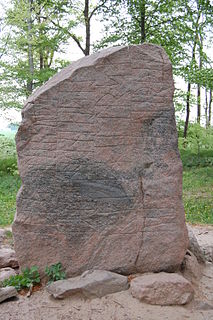
The Glavendrup stone, designated as DR 209 by Rundata, is a runestone on the island of Funen in Denmark and dates from the early 10th century. It contains Denmark's longest runic inscription and ends in a curse.
The Greece runestones are about 30 runestones containing information related to voyages made by Norsemen to the Byzantine Empire. They were made during the Viking Age until about 1100 and were engraved in the Old Norse language with Scandinavian runes. All the stones have been found in modern-day Sweden, the majority in Uppland and Södermanland. Most were inscribed in memory of members of the Varangian Guard who never returned home, but a few inscriptions mention men who returned with wealth, and a boulder in Ed was engraved on the orders of a former officer of the Guard.
The England runestones are a group of about 30 runestones in Northern Europe which refer to Viking Age voyages to England. They constitute one of the largest groups of runestones that mention voyages to other countries, and they are comparable in number only to the approximately 30 Greece Runestones and the 26 Ingvar Runestones, of which the latter refer to a Viking expedition near the Caspian Sea. They were engraved in Old Norse with the Younger Futhark.

The Sigurd stones form a group of eight or nine Swedish runic inscriptions and one picture stone that depict imagery from the Germanic heroic legend of Sigurd the dragon slayer. They were made during the Viking Age and constitute the earliest Norse representations of the matter of the Völsung cycle that is the basis of the Middle High German Nibelungenlied and the Sigurd legends in the Poetic Edda, the Prose Edda, and the Völsunga saga.
The Viking runestones are runestones that mention Scandinavians who participated in Viking expeditions. This article treats the runestone that refer to people who took part in voyages abroad, in western Europe, and stones that mention men who were Viking warriors and/or died while travelling in the West. However, it is likely that all of them do not mention men who took part in pillaging. The inscriptions were all engraved in Old Norse with the Younger Futhark. The runestones are unevenly distributed in Scandinavia: Denmark has 250 runestones, Norway has 50 while Iceland has none. Sweden have as many as between 1,700 and 2,500 depending on definition. The Swedish district of Uppland has the highest concentration with as many as 1,196 inscriptions in stone, whereas Södermanland is second with 391.
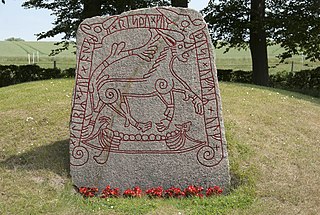
The Tullstorp Runestone is a Viking Age memorial runestone, listed as DR 271 in the Rundata catalog, that is located in Tullstorp, which is about twenty kilometers east of Trelleborg, Skåne County, Sweden, and in the historic province of Scania.
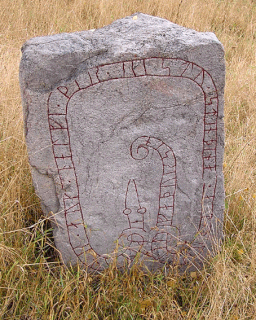
Sö 194 is the Rundata designation for a runic inscription on a memorial runestone located in Brössike, which is about 12 kilometers northeast of Strängnäs, Södermanland County, Sweden, which was in the historic province of Södermanland. There are many such memorial runestones in Scandinavia. While the tradition of carving inscriptions into boulders began in the 4th century and lasted into the 12th century, most runestones date from the late Viking Age.
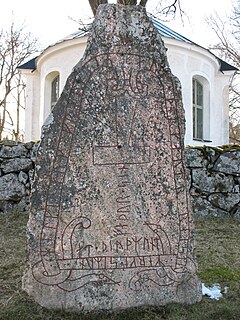
The Stenkvista runestone, designated as runic inscription Sö 111 in the Rundata catalog, is a memorial runestone located near the church at Stenkvista, which is two kilometers east of Skogstorp, Södermanland County, Sweden, which was formerly part of the historic Södermanland, and which features a depiction of Thor's hammer, Mjöllnir. This runestone is one of several runestones in Scandinavia that has a dedication to Thor. While the tradition of carving inscriptions into boulders began in the 4th century and lasted into the 12th century, most runestones in Scandinavia date from the late Viking Age.

This runic inscription, designated as U 448 in the Rundata catalog, is on a Viking Age memorial runestone located in Harg, which is about 4 kilometers north of Märsta, Stockholm County, Sweden, which was in the historic province of Uppland.
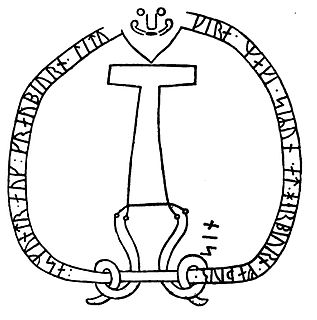
Sö 86 is the Rundata catalog number for a Viking Age memorial runic inscription located in Åby, which is about one kilometer north of Ålberga, Södermanland County, Sweden, and in the historic province of Södermanland. The inscription features a depiction of the hammer of the Norse pagan god Thor named Mjöllnir and a facial mask.

Östergötland Runic Inscription 224 or Ög 224 is the Rundata catalog number for a Viking Age memorial runestone that is located in Stratomta, 9 kilometers (5.6 mi) east of Linköping, Östergötland, Sweden. The runestone has an inscription on two sides with an image of a ship on the south side.

The Sønder Kirkeby Runestone, listed as runic inscription DR 220 in the Rundata catalog, is a Viking Age memorial runestone that was discovered in Sønder Kirkeby, which is located about 5 kilometers east of Nykøbing Falster, Denmark.

Södermanland Runic Inscription 158 or Sö 158 is the Rundata catalog number for a Viking Age memorial runestone located in Österberga, which is one kilometer southwest of Ärsta and three kilometers southwest of Runtuna, Södermanland County, Sweden, and in the historic province of Södermanland. The inscription includes an image of a ship and uses same-stave bind runes to commemorate a man described as being a thegn.

Södermanland Runic Inscription 352 or Sö 352 is a Viking Age memorial runestone located at Linga, which is about two kilometers south of Järna, Stockholm County, Sweden, which was in the historic province of Södermanland. The inscription depicts a ship with an anchor and a portion of the runic text uses same-stave bind runes on the ship mast.

Östergötland Runic Inscription MÖLM1960;230 or Ög MÖLM1960;230 is the Rundata catalog number for a memorial runestone that is located near a church in Törnevalla, which is 2 kilometers east of Linghem, Östergötland County, Sweden, which was in the historic province of Östergötland. The runestone has an inscription which refers to a Viking Age mercantile guild and depicts a ship.
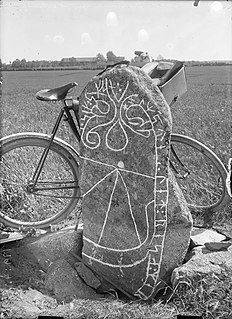
Västmanland Runic Inscription 17 or Vs 17 is the Rundata designation for a Viking Age memorial runestone with an image of a ship that is located in Råby, which is about two kilometers east of Tortuna, Västmanland County, Sweden, which was in the historic province of Västmanland.

Södermanland Runic Inscription 351 or Sö 351 is the Rundata catalog number of a Viking Age memorial runestone located in Överjärna, which is part of Järna, Stockholm County, Sweden, which was part of the historic province of Södermanland. The damaged inscription depicts a ship and the text names the killer of the decedent.
The Bjärby Runestones are two Viking Age memorial runestones located near Grästorp, Sweden, in Bjärby synod, which was in the historic province of Västergötland. The two stones are memorials to men who held the titles thegn and drengr, and one has a depiction of the hammer of the Norse pagan deity Thor.

The Källby Runestones are two Viking Age memorial runestones located in Källby, Västra Götaland County, Sweden, which was in the historic province of Västergötland.