Príncipe is the smaller, northern major island of the country of São Tomé and Príncipe lying off the west coast of Africa in the Gulf of Guinea. It has an area of 136 square kilometres (53 sq mi) and a population of 7,324 (2012). The island is a heavily eroded volcano speculated to be over three million years old, surrounded by smaller islands including Ilheu Bom Bom, Ilhéu Caroço, Tinhosa Grande and Tinhosa Pequena. Part of the Cameroon Line archipelago, Príncipe rises in the south to 947 metres at Pico do Príncipe. The island is the main constituent of the Autonomous Region of Príncipe, established in 1995, and of the coterminous district of Pagué.

The São Tomé shrew is a white-toothed shrew about 3.0 in (7.6 cm) long found only on São Tomé Island, São Tomé and Príncipe. It is listed as a critically endangered species due to habitat loss and a restricted range. It was discovered in 1886. The population continues to decrease, making these animals rare. It is found only on São Tomé Island, a small island that is actually a shield volcano that rises out of the Atlantic Ocean.
Tinhosa Grande is an uninhabited islet in São Tomé and Príncipe, located 23 km (14 mi) southwest of the island of Príncipe and 124 km (77 mi) northeast of the island of São Tomé. Together with the smaller islet Tinhosa Pequena, 4 kilometers to its north, it forms the Pedras Tinhosas group. It is 55 metres high, and its area is 20 hectares.
Ptychadena newtoni is a species of frog in the Ptychadenidae family. It is endemic to the island of São Tomé in São Tomé and Príncipe, where it occurs up to 600 metres elevation. Its natural habitats are swamps, freshwater marshes, arable land, plantations, rural gardens, urban areas, heavily degraded former forest, ponds, and canals and ditches. It is threatened by habitat loss. The animal was first described as Rana newtoni by Bocage in 1886. The species is named after Francisco Xavier Oakley de Aguiar Newton (1864–1909).

The São Tomé spinetail is a species of swift in the family Apodidae. It is endemic to São Tomé and Príncipe. The species was described by Ernst Hartert on 1900.
The island bronze-naped pigeon, also known as the São Tomé bronze-naped pigeon, is a species of bird in the family Columbidae. It is endemic to the Gulf of Guinea islands of Annobón, São Tomé and Príncipe. Its natural habitat is subtropical or tropical moist lowland forest. It is part of the subgenus Turturoena. The species of birds was described by Jules and Edouard Verreaux in 1851.

The giant sunbird is a species of bird in the family Nectariniidae. It is the only species in the genus Dreptes. It is endemic to the island of São Tomé, where it occurs in the central massif.

The Príncipe weaver is a species of bird in the family Ploceidae. It is endemic to São Tomé and Príncipe, where it is found on the island of Príncipe. It was described by Charles Lucien Bonaparte in 1851. Its natural habitat is subtropical or tropical moist lowland forests.

The Fraser's musk shrew is a species of mammal in the family Soricidae. It is found in Benin, Cameroon, Ivory Coast, Equatorial Guinea, Ghana, Guinea, Liberia, Nigeria, São Tomé and Príncipe, Sierra Leone, and Togo. Its natural habitat is subtropical or tropical moist lowland forests. This large black shrew was first described by the British zoologist Louis Fraser in 1843. Its exact definition is unclear; the karyotype comes from Ivory Coast but not from Equatorial Guinea, which is given as the type locality.
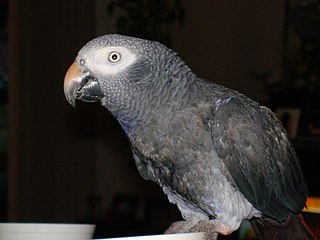
The wildlife of São Tomé and Príncipe is composed of its flora and fauna. São Tomé and Príncipe are oceanic islands which have always been separate from mainland West Africa and so there is a relatively low diversity of species, restricted to those that have managed to cross the sea to the islands. However the level of endemism is high with many species occurring nowhere else in the world.

São Tomé and Príncipe, officially the Democratic Republic of São Tomé and Príncipe, is an island country in the Gulf of Guinea, off the western equatorial coast of Central Africa. It consists of two archipelagos around the two main islands of São Tomé and Príncipe, about 140 kilometres apart and about 250 and 225 kilometres off the northwestern coast of Gabon, respectively.

Agathotoma finalis is a species of sea snail, a marine gastropod mollusk in the family Mangeliidae. It was first described in 1992.
Anonaepestis tamsi is a species of snout moth in the genus Anonaepestis. It was described by John David Bradley in 1965 and is known from Cameroon and the Central African Republic.
Endotricha tamsi is a species of snout moth in the genus Endotricha. It was described by Paul Ernest Sutton Whalley in 1963, and is known from São Tomé & Principe.
Mesocrambus tamsi is a species of moth in the Crambidae family described by Stanisław Błeszyński in 1960. It is found on Sardinia and in North Africa and Syria.

The Príncipe white-eye is a species of bird in the family Zosteropidae. The species was described by Gustav Hartlaub in 1866. It is endemic to the island of Príncipe, where it is restricted to the hilly interior of the southern part. Its natural habitats are subtropical or tropical moist lowland forests and subtropical or tropical moist montane forests. It is threatened by habitat loss.
Events in the year 2018 in Laos.
Feadillo saotomensis is an endemic species of armadillo woodlice, a land crustacean isopod of the family Armadillidae that lives in the island of São Tomé in São Tomé and Príncipe. The species was described in 1983 by Helmut Schmalfuss and Franco Ferrara.
Homapoderus is a genus of weevils in the family Attelabidae. The genus was named and described by Legalov in 2003.