Homapoderus

Last updated

Homapoderus
Scientific classification Red Pencil Icon.png
Kingdom: Animalia
Phylum: Euarthropoda
Class: Insecta
Order: Coleoptera
Family: Attelabidae
Genus:Homapoderus
Legalov, 2003

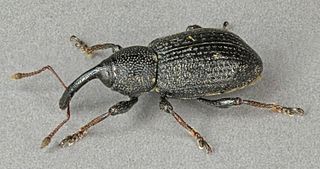
Homapoderus is a genus of weevils in the family Attelabidae. [1] [2] The genus was named and described by Legalov in 2003.

A genus is a taxonomic rank used in the biological classification of living and fossil organisms, as well as viruses, in biology. In the hierarchy of biological classification, genus comes above species and below family. In binomial nomenclature, the genus name forms the first part of the binomial species name for each species within the genus.

Weevil superfamily of insects

Weevils are certain beetles, namely the ones belonging to the superfamily Curculionoidea. They are usually small, less than 6 mm (0.24 in), and herbivorous. About 97,000 species of weevils are known. They belong to several families, with most of them in the family Curculionidae. Some other beetles, although not closely related, bear the name "weevil", such as the biscuit weevil, which belongs to the family Ptinidae.

Attelabidae family of insects

The Attelabidae is a widespread family of weevils. They are among the primitive weevils, because of their straight antennae, which are inserted near the base of the rostrum. The prothorax is much narrower than the base of the elytra on the abdomen. Attelabidae and the related family Rhynchitidae are known commonly as the leaf-rolling weevils. Rhynchitidae may be treated as subfamily Rhychitinae of the Attelabidae.

Species

Homapoderus tamsi is a species of weevils of the family Attelabidae. It occurs in Equatorial Guinea, the Democratic Republic of the Congo and the island of Príncipe in São Tomé and Príncipe. The species was described as Parapoderus tamsi in 1937. It was placed into the genus Homapoderus by Legalov in the mid-2000s.

Related Research Articles

A military dictatorship is a dictatorship wherein the military exerts complete or substantial control over political authority.

This is a timeline of the history of organized crime.

Munster GAA

The Munster Council is a Provincial Council of the Gaelic Athletic Association sports of hurling, Gaelic football, camogie, rounders and handball in the province of Munster.

H. G. Wells bibliography

H. G. Wells was a prolific writer of both fiction and non-fiction. His writing career spanned more than sixty years, and his early science fiction novels earned him the title of "The Father of Science Fiction".

The Grosser Preis von Baden is a Group 1 flat horse race in Germany open to thoroughbreds aged three years or older. It is run at Baden-Baden over a distance of 2,400 metres, and it is scheduled to take place each year in early September.

Cyphicerini tribe of insects

Cyphicerini is a tribe of oriental broad-nosed weevils in the subfamily of beetles known as Entiminae.

Trachyphloeini tribe of insects

Trachyphloeini is a tribe of broad-nosed weevils in the beetle family Curculionidae. There are more than 25 genera in Trachyphloeini.

<i>Eupterote</i> genus of insects

Eupterote is a genus of moths in the family Eupterotidae. It was first described by Hübner in 1820.

<i>Notaris</i> (beetle) genus of insects

Notaris is a genus of marsh weevils in the family of beetles known as Brachyceridae. There are at least 40 described species in Notaris.

Haplorhynchites is a genus of leaf and bud weevils in the family of beetles known as Attelabidae. There are about 11 described species in Haplorhynchites.

Pterocolus is a genus of thief weevils in the family of beetles known as Attelabidae. There are about seven described species in Pterocolus.

Ochyromera is a genus of leguminous seed weevils in the family of beetles known as Curculionidae. There are at least 30 described species in Ochyromera.

Stephanocleonus is a genus of cylindrical weevils in the family of beetles known as Curculionidae. There are at least 60 described species in Stephanocleonus.

References

  1. "Homapoderus". EOL. Retrieved 11 January 2016.
  2. Homapoderus Legalov, 2003 . Retrieved through: Interim Register of Marine and Nonmarine Genera  on 21 January 2019.