 | This article has multiple issues. Please help improve it or discuss these issues on the talk page . (Learn how and when to remove these messages)
|


Look up Sclafani in Wiktionary, the free dictionary.
Sclafani is an Italian noble family.
| This article has multiple issues. Please help improve it or discuss these issues on the talk page . (Learn how and when to remove these messages)
|
Sclafani is an Italian noble family.
Giovanni Sclifano was given a castle, Castello Megerio, and its territory by King William I of Sicily to show his gratitude for having Giovanni's support in the conspiracy of Matthew Bonello. A son of Giovanni, Goffredo Sclifano, founded a monastery in Lentini around the year 1185.
Matteo Sclafani, a powerful baron of the time who became the first Count of Adernò in 1303, during the rule of the Aragonese rule, and later also Count and Lord of Sclafani in 1330. Aside from being involved with the Knights Templar, he built many palaces and cathedrals throughout Italy including a magnificent royal palace in Palermo, Palazzo Sclafani (which later became an important hospital, today the Trinità military barracks), the Monastery of Santa Chiara in 1341, the church of Sant'Agostino, and of San Niccolò dell'Albergaria. [1] He died in the year 1354, in Castle Pietrarossa, Caltanissetta. A second Matteo Scalafani was Count of Adernò and Lord of Cimina. His son, Antonino, helped free Blanche I of Navarre from the grip of Count Bernardo Cabrera, by secreting her into a boat of the harbor. [2]
Due to lack of male heirs, some of the family's fortune of that time was passed to the Moncada family.

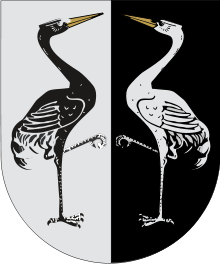
The Sclafani coat of arms is divided in half and bears two cranes facing one another, inversely colored in Argent (silver) to signify peace, and Sable (black) to represent jewels, specifically diamond. An eagle is displayed with a Count's crown of Or (gold) signifying the family's noble heritage.
Crane - Longevity, loyalty, vigilance.
Eagle - One of noble nature, strength, bravery, and alertness; one who is high-spirited, ingenious, quick-witted, judicious, true magnanimity and strength of mind. Wings displayed signifies protection.
 |
Cities bearing the name Sclafani:
Sclafani Bagni
Official Site
Elevation: 811 meters
Land Area: 135,06 km2
Economy: agriculture, thermal station
Population: 506
Population name: Sclafanese
Chiusa Sclafani
Official Site
Elevation: 614 meters
Land Area: 58 km2
Economy: agriculture, stock-breeding, timber
Population: 3.302
Population name: Chiusino
Cities with a large population of Sclafani:
Sciacca
Official Site
Elevation: 60 meters
Land Area: 191,0 km2
Economy: agriculture, fishing, summer tourism, shipbuilding
Population: 40.240
Population name: Saccense
Palermo
Official Site
Elevation: 29 meters
Land Area: 158,88 km2
Economy: agriculture (citrus fruit, vegetables), industries, handicraft, commerce and trade, tourism, services
Population: 686.722
Population name: Palermitano
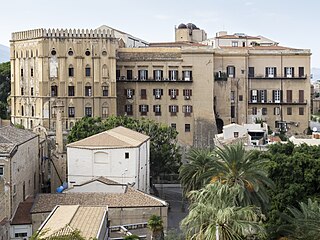
Palermo is a city in southern Italy, the capital of both the autonomous region of Sicily and the Metropolitan City of Palermo, the city's surrounding metropolitan province. The city is noted for its history, culture, architecture and gastronomy, playing an important role throughout much of its existence; it is over 2,700 years old. Palermo is in the northwest of the island of Sicily, by the Gulf of Palermo in the Tyrrhenian Sea.

Caltanissetta is a comune (municipality) in the central interior of Sicily, Italy, and the capital of the province of Caltanissetta. Its inhabitants are called nisseni.

Vizzini is a town and comune in the Metropolitan City of Catania, on the island of Sicily, southern Italy. It is located 60 kilometres (37 mi) from Catania in the Hyblaean Mountains, on the most northwesterly slopes of Monte Lauro.

The province of Palermo was a province in the autonomous region of Sicily, a major island in Southern Italy. Its capital was the city of Palermo. On 4 August 2015, it was replaced by the Metropolitan City of Palermo.

The D'Agostino family is a Sicilian noble lineage originated at least in the thirteenth century, Sicilian strain of historical noble family Agostini Fantini Venerosi Della Seta Gaetani Bocca Grassi from Pisa, family of noble origin, Earls of the Kingdom of Italy, Earls Palatino of the Grand Duchy of Tuscany, noble patricians of the Maritime Republic of Pisa. This family dressed different political-military roles in Sicily. The surname "D'Agostino" is rooted in the Latin name "Augustus," symbolizing a direct connection to the Roman emperor.

Palazzo Adriano is a town and comune of Arbëresh origin in the Metropolitan City of Palermo, Sicily, southern Italy.

Giuliana is a comune (municipality) in the Metropolitan City of Palermo in Sicily, located about 50 kilometres (31 mi) south of Palermo. As of 31 December 2004, it had a population of 2,234 and an area of 24.2 square kilometres (9.3 sq mi).
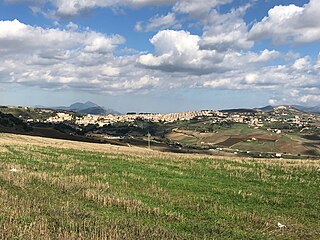
Lercara Friddi is a comune (municipality) in the Metropolitan City of Palermo in the Italian region Sicily, located about 45 kilometres (28 mi) southeast of Palermo.
The Sicilian title Duke of Bivona stems from the middle 16th century. Bivona is in Sicily, which had been conquered by Peter III of Aragon in 1282. It was given to people related to the powerful medieval Aragonese family of Luna, Zaragoza.
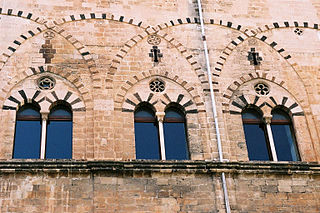
Palazzo Sclafani is a medieval former aristocratic palace located on Piazza della Vittoria #14, in Palermo, region of Sicily, Italy. Across the Piazza della Vittoria park rises the Palazzo dei Normanni and the street along the park leads in a block to the cathedral.

Giovanni II Ventimiglia y Moncada, 6th Marquis of Geraci was a Sicilian aristocrat, a member of the prominent House of Ventimiglia.
Giovanni Forti Natoli or Gianforte Natoli was a Sicilian nobleman, the son of Blasco Natoli Lanza and Domenica Giambruno Perna. He was baron of S. Bartolomeo and Belice. On 20 August 1597 he bought the barony of Sperlinga from Giovanni Ventimiglia, marquis of Gerace, for 30,834 ounces of gold. Natoli was granted a licentia populandi cum privilegium aedificandi by the king of Sicily, Philip II of Spain. In 1627 he was made prince of Sperlinga by Philip IV of Spain.

The Metropolitan City of Palermo is a metropolitan city in Sicily, Italy. Its capital is the city of Palermo. It replaced the province of Palermo and comprises the city of Palermo and 82 other comuni.

The following outline is provided as an overview of and topical guide to Palermo:

Simone De Wobreck was a 16th-century Flemish painter, whose known works all come from his long period in Sicily.
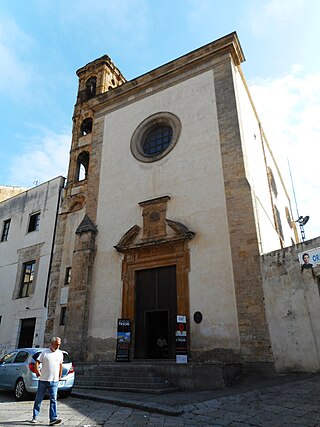
Santa Chiara all'Albergaria refers to a church and former monastery located in piazza Santa Chiara, in the quarter of Albergaria in the city of Palermo, region of Sicily, Italy. The church is located near the busy outdoor Ballarò marketplace.

Francesco Moncada de Luna, prince of Paternò was an Italian nobleman in Spanish-ruled Sicily. He was invested as the first prince of Paternò by King Philip II of Spain.
Sclafani may refer to:
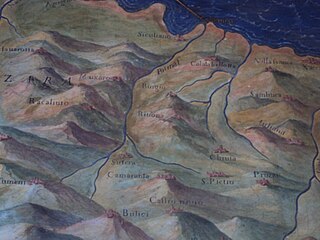
The history of Bivona, an Italian municipality in the province of Agrigento in Sicily, begins with the appearance of the first human settlements in the municipal area dating back to the Copper Age. Also documented in the Bivona area are settlements from the Greek, late Roman and medieval periods. The town of Bivona, although sometimes believed to be of Islamic origin, is documented from 1160: first a simple hamlet, then a lordship, it was one of the main feudal centers of the Vallo di Mazara.