| An aquatic therapist and participant performing Watsu | |
| Characteristics | |
|---|---|
| Mixed-sex | Yes |
| Type | Aquatic |
| Equipment | Resistance, floaties |
Hydrogymnastics is a water-based therapeutic exercise. [1] As its name suggests, this form of aquatic therapy or aquatic rehabilitation [2] is performed in water, and it can take place in swimming pools at aquatic leisure centres and/or in home pools. Being a form of aquatic therapy, hydrogymnastics aims to improve the physical and psychological health and well-being of an individual. Hydrogymnastics can be performed by anyone, including youths (children, teenagers, young adults), middle-aged people, the elderly, athletes and those with disabilities. Hydrogymnastics is often assisted by a qualified aquatic therapist and/or exercise physiologist. Although the effects of hydrogymnastics may vary between individuals belonging to different age groups and genders, hydrogymnastics mainly improves one's cardiovascular fitness, strength, balance and mobility. [2]
Over time many different terms and names have been used to describe hydrogymnastics; however, all are categorised as a form of aquatic or water rehabilitation. [3] The practice of water rehabilitation began in the 24th century BC in Ancient Greece and Asia, where people used the therapeutic benefits of water as both a remedy for illnesses and for religious reasons. [4] However, hydrogymnastics (in a form less modern than today) began in the year 460 BC in Ancient Greece, where it simply involved a person transitioning between hot and cold water in order to treat diseases, muscle aches and pains and bring high fever temperatures down. [5] This form of treatment continued over the years, but in the 6th century people's fear of water meant hydrogymnastics was not performed as often, and as a result bathing in general also declined. [4] But in the 1700s, water and hydrogymnastics were used once again to treat illnesses; one of which was smallpox, which was a very common disease during this period of time.[ citation needed ]
As time passed, more and more people began to see the benefits of water rehabilitation, and as a result people all over the world adopted it into their lives. Consequently, new names, methods, techniques, styles, equipment and principles have been introduced into aquatic rehabilitation, one of which is hydrogymnastics. Today hydrogymnastics helps people of all ages and genders, including those with disabilities, to improve their balance, strength, endurance and movement. [6] At the present time, almost every local aquatic centre has hydrogymnastics classes available. [4]
Hydrogymnastics is also performed by athletes, who use hydrogymnastics as a form of recovery that can help them heal from injuries at a faster rate. Depending on the athlete and the sport, these injuries can range from serious back and shoulder injuries to hip and knee problems, including ligament tear or rupture. [7] The severity of the injury will also determine whether the participants are assisted by the therapist, [7] whether they use specific equipment and/or a form of resistance, how long they spend in the water, and the intensity of the activity. These are all also determined by the participant's pain levels.
One technique of hydrogymnastics is the Bad Ragaz Ring Method. In 1957, BRRM was created in the "therapeutic thermal pools of Bad Ragaz in Switzerland" [6] by Dr. Knupfer. [8] BRRM involves a participant and three ring floaties which are located around their neck, pelvis, keens and/or ankles. These floaties help the participant to stay afloat in a horizontal position. The therapist is located at the participants head, side or feet and hence is able to effectively perform movement (e.g. swaying, rocking, rolling, etc.). [5] In order to be beneficial, this method requires warm water.
There are many benefits associated with BRRM; these include spinal alignment and elongation, stability, better range of joint motion, and ability to activate pre-weight bearing. [5] People who would benefit from the Bad Ragaz Ring Method include those who suffer from pain while moving (e.g. walking, lifting, etc.), those who have poor range of motion and coordination, those who have "proprioceptive or sensory deficits", [9] and those who are unable to use their full weight bearing. By using a particular form of equipment (floaties), BRRM is simultaneously a method for learning to activate different muscles and a form of body relaxation. [9]
Another hydrogymnastics technique is Watsu, which was created by Harold Dull in 1980 in the Hot Springs of Northern California. [6] Essentially, Watsu combines both the Bad Ragaz Ring Method and Shiatsu massage [6] – a type of massage that only uses hand pressure from a therapist. Like BRRM, this method should be performed in warm water in order to be completely beneficial.[ citation needed ]
In order for Watsu to work, the therapist should be situated at the centre of the participant's back, not so low that they are near their lumbar spine and not so high that they are near their cervical vertebrae. [9] Watsu is heavily dependent on the therapist, as no floaties are used. By using the "supine position", [5] the therapist literally holds or cradles the participant and glides them through the water. In Watsu it is extremely important that rhythmical breathing occur while the body is moving.
The benefits of Watsu include: reduced pain, freer range of motion and movement, more energy, development of even breathing, better sleeping and rest patterns, and a higher body awareness (the ability to feel when something in their body does not feel right). People who will benefit from Watsu include those who experience pain while moving, those who have suffered from a traumatic brain injury, and those who suffer from a neuromuscular disorder, soft tissue dysfunction, fatigue, hyperactivity, depression, stress, or anxiety. [5]
In 1990, Jun Knoon created another hydrogymnastics technique: Ai Chi, which incorporates both Tai chi and Qigong. Unlike the other methods, the participant who takes part in Ai Chi is alone and does not use any assistance from a therapist. The only commonality Ai Chi shares with the other methods is that it too is performed at shoulder level in warm water. To perform Ai Chi, the participant stands with their feet shoulder-width apart with their knees slightly bent [5] (to prevent strain on their lower back). While they coordinate deep breaths and rhythmical inhaling and exhaling, they slowly move their body to stretch out muscles. By engaging their core/abdominal muscles to shift their body weight, the participant is able to lift their arms and legs to perform various stretches. The benefits of Ai Chi include: better flexibility and balance, improved range of motion and mobility, increased blood circulation, and higher energy levels. As a result, Ai Chi reduces one's stress, anxiety, fatigue, anger, and depression. [5]
AquaStretch is the most recent hydrogymnastics technique, developed and introduced in 2010 by George Eversaul. It involves resistance (e.g. wearing weights) in order to restore one's range of motion. [5] Like the other techniques, AquaStretch takes place in warm water. In order to perform it, it is essential that both the therapist and participant abide by the "basic procedure", [5] which incorporates four steps. The first step is "play", meaning that the participant freely moves around in water to find the exact location where they are experiencing pain. They then "freeze" when they have found the spot where they have pain and/or are prevented from moving. The therapist then applies pressure (with fingers, hand and/or elbow) to the muscle where the participant is experiencing the pain. The final step is "move"; this step, however, is not always performed. Depending on the participant and if "they feel the need to move", this step aims to release muscle or body tension. [5]
The benefits of AquaStretch include decreased pain or soreness and improved flexibility, which suggests that the people most likely to benefit from AquaStretch are those who suffer from aches, pains, and muscle strains. It is also important for the therapist to shed light on the differences between "good" and "bad" pains; if the participant is experiencing "bad" or sharp pains, they must stop immediately. [5]
There are many health benefits associated with hydrogymnastics; these benefits are evidently found in a variety of people who suffer from physical health issues (e.g. arthritis, muscle pain, etc.), mental health issues (e.g. depression, low self-esteem, anxiety, etc.), injuries (e.g. ligament tears), and disabilities (e.g. cerebral palsy, Parkinson's disease, etc.). [6] However, the overall benefits of hydrogymnastics on the participant/patient include: better coordination, balance and strength; improved endurance (muscular and cardiovascular); better range of joint and muscle motion; ability to manage pain; increased hydro-static pressure; and improved motor skills and locomotion skills. [6] It is also important to note that hydrogymnastics has benefits also on the therapist, as the water buoyancy gives the participant a lighter body weight, thus allowing the therapist to lift, hold, and move the participant more easily. [10]
Buoyancy indeed plays a large role in ensuring the participant's benefits from performing hydrogymnastics. When one is "submerged" in water, one's body will float, [11] mainly due to the fact that water has an anti-gravitational effect. In hydrogymnastics, the deeper a person is immersed in water, the less body weight they are carrying, [6] with this resulting in less pressure on one's joints, ligaments, bones and muscles; better flexibility; and increased range of motion. [10] Because resistance activities are also incorporated into hydrogymnastics, this means that the participant will experience other health benefits such as muscle toning (especially around the legs, buttocks and arms) and reduced swelling (e.g. around the lower legs and feet).[ citation needed ]
When elderly people participate in hydrogymnastics, they gain the ability to move their body freely without the fear or risk of severely injuring themselves. This fear derives from their being prone to falling over because their weak, frail and fragile bodies simply cannot bear their body weight. [12] In addition, hydrogymnastics will benefit the elderly because it is a way for them to keep active, move their body, stay physically healthy, and interact with others, which will ultimately benefit their mental, emotional and social well-being.[ citation needed ]
As one enters the middle-aged stage of life, it is common for one to lose strength and, as a result, be prone to injuries. By performing hydrogymnastics during this age period, one obtains benefits that can include improved upper/lower body strength, and endurance. [13] One of the most beneficial hydrogymnastics activities would be "large muscle activities" such as walking in water, as this explicitly uses arm and leg movements and will increase the participant's muscular strength, endurance, and range of motion. [14]
In regards to the youth age group, hydrogymnastics is mainly used to help support children or young adults who have disabilities or developmental delays. To positively affect children's functional mobility without causing excessive fatigue, therapists lead and assist activities such as floating, walking, resistance activities (e.g. using weights), sitting on floating mats, and performing in different water heights and water currents. Consequently, this increases their functional mobility. [15] Doing hydrogymnastics in a group or with other participants also improves their socialisation skills, as interacting with others encourages them to engage with people belonging to their environment, a key characteristic necessary for individuals to function within society. Having an improved functional mobility has important implications on the overall health and development of young children with disabilities. This has the power to promote participation in other physical activities, which will improve their mental, physical, emotional, and spiritual well-being.[ citation needed ]
Hydrogymnastics can also be performed by any level of athlete, including: professionals (Olympians, world champions, etc.), elite athletes, and international, national, state, and local stream athletes. To these athletes, hydrogymnastics is a different way of training; moving in water means they are carrying a lighter body weight and are therefore not putting extra strain on their bodies, muscles, bones, and joints. If they are recovering from an injury or going through their recovery, building back their strength and endurance in water is a very effective method and can potentially result in their returning to their land-based sport more speedily. [16] Applying motor skills in water can potentially increase the participant's confidence, because in water they can do things they are unable to do on land. [17]
There are not many health risks associated with hydrogymnastics; however, it is important for therapists and participants to take precautions in order to prevent injuries or internal damage, regardless of age or ability level. These precautions include: being aware of potential ear infections (considering hydrogymnastics is performed in water) and understanding that overuse can cause muscle strains, aches, cramps, soreness, and even tears. If a severe injury such as a broken bone, soft tissue or fracture exists, it is strongly recommended that the participant not perform hydrogymnastics until the injury has sufficiently healed or until the therapist advises to do so. [6]
Hemiparesis, also called unilateral paresis, is the weakness of one entire side of the body. Hemiplegia, in its most severe form, is the complete paralysis of one entire side of the body. Either hemiparesis or hemiplegia can result from a variety of medical causes, including congenital conditions, trauma, tumors, traumatic brain injury and stroke.
Massage is the rubbing or kneading of the body's soft tissues. Massage techniques are commonly applied with hands, fingers, elbows, knees, forearms, feet or a device. The purpose of massage is generally for the treatment of body stress or pain. In European countries, a person professionally trained to give massages is traditionally known as a masseur (male) or masseuse (female). In the United States, these individuals are often referred to as "massage therapists". In some provinces of Canada, they are called "registered massage therapists."
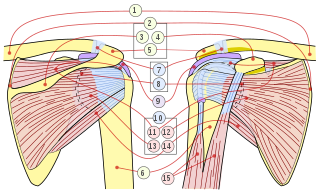
The rotator cuff is a group of muscles and their tendons that act to stabilize the human shoulder and allow for its extensive range of motion. Of the seven scapulohumeral muscles, four make up the rotator cuff. The four muscles are:
Pilates is a type of mind-body exercise developed in the early 20th century by German physical trainer Joseph Pilates, after whom it was named. Pilates called his method "Contrology". It is practiced worldwide, especially in developed countries such as Australia, Canada, Germany, South Korea, New Zealand, the United Arab Emirates, the United Kingdom, and the United States. Pilates uses a combination of around 50 repetitive exercises to spur muscle exertion. Each exercise flows from the "five essentials": breath, cervical alignment, rib and scapular stabilization, pelvic mobility, and utilization of the transversus abdominis. Each exercise is typically repeated three to five times. As of 2023, over 12 million people practice Pilates.
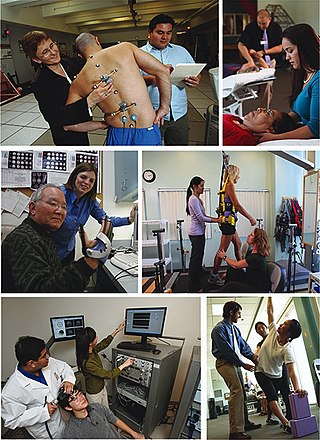
Kinesiology is the scientific study of human body movement. Kinesiology addresses physiological, anatomical, biomechanical, pathological, neuropsychological principles and mechanisms of movement. Applications of kinesiology to human health include biomechanics and orthopedics; strength and conditioning; sport psychology; motor control; skill acquisition and motor learning; methods of rehabilitation, such as physical and occupational therapy; and sport and exercise physiology. Studies of human and animal motion include measures from motion tracking systems, electrophysiology of muscle and brain activity, various methods for monitoring physiological function, and other behavioral and cognitive research techniques.
Strength training, also known as weight training or resistance training, involves the performance of physical exercises that are designed to improve strength and endurance. It is often associated with the lifting of weights. It can also incorporate a variety of training techniques such as bodyweight exercises, isometrics, and plyometrics.
Manual therapy, or manipulative therapy, is a part of Physiotherapy, it is a physical treatment primarily used by physical therapists, occupational therapists to treat musculoskeletal pain and disability; it mostly includes kneading and manipulation of muscles, joint mobilization and joint manipulation. It is also used by Rolfers, massage therapists, athletic trainers, osteopaths, and physicians.
The acetabular labrum is a fibrocartilaginous ring which surrounds the circumference of the acetabulum of the hip, deepening the acetabulum. The labrum is attached onto the bony rim and transverse acetabular ligament. It is triangular in cross-section.
Aquatic therapy refers to treatments and exercises performed in water for relaxation, fitness, physical rehabilitation, and other therapeutic benefit. Typically a qualified aquatic therapist gives constant attendance to a person receiving treatment in a heated therapy pool. Aquatic therapy techniques include Ai Chi, Aqua Running, Bad Ragaz Ring Method, Burdenko Method, Halliwick, Watsu, and other aquatic bodywork forms. Therapeutic applications include neurological disorders, spine pain, musculoskeletal pain, postoperative orthopedic rehabilitation, pediatric disabilities, pressure ulcers, and disease conditions, such as osteoporosis.
The Shepherd hospital is a private non-profit center in Atlanta, Georgia founded in 1975. The hospital focuses on rehabilitation for people with spinal cord injury, disease, acquired brain injury, multiple sclerosis, chronic pain and other neuromuscular problems.
Physical therapy for canines adapts human physical therapy techniques to increase function and mobility of joints and muscles in animals. Animal rehabilitation can reduce pain and enhance recovery from injury, surgery, degenerative diseases, age-related diseases, and obesity.
The Halliwick Concept focuses on biophysical principles of motor control in water, in particular developing sense of balance (equilibrioception) and core stability. The Halliwick Ten-Point-Programme implements the concept in a progressive programme of mental adjustment, disengagement, and development of motor control, with an emphasis on rotational control, and applies the programme to teach physically disabled people balance control, swimming, and independence. Halliwick Aquatic Therapy, implements the concept in patient-specific aquatic therapy for application in rehabilitation of injury and disability.
Over time, the approach to cerebral palsy management has shifted away from narrow attempts to fix individual physical problems – such as spasticity in a particular limb – to making such treatments part of a larger goal of maximizing the person's independence and community engagement. Much of childhood therapy is aimed at improving gait and walking. Approximately 60% of people with CP are able to walk independently or with aids at adulthood. However, the evidence base for the effectiveness of intervention programs reflecting the philosophy of independence has not yet caught up: effective interventions for body structures and functions have a strong evidence base, but evidence is lacking for effective interventions targeted toward participation, environment, or personal factors. There is also no good evidence to show that an intervention that is effective at the body-specific level will result in an improvement at the activity level, or vice versa. Although such cross-over benefit might happen, not enough high-quality studies have been done to demonstrate it.
Eccentric training is a type of strength training that involves using the target muscles to control weight as it moves in a downward motion. This type of training can help build muscle, improve athletic performance, and reduce the risk of injury. An eccentric contraction is the motion of an active muscle while it is lengthening under load. Eccentric training is repetitively doing eccentric muscle contractions. For example, in a biceps curl the action of lowering the dumbbell back down from the lift is the eccentric phase of that exercise – as long as the dumbbell is lowered slowly rather than letting it drop.
A gait trainer is a wheeled device that assists a person who is unable to walk independently to learn or relearn to walk safely and efficiently as part of gait training. Gait trainers are intended for children or adults with physical disabilities, to provide the opportunity to improve walking ability. A gait trainer offers both unweighting support and postural alignment to enable gait practice. It functions as a support walker and provides more assistance for balance and weight-bearing, than does a traditional rollator walker, or a walker with platform attachments. It also provides opportunities to stand and to bear weight in a safe, supported position.
Spastic hemiplegia is a neuromuscular condition of spasticity that results in the muscles on one side of the body being in a constant state of contraction. It is the "one-sided version" of spastic diplegia. It falls under the mobility impairment umbrella of cerebral palsy. About 20–30% of people with cerebral palsy have spastic hemiplegia. Due to brain or nerve damage, the brain is constantly sending action potentials to the neuromuscular junctions on the affected side of the body. Similar to strokes, damage on the left side of the brain affects the right side of the body and damage on the right side of the brain affects the left side of the body. Other side can be effected for lesser extent. The affected side of the body is rigid, weak and has low functional abilities. In most cases, the upper extremity is much more affected than the lower extremity. This could be due to preference of hand usage during early development. If both arms are affected, the condition is referred to as double hemiplegia. Some patients with spastic hemiplegia only experience minor impairments, where in severe cases one side of the body could be completely paralyzed. The severity of spastic hemiplegia is dependent upon the degree of the brain or nerve damage.
When treating a person with a spinal cord injury, repairing the damage created by injury is the ultimate goal. By using a variety of treatments, greater improvements are achieved, and, therefore, treatment should not be limited to one method. Furthermore, increasing activity will increase his/her chances of recovery.
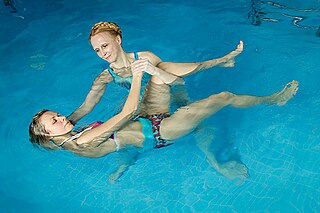
Watsu is a form of aquatic bodywork used for deep relaxation and passive aquatic therapy. Watsu is characterized by one-on-one sessions in which a practitioner or therapist gently cradles, moves, stretches, and massages a receiver in chest-deep warm water.
The Bad Ragaz Ring Method (BRRM) is a type of aquatic therapy used for physical rehabilitation based on proprioceptive neuromuscular facilitation (PNF). BRRM is a water-based technique in which therapist-assisted strengthening and mobilizing exercises are performed while the patient lies horizontally in the water, with support provided by rings or floats around the neck, arms, pelvis, and legs.
Video game rehabilitation is a process of using common video game consoles and methodology to target and improve physical and mental weaknesses through therapeutic processes. Video games are becoming an integral part of occupational therapy practice in acute, rehabilitation, and community settings. The design for video games in rehabilitation is focused on a number of fundamental principles, such as reward, goals, challenge, and meaningful play. 'Meaningful play' emerges from the relationship between player action and system outcome, apparent to the player through, visual, physical and aural feedback. Platforms that feature motion control, notably the Nintendo Wii, Microsoft's Xbox Kinect, Sony's Eye Toy, and virtual reality have all been effective in this field of research. Methodologies have been applied to all age groups, from toddlers to the elderly. It has been used in a variety of cases ranging from stroke rehabilitation, cerebral palsy and other neurological impairments, to tendinitis and multiple sclerosis. Researchers have promoted such technology based on the personalization of gaming systems to patients, allowing for further engagement and interaction. Additionally, gaming consoles have the ability to capture real-time data and provide instant feedback to the patients using the systems. Currently, several researchers have performed case studies to demonstrate the benefits of this technology. Repeat trials and experiments have shown that outcomes are easily replicated among various groups worldwide. Additionally, the outcomes have increased interest in the field, growing experiments beyond simple case studies to experiments with a larger participant base.
{{cite book}}: CS1 maint: others (link){{cite book}}: CS1 maint: others (link)