
Hypercompe is a genus of tiger moths in the family Erebidae erected by Jacob Hübner in 1819.

The Arctiini are a tribe of tiger moths in the family Erebidae.
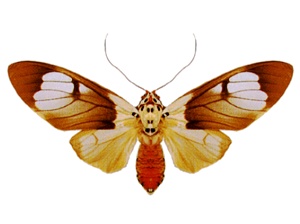
Amerila is a genus of moths in the subfamily Arctiinae. A number of species in this genus have a special defence mechanism when they are in their adult stage. When disturbed, they exude a frothy yellow fluid from glands beside the eyes, while making a sizzling noise to ward off their attacker. Similar behaviour has been observed in fertilised females of the North-American moth Utetheisa ornatrix.

Hypercompe melanoleuca is a moth of the family Erebidae first described by Walter Rothschild in 1910. It is found in Argentina.

Leucanopsis is a genus of moths in the family Erebidae. The genus was described by Alfredo Rei do Régo Barros in 1956.

Lophocampa is a genus of moths in the family Erebidae. The genus was erected by Thaddeus William Harris in 1841. It contains around 75 species.
Paracles is a genus of moths in the subfamily Arctiinae. The genus was described by Francis Walker in 1855. The species range from Panama to Patagonia, with quite a few in the southern temperate region of South America.

Spilosoma is a genus of moths in the family Erebidae originally described by John Curtis in 1825. A very heterogeneous group, it is in need of review by the scientific community, as certain species probably need reclassification into their own genera.

Hypercompe testacea is a moth of the family Erebidae first described by Walter Rothschild in 1909. It is found in Peru.

Hypercompe burmeisteri is a moth of the family Erebidae first described by Walter Rothschild in 1910. It is found in Argentina.

Hypercompe oslari is a moth of the family Erebidae first described by Walter Rothschild in 1910. It is found from the extreme south of Texas south into Mexico.

Hypercompe ockendeni is a moth of the family Erebidae first described by Walter Rothschild in 1909. It is found in Peru and Bolivia.
Hypercompe bricenoi is a moth of the family Erebidae first described by Walter Rothschild in 1909. It is found in Venezuela.
Hypercompe dognini is a moth of the family Erebidae first described by Walter Rothschild in 1910. It is found in Brazil.
Hypercompe dubia is a moth of the family Erebidae first described by Walter Rothschild in 1922. It is found in Peru.
Hypercompe ecpantherioides is a moth of the family Erebidae first described by Walter Rothschild in 1935. It is found in Panama.
Hypercompe fuscescens is a moth of the family Erebidae first described by Walter Rothschild in 1917. It is found in Peru.
Hypercompe kennedyi is a moth of the family Erebidae first described by Walter Rothschild in 1910. It is found in Minas Gerais, Brazil.
Hypercompe pertestacea is a moth of the family Erebidae first described by Walter Rothschild in 1935. It is found in Peru.

Hypercompe trinitatis is a moth of the family Erebidae first described by Walter Rothschild in 1910. It is found in Trinidad.
