Barcelona–El Prat Airport, and also known as El Prat Airport, is an international airport located 15 km (9.3 mi) southwest of the centre of Barcelona, lying in the municipalities of El Prat de Llobregat, Viladecans, and Sant Boi, in Catalonia, Spain.

Delta Air Lines Flight 191 was a regularly scheduled Delta Air Lines domestic service from Fort Lauderdale, Florida to Los Angeles with an intermediate stop at Dallas/Fort Worth International Airport (DFW). On August 2, 1985, the Lockheed L-1011 TriStar operating Flight 191 encountered a microburst while on approach to land at DFW. The aircraft impacted ground over one mile (1.6 km) short of the runway, struck a car near the airport, collided with two water tanks and disintegrated. The crash killed 137 people and injured 26 others. The National Transportation Safety Board (NTSB) determined that the crash resulted from the flight crew's decision to fly through a thunderstorm, the lack of procedures or training to avoid or escape microbursts, and the lack of hazard information on wind shear.

China Airlines Flight 642 was a flight that crashed at Hong Kong International Airport on 22 August 1999. It was operating from Bangkok to Taipei with a stopover in Hong Kong.

Eastern Air Lines Flight 66 was a regularly scheduled flight from New Orleans to New York City that crashed on June 24, 1975 while on approach to New York's John F. Kennedy International Airport, killing 113 of the 124 people on board. The crash was determined to be caused by wind shear caused by a microburst, but the failure of the airport and the flight crew to recognize the severe weather hazard was also a contributing factor.

USAir Flight 1016 was a regularly scheduled flight in the southeastern United States, between Columbia, South Carolina, and Charlotte, North Carolina. On July 2, 1994, the flight encountered heavy thunderstorms and microburst-induced windshear while attempting to land, and crashed into heavy trees and a private residence near the airport. The crash and ensuing fire caused 37 fatalities and seriously injured twenty others.

Bilbao Airport is a minor international airport located 9 km (5.6 mi) north of Bilbao, in the municipality of Loiu, in Biscay. It is the largest airport in the Basque Country and northern Spain, with 5,469,453 passengers in 2018. It is famous for its new main terminal opened in 2000 designed by Santiago Calatrava.

Armavia Flight 967 was a scheduled international passenger flight operated by Armavia from Zvartnots International Airport, Zvarnots in Armenia to Sochi, a Black Sea coastal resort city in Russia. On 3 May 2006, the aircraft operating the route, an Airbus A320-200, crashed into the sea while attempting to go-around following its first approach to Sochi airport, killing all 113 aboard.
Iberia Líneas Aéreas de España, S.A., usually shortened to Iberia, is the largest airline of Spain, based in Madrid.

Lufthansa Flight 2904 was an Airbus A320-200 flying from Frankfurt, Germany to Warsaw, Poland that overran the runway at Okęcie International Airport on 14 September 1993.

Indian Airlines Flight 605 was a scheduled domestic passenger flight from Mumbai to Bengaluru. On 14 February 1990, an Airbus A320-231 registered as VT-EPN, crashed onto a golf course while attempting to land at Bangalore, killing 92 of 146 people.

China Airlines Flight 605 was a daily non-stop flight departing from Taipei at 6:30 a.m. and arriving at Kai Tak Airport in Hong Kong at 7:00 a.m. local time. On November 4, 1993, the plane went off the runway while landing during a storm. It was the first hull loss of a Boeing 747-400.

TACA Flight 390 was a scheduled flight on May 30, 2008, by TACA Airlines from San Salvador, El Salvador, to Miami, Florida, United States, with intermediate stops at Tegucigalpa and San Pedro Sula in Honduras. The aircraft, an Airbus A320-233, overran the runway after landing at Tegucigalpa's Toncontín International Airport and rolled out into a street, crashing into an embankment and smashing several cars in the process.
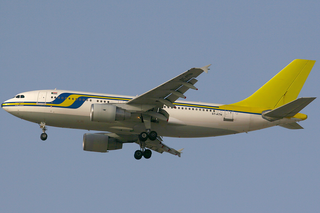
Sudan Airways Flight 109 was a scheduled international Amman–Damascus–Khartoum passenger flight, operated with an Airbus A310 by the flag carrier of Sudan, Sudan Airways. On 10 June 2008, at approximately 17:00 UTC, the Airbus A310 crashed on landing at Khartoum International Airport, killing 30 of the 214 occupants on board.
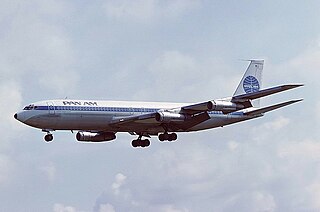
Pan Am Flight 806 was an international scheduled flight from Auckland, New Zealand, to Los Angeles, California, with intermediate stops at Pago Pago, American Samoa and Honolulu, Hawaii. On January 30, 1974, the Boeing 707 Clipper Radiant crashed on approach to Pago Pago International Airport, killing 87 passengers and ten crew members.

Iberia Airlines Flight 610 was a scheduled domestic passenger flight from Madrid to Bilbao, Spain. On 19 February 1985, a Boeing 727-200 operating the flight crashed into a television antenna on the summit of Mount Oiz in Biscay near Bilbao. All 141 passengers and 7 crew on board died. The crash is the deadliest aviation disaster in both Basque Country and Iberia history.

Bhoja Air Flight 213 was a domestic scheduled passenger flight operated by the Pakistani airline Bhoja Air from Karachi to Islamabad. On 20 April 2012, the Boeing 737-200 aircraft serving the route crashed in bad weather during its final approach to land. All 121 passengers and 6 crew members aboard were killed. It was the inaugural flight of Bhoja Air's second daily service on this route.

Air Canada Flight 624 was a scheduled Canadian domestic passenger flight from Toronto Pearson International Airport to Halifax Stanfield International Airport in Halifax, Nova Scotia. During heavy snow and poor visibility, at 00:43 ADT on March 29, 2015, the Airbus A320-211 landed short of the runway and was severely damaged. Twenty-six people were injured.

Asiana Airlines Flight 162 was a regular short-haul international passenger flight from Incheon International Airport near Seoul, South Korea, to Hiroshima Airport in Hiroshima, Japan. On 14 April 2015, the Airbus A320-232 aircraft touched down short of the runway, struck the localizer array, skidded onto the runway on its tail, and spun 120 degrees before finally coming to a rest on the grass, opposite the terminal building. The aircraft suffered substantial damage to the left wing and engine. Of the 82 people aboard, 27 were injured, one seriously.

Aeroméxico Connect Flight 2431 (SLI2431/5D2431) was a Mexican domestic scheduled passenger flight bound for Mexico City that crashed on takeoff from Durango International Airport on July 31, 2018. Shortly after becoming airborne, the plane encountered sudden wind shear caused by a microburst. The plane rapidly lost speed and altitude and impacted the runway, detaching the engines and skidding to a halt about 1,000 feet (300 m) beyond the runway. The plane caught fire and was destroyed. All 103 people on board survived, but 39 passengers and crew members were injured.