
Walter Adolph Georg Gropius was a German-American architect and founder of the Bauhaus School, who, along with Alvar Aalto, Ludwig Mies van der Rohe, Le Corbusier and Frank Lloyd Wright, is widely regarded as one of the pioneering masters of modernist architecture. He was a founder of Bauhaus in Weimar (1919). Gropius was also a leading architect of the International Style. Gropius emigrated from Germany to England in 1934 and from England to the United States in 1937, where he spent the rest of his life.

Vladimir Yevgrafovich Tatlin was a Russian and Soviet painter, architect and stage-designer. Tatlin achieved fame as the architect who designed The Monument to the Third International, more commonly known as Tatlin's Tower, which he began in 1919. With Kazimir Malevich he was one of the two most important figures in the Soviet avant-garde art movement of the 1920s, and he later became an important artist in the constructivist movement.

The International Style is a major architectural style and movement that began in western Europe in the 1920s and dominated modern architecture until the 1970s. It is defined by strict adherence to functional and utilitarian designs and construction methods, typically expressed through minimalism. The style is characterized by modular and rectilinear forms, flat surfaces devoid of ornamentation and decoration, open and airy interiors that blend with the exterior, and the use of glass, steel, and concrete.

Modern architecture, also called modernist architecture, was an architectural movement and style that was prominent in the 20th century, between the earlier Art Deco and later postmodern movements. Modern architecture was based upon new and innovative technologies of construction ; the principle functionalism ; an embrace of minimalism; and a rejection of ornament.
Brutalist architecture is an architectural style that emerged during the 1950s in the United Kingdom, among the reconstruction projects of the post-war era. Brutalist buildings are characterised by minimalist constructions that showcase the bare building materials and structural elements over decorative design. The style commonly makes use of exposed, unpainted concrete or brick, angular geometric shapes and a predominantly monochrome colour palette; other materials, such as steel, timber, and glass, are also featured.

Karel Teige was a Czech modernist avant-garde artist, writer, critic and one of the most important figures of the 1920s and 1930s movement. He was a member of the Devětsil (Butterbur) movement in the 1920s and also worked as an editor and graphic designer for Devětsil's monthly magazine ReD. One of his major works on architecture theory is The Minimum Dwelling (1932).

Slavutych is a city and municipality in northern Ukraine, purpose-built for the evacuated personnel of the Chernobyl Nuclear Power Plant after the 1986 disaster that occurred near the city of Pripyat. Geographically located within Chernihiv Raion, Chernihiv Oblast, Slavutych is administratively subordinated to the Kyiv Oblast and is part of Vyshhorod Raion. It is coterminous with Slavutych urban hromada, one of the hromadas of Ukraine. In 2021 the city had a population of 24,464.

Constructivist architecture was a constructivist style of modern architecture that flourished in the Soviet Union in the 1920s and early 1930s. Abstract and austere, the movement aimed to reflect modern industrial society and urban space, while rejecting decorative stylization in favor of the industrial assemblage of materials. Designs combined advanced technology and engineering with an avowedly communist social purpose. Although it was divided into several competing factions, the movement produced many pioneering projects and finished buildings, before falling out of favor around 1932. It has left marked effects on later developments in architecture.

The Derzhprom or Gosprom building is an office building located on Freedom Square in Kharkiv, Ukraine. Built in the Constructivist style, it was the first modern skyscraper building in the Soviet Union upon its completion in 1928. Its name is an abbreviation of two words that, taken together, mean State Industry. In English the structure is known as the State Industry Building or the Palace of Industry.

The OSA Group was an architectural association in the Soviet Union, which was active from 1925 to 1930 and considered the first group of constructivist architects. It published the journal SA. It published material by Soviet and overseas contributors. However this led to them being attacked as a 'Western' group and some individuals as being 'bourgeois'. After the closure of the group, their modernist approach to architecture and town planning was eliminated in the Soviet Union by 1934, in favour of social realism.
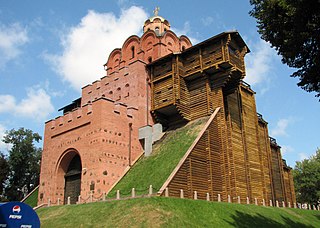
Ukrainian architecture has initial roots in the Eastern Slavic state of Kievan Rus'. After the Mongol invasion of Kievan Rus', the distinct architectural history continued in the principalities of Galicia-Volhynia and later in the Grand Duchy of Lithuania. During the epoch of the Zaporozhian Cossacks, a style unique to Ukraine developed under the influences of the Polish–Lithuanian Commonwealth.

Shevchenko National Prize is the highest state prize of Ukraine for works of culture and arts awarded since 1961. It is named after the inspirer of Ukrainian national revival Andriy Shevchenko. It is one of the five state prizes of Ukraine that are awarded for achievements in various fields.
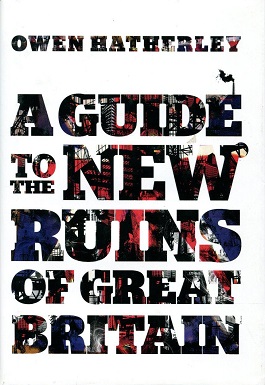
A Guide to the New Ruins of Great Britain is a book by the British writer Owen Hatherley, published by Verso Books in November 2010. The book is a critique of the architecture and urbanism of postmodern Britain, taking the form of a tour of British cities.
Georgie Wolton was a British architect, an original member of the architecture firm Team 4. Critic Jonathan Meades describes her as the "outstanding woman architect of the generation before Zaha [Hadid]".
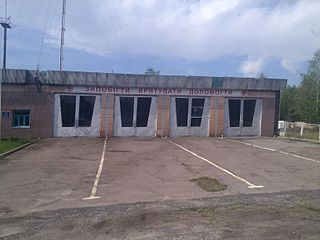
Vilcha is an abandoned settlement and former urban-type settlement in the Chernobyl Exclusion Zone, part of Vyshhorod Raion, Kyiv Oblast, Ukraine.
Ukrainian football clubs have participated in European football competitions since 1965, when in the 1965–66 season, Dynamo Kyiv took part in the UEFA Cup Winners' Cup – the first Ukrainian and the first Soviet club to do so. In total, 17 clubs have represented Ukraine in European competition, among which 7 also previously represented the Soviet Union.
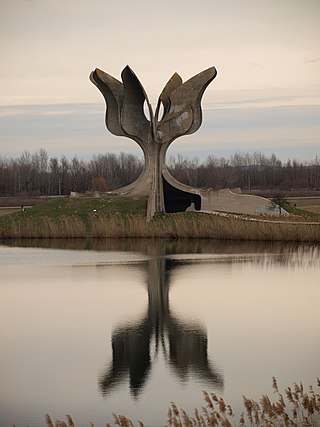
The architecture of Yugoslavia was characterized by emerging, unique, and often differing national and regional narratives. As a socialist state remaining free from the Iron Curtain, Yugoslavia adopted a hybrid identity that combined the architectural, cultural, and political leanings of both Western liberal democracy and Soviet communism.

DOM publishers, founded in Berlin in 2005, publishes architectural guides and specialist publications on architecture, urban planning, and design within an international context. The publishing house is owned and managed by Philipp Meuser and Natascha Meuser, who are also practising architects at their firm, Meuser Architekten. It releases around 40 books per year.

Roza Sarkisian is a Ukrainian theatre director and curator.

