This article includes a list of general references, but it lacks sufficient corresponding inline citations .(March 2017) |
The burning of incense in Japan began during the 6th century (the Asuka period) with the introduction of Buddhism, which uses incense during rituals and ceremonies. Agarwood was imported into Japan from China via Korea. From that point on, incense would become an important facet of Japanese culture. Incense is used for a variety of purposes, including Buddhist ceremonies, spirituality and meditation.
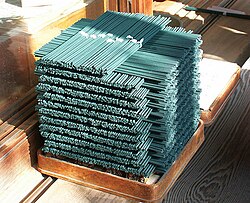
There are two major types of incense in Japan, which are either heating or smouldering small pieces of fragrant wood, or direct-burning incense in form of sticks or cones formed out of paste without a bamboo stick.
Many of the current incense companies have been in existence for more than 300 years.
The word incense (kō) in Japan is written in the Chinese Kangxi radical 186 composed of nine strokes, 香, which can also be expanded up to 27 strokes 馫. A literal translation is "fragrance", though in context it is understood as "incense". The word 道 dō may be added, which means "way", both literally (street) and metaphorically (a stream of life experience), to give kōdō: the "way of incense", which involves using incense within a structure of codified conduct.
Nihon Shoki , a book of classical Japanese history, gives the first formal record of incense in Japan when a log of agarwood, a fragrant wood used in incense burning, drifted ashore on Awaji Island during the Asuka period in 595 CE, and was presented to Prince Shōtoku and the Empress Suiko. [1] Shōtoku knew of incense burning from Buddhism, which had been introduced into Japan around 538 CE; incense was part of Buddhist ritual, [2] and was imported into Japan from China through Korea. [3] Agarwood was imported in 538 CE during the building of a temple. A ritual known as sonaekō became established. Koboku fragrant wood combined with herbs and other aromatic substances was burned to provide a fragrant incense for religious purposes. [4] The custom of burning incense was further developed and blossomed amongst the court nobility with the pastime of takimono, a powdered mixture of aromatic substances. [5] Fragrant scents played a vital role at court life during the Heian period, robes and even fans were perfumed and poems written about them, it also featured prominently in the epic The Tale of Genji in the 11th century.
Samurai warriors would prepare for battle by purifying their minds and bodies with the incense of koboku; developing an appreciation for its fragrances. In the late Muromachi period in the 16th century, this aesthetic awareness would develop into the accomplishment known as kōdō, which is the art of enjoying the incense of smouldering koboku. [6] The present style of kōdō has largely retained the structure and manner of the Muromachi period, in which time the tea ceremony and the ikebana style of flower arrangement developed as well.
During the Tenshō era in the late 16th century, the master craftsmen Kōju was employed at the Kyoto Imperial Palace and practiced incense ceremony. The third Kōju served under Toyotomi Hideyoshi, the fourth under Tokugawa Ieyasu. The eighth Kōju Takae Jyuemon was known as a particular master of incense of note. During this time the “Ten Virtues of Kō” (香の十徳, kōnojūtoku) were formulated, which is a traditional listing of the benefits derived from the proper and correct use of quality incense: [7] [8] [9]
Even today, there is a strong relationship and holistic approach in kōdō between fragrant scent, the senses, the human spirit, and nature. The spirituality and refined concentration that is central to kōdō places it on the same level as kadō and chadō.
The start of the Edo period in the 19th century saw major changes in the history and production of incense. Senkō incense sticks became more widely available to the general public as production method shifted to an industrial scale. At the start of the 20th century, mainichi-kō, or "everyday incense" was developed by the master craftsman Kitō Yujiro during the Meiji and Taishō era.
Today companies such as Nippon Kodo, Shoyeido, and Baieido are some of the most established suppliers for incense.
The fragrant woods agarwood and sandalwood are the main ingredients used in Japanese incense. Agarwood is produced in certain parts of southeast Asia such as Vietnam. Japanese incense companies divide agarwood into six categories depending on the region obtained and properties of the agarwood. [10] The trees secrete an aromatic resin, which over time turns into kōboku. One particular grade of kōboku with a high oil content and superior fragrance is called kyara. Kyara is currently worth more than its weight in gold. Sandalwood originates primarily from India, Indonesia, southern China or other parts of southeast Asia. Sandalwood trees need around 60 years to produce their signature fragrance that can be deemed acceptable to be used for kōdo. The most valued sandalwood comes from Mysore in the state of Karnataka in India, where it is endangered. Makkō (which translates as "incense powder") is used to bind the ingredients together. It is able to bind ingredients while having little scent of its own.
Other materials used are cinnamon bark, chebulic myrobalan, clove, ginger lily, lavender, licorice, patchouli, spikenard, camomile, rhubarb, safflower, star anise, and other herbs. Shell fragrances and other animal-derived aromatic materials are also used.
Raw materials such as agarwood are becoming increasingly rare due to the depletion of the wild resource. This has made prime material very expensive. For example, the cost of lower grade kyara is about 20,000 yen per gram. Top quality kyara costs over 40,000 yen per gram, or many times the equivalent weight of gold (as of late 2012). If the particular piece of incense wood has a history, the price can be even higher. The highest regarded wood, ranjyatai, dates back to at least the 10th century and is kyara wood from Laos or Vietnam, and was used by emperors and warlords for its fragrance. It is said to contain so much resin that it can be used many times over. The wood is kept at the Shōsōin treasury in Nara, which is under the administration of the Imperial Household. The high costs and difficulty in obtaining acceptable raw material is one of the reasons why kōdō is not as widely practised or known compared to the art of flower arrangement or the tea ceremony.
Sasaki Dōyō (1306–1373), who was regarded as a paragon of elegance and luxury and the quintessential military aristocrat during Nanboku-chō period, owned many incense woods and named them.
Shōgun Ashikaga Yoshimasa (1436–1490) himself appreciated precious scented woods and collected some or inherited them from Sasaki. In order to properly organise the large collection of incense wood, he appointed the experts of that time Sanjonishi Sanetaka, who became the founder of the Oie School, and Shino Soshin, the founder of the Shino School. They established a classifying system called rikkoku gomi, which means "six countries, five scents".
| Name | Character | rikkoku (country) | gomi (scent) |
|---|---|---|---|
| kyara | 伽羅 | Vietnam | bitter |
| rakoku | 羅国 | Thailand | sweet |
| manaka | 真那伽 | Malacca, Malaysia | no scent |
| manaban | 真南蛮 | unknown | salty |
| sasora | 佐曾羅 | India | hot |
| sumotara / sumontara | 寸聞多羅 | Sumatra, Indonesia | sour |
*Manaban comes from the word nanban which means "southern barbarian", and was brought to Japan by Portuguese traders with unknown origin. [11]
One of the oldest traditional incense companies in Japan is Baieido, founded in 1657 with roots going back to the Muromachi period. Ostensibly the longest standing incense maker is Kungyokudo, established in the third year of the Bunroku era (1594), and originally operating as an apothecary serving the Nishi Honganji Buddhist Temple in Kyoto. [12] Other traditional and still operating companies include Kyukyodo (1663, Kyoto), and Shoyeido, founded in 1705 in Kyoto. Nippon Kodo is also a major supplier of incense material.
Both Baieido and Shoyeido are used extensively by Zen Buddhist temples, both in Japan and worldwide. Nippon Kōdō was established by incorporation in New York City in August 1965 and is the largest seller of Japanese incense worldwide. Most of their incense is "everyday" quality (毎日 mainichi). They do make some "traditional" incense as well. These three are the major exporters of Japanese incense.
Currently, 70% of all of Japan's incense is manufactured on a small island south of Osaka called Awaji Island. The history extends back to 1850 in Ei of the city of Awaji in 1850 when Senshuu Sakai manufacturing technology was introduced. At the time, Ei was a military run trade port for the Tokushima Clan, which opened the door to the import and sale of raw materials used in making incense. Over time, the incense made in Awaji Island became renowned throughout Japan. The main reason incense manufacturing took root in Awaji Island is because of its nishi-kaze (west wind). This strong seasonal wind hampers the fishing industry, giving rise to the necessity for cottage industries such as incense making. This wind is also great for drying incense. [13]
Kyūkyodō, Kunmeidō, and Kōkandō also sell some incense overseas. It may be difficult to find the other brands outside Japan. There are numerous other incense makers in Japan, of course. These are the either the major sellers or the oldest companies in Japan.
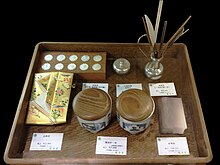
Kōdō (香道, Way of Incense) is the Japanese art of appreciating incense, similar to the tea ceremony, in which participants follow established practises involving the preparation and enjoyment of incense. [14] Though it is counted as one of the three classical arts of refinement, it is relatively unknown amongst modern Japanese people.[ citation needed ] Kōdō includes all aspects of the incense process – from the tools (kōdōgu (香道具)), which, much like tools of the tea ceremony, are valued as high art, to activities such the incense-comparing games kumikō and genjikō.
For kumikō, participants sit near one another and take turns smelling incense from a censer as they pass it around the group. Participants comment on and make observations about the incense, and play games to guess the incense material. Genjikō is one such game, in which participants are to determine which of five prepared censers contain different scents, and which contain the same scent. Players' determinations (and the actual answers) are recorded using genji-mon linear patterns, the elements of which allude to chapters in the Tale of Genji . [15]
Apart from kōdō, incense can also be used during the tea ceremony or other functions. A variety of containers and censers, or kōro, made out of porcelain, wood, lacquer or other materials were created over the centuries for this purpose, such as kōgō, and kōbako, all of which can be supremely valuable items. [16]
Perfume is a mixture of fragrant essential oils or aroma compounds (fragrances), fixatives and solvents, usually in liquid form, used to give the human body, animals, food, objects, and living-spaces an agreeable scent. Perfumes can be defined as substances that emit and diffuse a pleasant and fragrant odor. They consist of manmade mixtures of aromatic chemicals and essential oils. The 1939 Nobel Laureate for Chemistry, Leopold Ružička stated in 1945 that "right from the earliest days of scientific chemistry up to the present time, perfumes have substantially contributed to the development of organic chemistry as regards methods, systematic classification, and theory."
Incense is an aromatic biotic material that releases fragrant smoke when burnt. The term is used for either the material or the aroma. Incense is used for aesthetic reasons, religious worship, aromatherapy, meditation, and ceremonial reasons. It may also be used as a simple deodorant or insect repellent.
Sandalwood is a class of woods from trees in the genus Santalum. The woods are heavy, yellow, and fine-grained, and, unlike many other aromatic woods, they retain their fragrance for decades. Sandalwood oil is extracted from the woods. Sandalwood is often cited as one of the most expensive woods in the world. Both the wood and the oil produce a distinctive fragrance that has been highly valued for centuries. Consequently, some species of these slow-growing trees have suffered over-harvesting in the past.
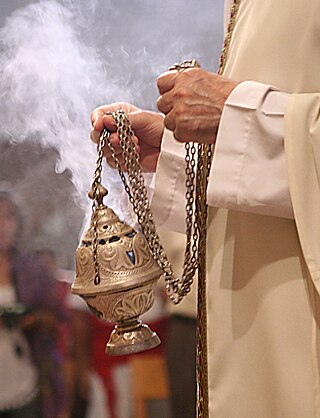
A censer, incense burner, perfume burner or pastille burner is a vessel made for burning incense or perfume in some solid form. They vary greatly in size, form, and material of construction, and have been in use since ancient times throughout the world. They may consist of simple earthenware bowls or fire pots to intricately carved silver or gold vessels, small table top objects a few centimetres tall to as many as several metres high. Many designs use openwork to allow a flow of air. In many cultures, burning incense has spiritual and religious connotations, and this influences the design and decoration of the censer.
Ikebana is the Japanese art of flower arrangement. It is also known as kadō. The origin of ikebana can be traced back to the ancient Japanese custom of erecting evergreen trees and decorating them with flowers as yorishiro to invite the gods.
Agarwood, aloeswood, eaglewood, gharuwood or the Wood of Gods, most commonly referred to as oud or oudh, is a fragrant, dark and resinous wood used in incense, perfume, and small hand carvings. It forms in the heartwood of Aquilaria trees after they become infected with a type of Phaeoacremonium mold, P. parasitica. The tree defensively secretes a resin to combat the fungal infestation. Prior to becoming infected, the heartwood mostly lacks scent, and is relatively light and pale in colouration. However, as the infection advances and the tree produces its fragrant resin as a final option of defense, the heartwood becomes very dense, dark, and saturated with resin. This product is harvested, and most famously referred to in cosmetics under the scent names of oud, oodh or aguru; however, it is also called aloes, agar, as well as gaharu or jinko. With thousands of years of known use, and valued across Muslim, Christian, and Hindu communities, oud is prized in Middle Eastern and South Asian cultures for its distinctive fragrance, utilized in colognes, incense and perfumes.
Nag champa is a natural fragrance of Indian origin. It is made from a combination of sandalwood and either champak or frangipani. When frangipani is used, the fragrance is usually referred to simply as champa.
Kōdō is the art of appreciating Japanese incense, and involves using incense within a structure of codified conduct. Kōdō includes all aspects of the incense process, from the tools, to activities such as the incense-comparing games kumikō (組香) and genjikō (源氏香). Kōdō is counted as one of the three classical Japanese arts of refinement, along with ikebana for flower arrangement, and chadō for tea and the tea ceremony.
The incense clock is a timekeeping device that originated from China during the Song Dynasty (960–1279) and spread to neighboring East Asian countries such as Japan and Korea. The clocks' bodies are effectively specialized censers that hold incense sticks or powdered incense that have been manufactured and calibrated to a known rate of combustion, used to measure minutes, hours, or days. The clock may also contain bells and gongs which act as strikers. Although the water clock and astronomical clock were known in China, incense clocks were commonly used at homes and temples in dynastic times.
Fragrance extraction refers to the separation process of aromatic compounds from raw materials, using methods such as distillation, solvent extraction, expression, sieving, or enfleurage. The results of the extracts are either essential oils, absolutes, concretes, or butters, depending on the amount of waxes in the extracted product.
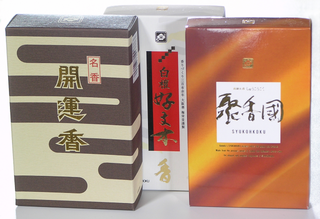
Baieidō is a Japanese incense company established in 1657, located in Sakai, Osaka Prefecture, It is one of the oldest traditional incense makers in Japan.
Nippon Kodo is a Japanese incense company that traces their origins back over 400 years to an incense maker known as Koju, who made incense for the Emperor of Japan. The Nippon Kodo Group was established in August 1965, has acquired several other incense companies worldwide, and has offices in New York City, Los Angeles, Paris, Chicago, Hong Kong, Vietnam, and Tokyo. Mainichi-Koh, introduced in 1912, is the company's most popular product.
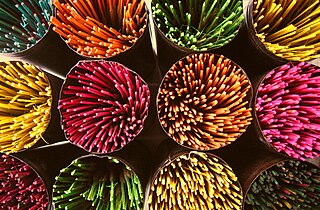
India is the world's main incense producing country, and is also a major exporter to other countries. In India, incense sticks are called Agarbatti (Agar: from Dravidian probably Tamil அகில், அகிர், Sanskrit varti, meaning "stick". An older term "Dhūpavarti" is more commonly used in ancient and medieval texts which encompasses various types of stick incense recipes. Incense is part of the cottage industry in India and important part of many religions in the region since ancient times. The method of incense making with a bamboo stick as a core originated in India at the end of the 19th century, largely replacing the rolled, extruded or shaped method which is still used in India for dhoop.
The word perfume is used today to describe scented mixtures and is derived from the Latin word per fumus. The word perfumery refers to the art of making perfumes. Perfume was produced by ancient Greeks, and perfume was also refined by the Romans, the Persians and the Arabs. Although perfume and perfumery also existed in East Asia, much of its fragrances were incense based. The basic ingredients and methods of making perfumes are described by Pliny the Elder in his Naturalis Historia.
Lorenzo Villoresi is a perfumer in Florence, Italy. His study and travel in the Middle East has greatly influenced his work and some of his most important fragrances are Orientals, exotic perfumes of spices, amber, incense, resins, vanilla, sandalwoods and other aromatics. He continues in the long tradition of perfumery in Florence, arguably where modern perfume making began. The LV house opened in 1990 in the 15th-century family palace, overlooking the Arno.
Religious use of incense has its origins in antiquity. The burned incense may be intended as a symbolic or sacrificial offering to various deities or spirits, or to serve as an aid in prayer.
Stacte and nataph are names used for one component of the Solomon's Temple incense, the Ketoret, specified in the Book of Exodus. Variously translated to the Greek term or to an unspecified "gum resin" or similar, it was to be mixed in equal parts with onycha, galbanum and mixed with pure frankincense and they were to "beat some of it very small" for burning on the altar of the tabernacle.
Incense in China is traditionally used in a wide range of Chinese cultural activities including religious ceremonies, ancestor veneration, traditional medicine, and in daily life. Known as xiang, incense was used by the Chinese cultures starting from Neolithic times with it coming to greater prominence starting from the Xia, Shang, and Zhou dynasties.
The incense offering, a blend of aromatic substances that exhale perfume during combustion, usually consisting of spices and gums burnt as an act of worship, occupied a prominent position in the sacrificial legislation of the ancient Hebrews.
{{cite web}}: |first= has generic name (help)