Related Research Articles

The Underground Railroad was a network of secret routes and safe houses established in the United States during the early to mid-19th century. It was used by enslaved African Americans primarily to escape into free states and from there to Canada. The network, primarily the work of free African Americans, was assisted by abolitionists and others sympathetic to the cause of the escapees. The slaves who risked capture and those who aided them are also collectively referred to as the passengers and conductors of the Railroad, respectively. Various other routes led to Mexico, where slavery had been abolished, and to islands in the Caribbean that were not part of the slave trade. An earlier escape route running south toward Florida, then a Spanish possession, existed from the late 17th century until approximately 1790. However, the network generally known as the Underground Railroad began in the late 18th century. It ran north and grew steadily until the Emancipation Proclamation was signed by President Abraham Lincoln. One estimate suggests that, by 1850, approximately 100,000 slaves had escaped to freedom via the network.

William Still was an African-American abolitionist based in Philadelphia, Pennsylvania. He was a conductor of the Underground Railroad and was responsible for aiding and assisting at least 649 slaves to freedom towards North. Still was also a businessman, writer, historian and civil rights activist. Before the American Civil War, Still was chairman of the Vigilance Committee of the Pennsylvania Anti-Slavery Society, named the Vigilant Association of Philadelphia. He directly aided fugitive slaves and also kept records of the people served in order to help families reunite.
Amos Noë Freeman was an African-American abolitionist, Presbyterian minister, and educator. He was the first full-time minister of Abyssinian Congregational Church in Portland, Maine, where he led a station on the Underground Railroad.

Florence is a village in the northwestern portion of the city of Northampton, Hampshire County, Massachusetts. During the 19th century, Florence was a thriving manufacturing village shaped by progressive ideas on religion, abolitionism, and education.
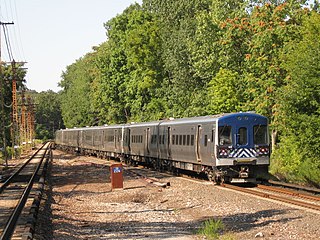
The Harlem Line is an 82-mile (132 km) commuter rail line owned and operated by the Metro-North Railroad in the U.S. state of New York. It runs north from New York City to Wassaic, in eastern Dutchess County. The lower 53 miles (85 km) from Grand Central Terminal to Southeast, in Putnam County, is electrified with a third rail and has at least two tracks. The section north of Southeast is a non-electrified single-track line served by diesel locomotives. Before the renaming of the line in 1983, it eventually became the Harlem Division of the New York Central Railroad. The diesel trains usually run as a shuttle on the northern end of the line, except for rush-hour express trains in the peak direction.

Thomas Garrett was an American abolitionist and leader in the Underground Railroad movement before the American Civil War. He helped more than 2,500 African Americans escape slavery.
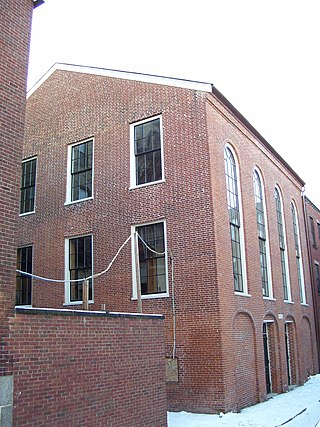
The Boston African American National Historic Site, in the heart of Boston, Massachusetts's Beacon Hill neighborhood, interprets 15 pre-Civil War structures relating to the history of Boston's 19th-century African-American community, connected by the Black Heritage Trail. These include the 1806 African Meeting House, the oldest standing black church in the United States.

Marcus Garvey Park is a 20.16-acre (81,600 m2) park on the border between the Harlem and East Harlem neighborhoods of Manhattan, New York City. The park, centered on a massive and steep outcropping of schist, interrupts the flow of Fifth Avenue traffic, which is routed around the park via Mount Morris Park West. The park is also bounded by 120th Street to the south, 124th Street to the north, and Madison Avenue to the east.

The Park Avenue main line, which consists of the Park Avenue Tunnel and the Park Avenue Viaduct, is a railroad line in the New York City borough of Manhattan, running entirely along Park Avenue. The line carries four tracks of the Metro-North Railroad as a tunnel from Grand Central Terminal at 42nd Street to a portal at 97th Street, where it rises to a viaduct north of 99th Street and continues over the Harlem River into the Bronx over the Park Avenue Bridge. During rush hours, Metro-North uses three of the four tracks in the peak direction.
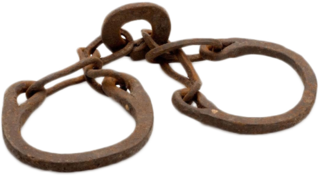
The Jerry Rescue occurred on October 1, 1851, and involved the public rescue of a fugitive slave who had been arrested the same day in Syracuse, New York, during the anti-slavery Liberty Party's state convention. The escaped slave was William Henry, a 40-year-old cooper from Missouri whose slave name was "Jerry."
Freedom Crossing Monument is located on the bank of the Niagara River in Lewiston, New York, and honors the courage of fugitive slaves who sought a new life of freedom in Canada, and to the local volunteers who protected and helped them on their journey across the Niagara River. It was dedicated on October 14, 2009.
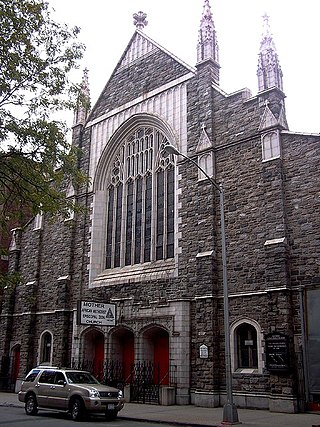
The Mother African Methodist Episcopal Zion Church, also known as "Mother Zion", located at 140–148 West 137th Street between Adam Clayton Powell Jr. Boulevard and Lenox Avenue in the Harlem neighborhood of Manhattan, New York City, is the oldest African-American church in New York City, and the "mother church" of the African Methodist Episcopal Zion conference.

Joy Chatel was a cosmetologist, community organizer and activist based in Brooklyn, New York. She fought battles against the Bloomberg administration and millionaire developers to keep the history of anti-slavery organizing from being erased from the Fulton Mall area.
John P. Coburn (1811–1873) was a 19th-century African-American abolitionist, civil rights activist, tailor and clothier from Boston, Massachusetts. For most of his life, he resided at 2 Phillips Street in Boston's Beacon Hill neighborhood. Coburn was one of the wealthiest African Americans in Boston of his time. His property on the North Slope of Beacon Hill had the third highest real property value in an 1850 census. Coburn was heavily involved in abolition-related work within his community, specifically work related to the New England Freedom Association and the Massasoit Guards.

Abolitionist Place is an alternative name for a section of Duffield Street in Brooklyn, New York City, which was a significant site of abolitionist activity in the 19th century. Abolitionists Harriet and Thomas Truesdell lived at 227 Duffield Street, which is believed to have been a stop on the Underground Railroad. William Harned, an Underground Railroad conductor, lived at the intersection with Willoughby Street, and stories have been passed down orally of involvement of several houses on the block. Duffield Street is said to be named for John Duffield, a Brooklyn resident and surgeon during the American Revolutionary War.

The Tilly Escape occurred in October 1856 when an enslaved woman, Tilly, was led by Harriet Tubman from slavery in Baltimore to safety in Philadelphia. Historians who have studied Tubman consider it "one of her most complicated and clever escape attempts." It was a risky trip because Tubman and Tilly would not have been able to travel directly from Baltimore to Philadelphia without proof that they were free women. In addition, local slave traders would have recognized strangers. Tubman sought to evade capture by going south, before heading north, and using different modes of transportation over water and land.
Kentucky raid in Cass County (1847) was conducted by slaveholders and slave catchers who raided Underground Railroad stations in Cass County, Michigan to capture black people and return them to slavery. After unsuccessful attempts, and a lost court case, the Fugitive Slave Act of 1850 was enacted. Michigan's Personal Liberty Act of 1855 was passed in the state legislature to prevent the capture of formerly enslaved people that would return them to slavery.
Guy Beckley (1803–1847) was a Methodist Episcopal minister, abolitionist, Underground Railroad stationmaster, and lecturer. The Guy Beckley House is on the National Park Service Underground Railroad Network to Freedom and the Journey to Freedom tour. It stands next to Beckley Park, which was named after him.

The PortlandFreedom Trail is a self-guided walking tour of Portland, Maine. Established in 2007, its 2-mile (3.2 km) course passes through the city's oldest and most historic areas, including those related to its African American population, and features thirteen points of interest. Most of the stops are in the Old Port and Arts District. The Abyssinian Meeting House, the third-oldest African American meetinghouse in the country, is a stop on the tour, while several others are tied to the city's former Underground Railroad.
References
- 1 2 3 4 5 6 7 8 9 10 Jerkins, Morgan (12 September 2018). "Harlem's mission to rename streets after black women before it's too late". The Guardian. Retrieved 27 January 2022.
- 1 2 3 4 5 6 7 8 9 10 11 12 13 14 15 16 17 18 19 Boyer-Dry, Margot (5 March 2021). "He Honors Black New Yorkers. Not All Black Activists Are Thrilled". The New York Times. Retrieved 27 January 2022.
- 1 2 Lombardi, Frank (21 November 2010). "Upper West Sider Jacob Morris is takin' it to the streets to honor blacks". New York Daily News. Retrieved 27 January 2022.
- ↑ Maloney, Jennifer (2 July 2012). "A New Freedom Trail". Wall Street Journal. Retrieved 27 January 2022.
- 1 2 3 4 5 Shapiro, Julie (20 March 2012). "'Freedom Trail' Plan Would Link Manhattan's Abolitionist Sites". Archived from the original on 27 January 2022.
- ↑ Maloney, Jennifer (14 February 2014). "Freedom Trail Idea on Move in New York City". Wall Street Journal.
- ↑ Venarchik, Anna (23 February 2021). "Underground Railroad Tours Are a Hot Ticket: Could NYC's Abolitionist History Get Easier to Access?". Bedford+Bowery. Retrieved 27 January 2022.
- ↑ Croghan, Lore (26 September 2019). "Planned Willougby Park could be renamed to honor Downtown BK abolitionists". Brooklyn Eagle. Retrieved 27 January 2022.
- ↑ O'Connell-Domenech, Alejandra (21 August 2019). "Moment of 'Truth' for suffragettes statue". amNY. Retrieved 27 January 2022.
- ↑ Small, Zachary (21 August 2019). "Historians Raise Concerns Over Central Park's Suffragist Monument". Hyperallergic. Retrieved 27 January 2022.