The Book of Numbers is the fourth book of the Hebrew Bible and the fourth of five books of the Jewish Torah. The book has a long and complex history; its final form is possibly due to a Priestly redaction of a Yahwistic source made sometime in the early Persian period. The name of the book comes from the two censuses taken of the Israelites.
The Book ofLeviticus is the third book of the Torah and of the Old Testament, also known as the Third Book of Moses. Many hypotheses presented by scholars as to its origins agree that it developed over a long period of time, reaching its present form during the Persian Period, from 538 to 332 BC, although this is disputed.
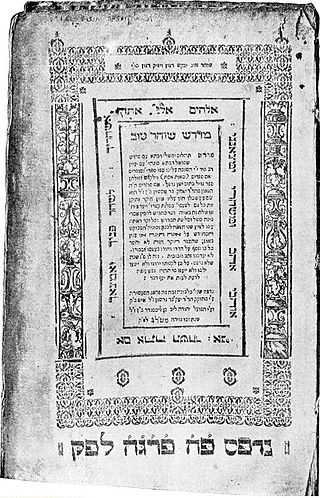
Midrash is expansive Jewish Biblical exegesis using a rabbinic mode of interpretation prominent in the Talmud. The word itself means "textual interpretation", "study", or "exegesis", derived from the root verb darash (דָּרַשׁ), which means "resort to, seek, seek with care, enquire, require".
The Old Testament (OT) is the first division of the Christian biblical canon, which is based primarily upon the 24 books of the Hebrew Bible, or Tanakh, a collection of ancient religious Hebrew and occasionally Aramaic writings by the Israelites. The second division of Christian Bibles is the New Testament, written in Koine Greek.

The Torah is the compilation of the first five books of the Hebrew Bible, namely the books of Genesis, Exodus, Leviticus, Numbers and Deuteronomy. In Christianity, the Torah is also known as the Pentateuch or the Five Books of Moses. In Rabbinical Jewish tradition it is also known as the Written Torah. If meant for liturgic purposes, it takes the form of a Torah scroll. If in bound book form, it is called Chumash, and is usually printed with the rabbinic commentaries.

The documentary hypothesis (DH) is one of the models used by biblical scholars to explain the origins and composition of the Torah. A version of the documentary hypothesis, frequently identified with the German scholar Julius Wellhausen, was almost universally accepted for most of the 20th century. It posited that the Pentateuch is a compilation of four originally independent documents: the Jahwist, Elohist, Deuteronomist, and Priestly sources, frequently referred to by their initials. The first of these, J, was dated to the Solomonic period. E was dated somewhat later, in the 9th century BCE, and D was dated just before the reign of King Josiah, in the 7th or 8th century BCE. Finally, P was generally dated to the time of Ezra in the 5th century BCE. The sources would have been joined at various points in time by a series of editors or "redactors".

The Law of Moses, also called the Mosaic Law, is the law said to have been revealed to Moses by God. The term primarily refers to the Torah or the first five books of the Hebrew Bible.
Martin Noth was a German scholar of the Hebrew Bible who specialized in the pre-Exilic history of the Hebrews and promoted the hypothesis that the Israelite tribes in the immediate period after the settlement in Canaan were organised as a group of twelve tribes arranged around a central sanctuary on the lines of the later Greek and Italian amphictyonies. With Gerhard von Rad he pioneered the traditional-historical approach to biblical studies, emphasising the role of oral traditions in the formation of the biblical texts.
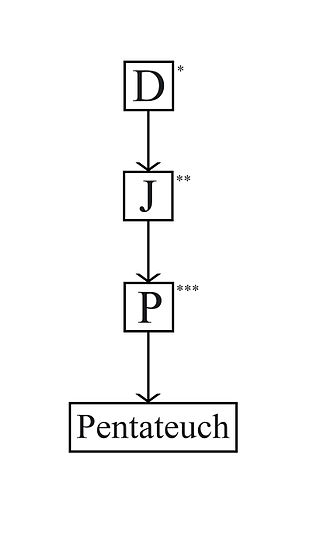
The Priestly source is perhaps the most widely recognized of the sources underlying the Torah, both stylistically and theologically distinct from other material in it. It is considered by most scholars as the latest of all sources, and “meant to be a kind of redactional layer to hold the entirety of the Pentateuch together,” It includes a set of claims that are contradicted by non-Priestly passages and therefore uniquely characteristic: no sacrifice before the institution is ordained by Yahweh (God) at Sinai, the exalted status of Aaron and the priesthood, and the use of the divine title El Shaddai before God reveals his name to Moses, to name a few.
John Van Seters is a Canadian scholar of the Hebrew Bible and the Ancient Near East. Currently University Distinguished Professor Emeritus at the University of North Carolina, he was formerly James A. Gray Professor of Biblical Literature at UNC. He took his Ph.D. at Yale University in Near Eastern Studies (1965) and a Th.D. h.c. from the University of Lausanne (1999). His honours and awards include a Guggenheim Fellowship, an NEH fellowship, an ACLS Fellowship, and research fellowships at Oxford, Cambridge, Katholieke Universiteit Leuven, and National Research Foundation of South Africa. His many publications include The Hyksos: A New Investigation (1966); Abraham in History and Tradition (1975); In Search of History ; The Edited Bible (2006); and The Biblical Saga of King David (2009).
The Covenant Code, or Book of the Covenant, is the name given by academics to a text appearing in the Torah, at Exodus 20:22–23:19; or, more strictly, the term Covenant Code may be applied to Exodus 21:1–22:16. Biblically, the text is the second of the law codes said to have been given to Moses by God at Mount Sinai. This legal text provides a small but substantive proportion of the mitzvot within the Torah, and hence is a source of Jewish Law.
Hebrew Bible English translations are English translations of the Hebrew Bible (Tanakh) according to the Masoretic Text, in the traditional division and order of Torah, Nevi'im, and Ketuvim. Most Jewish translations appear in bilingual editions (Hebrew–English).
There is much disagreement within biblical scholarship today over the authorship of the Bible. The majority of scholars believe that most of the books of the Bible are the work of multiple authors and that most have been edited to produce the works known today. The following article outlines the conclusions of the majority of contemporary scholars, along with the traditional views, both Jewish and Christian.
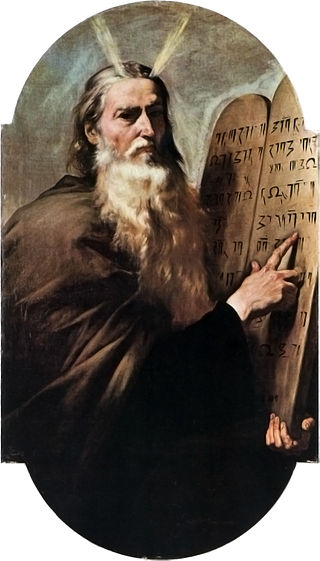
Mosaic authorship is the Judeo-Christian tradition that the Torah, the first five books of the Hebrew Bible/Old Testament, were dictated by God to Moses. The tradition probably began with the legalistic code of the Book of Deuteronomy and was then gradually extended until Moses, as the central character, came to be regarded not just as the mediator of law but as author of both laws and narrative.
Bernard Malcolm Levinson serves as Professor of Classical and Near Eastern Studies and of Law at the University of Minnesota, where he holds the Berman Family Chair in Jewish Studies and Hebrew Bible. He is the author of Deuteronomy and the Hermeneutics of Legal Innovation, "The Right Chorale": Studies in Biblical Law and Interpretation, and Legal Revision and Religious Renewal in Ancient Israel; and is the co-editor of The Pentateuch as Torah: New Models for Understanding Its Promulgation and Acceptance. He has published extensively on biblical and ancient Near Eastern law and on the reception of biblical literature in the Second Temple period. His research interests extend to early modern intellectual history, constitutional theory, the history of interpretation, and literary approaches to biblical studies.
David John Alfred Clines was a biblical scholar. He served as professor at the University of Sheffield.

Sheffield Phoenix Press Ltd. (SPP) is an independent academic publisher specializing in biblical studies. It was launched in January 2004, continuing the traditions of the former Sheffield Academic Press.
Ancient Hebrew writings are texts written in Biblical Hebrew using the Paleo-Hebrew alphabet before the destruction of the Second Temple in 70 CE.

Jacob L. Wright is a biblical scholar currently serving as professor of Hebrew Bible at Emory University. Prior to his Emory appointment, Wright taught at the University of Heidelberg (Germany), one of the foremost research-oriented public universities in Europe, for several years. His areas of expertise include Biblical Archaeology, warfare in the Ancient Near East, and the literary and redaction history of the Hebrew Bible canon. He has published extensively throughout his career, authoring several books and dozens of articles which span topics such as Ezra-Nehemiah, the Persian period, warfare in the Ancient Near East; as well as the material culture of the ancient Levant, the unique role of women in the Hebrew Bible, and larger themes such as defeat, peoplehood, and national identity in the Hebrew Bible. Areas of concentration in war studies include war commemoration, urbicide and ritual violence, and feasting and gift-giving.
The composition of the Torah was a process that involved multiple authors over an extended period of time.

