The conservation movement, also known as nature conservation, is a political, environmental, and social movement that seeks to manage and protect natural resources, including animal, fungus, and plant species as well as their habitat for the future. Conservationists are concerned with leaving the environment in a better state than the condition they found it in. Evidence-based conservation seeks to use high quality scientific evidence to make conservation efforts more effective.

The United States Department of Agriculture (USDA) is the federal executive department responsible for developing and executing federal laws related to farming, forestry, rural economic development, and food. It aims to meet the needs of commercial farming and livestock food production, promotes agricultural trade and production, works to assure food safety, protects natural resources, fosters rural communities and works to end hunger in the United States and internationally. It is headed by the secretary of agriculture, who reports directly to the president of the United States and is a member of the president's Cabinet. The current secretary is Tom Vilsack, who has served since February 24, 2021.

The International Union for Conservation of Nature (IUCN) is an international organization working in the field of nature conservation and sustainable use of natural resources. It is involved in data gathering and analysis, research, field projects, advocacy, and education. IUCN's mission is to "influence, encourage and assist societies throughout the world to conserve nature and to ensure that any use of natural resources is equitable and ecologically sustainable".

Man and the Biosphere Programme (MAB) is an intergovernmental scientific program, launched in 1971 by UNESCO, that aims to establish a scientific basis for the improvement of relationships between people and their environments.

The Global Environment Facility (GEF) is a multilateral environmental fund that provides grants and blended finance for projects related to biodiversity, climate change, international waters, land degradation, persistent organic pollutants (POPs), mercury, sustainable forest management, food security, and sustainable cities in developing countries. It is the largest source of multilateral funding for biodiversity globally, and distributes more than $1 billion a year on average to address inter-related environmental challenges.
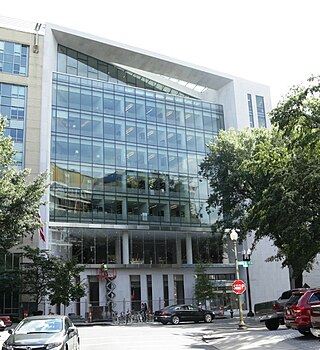
The Center for Strategic and International Studies (CSIS) is an American think tank based in Washington, D.C. From its founding in 1962 until 1987, it was an affiliate of Georgetown University, initially named the Center for Strategic and International Studies of Georgetown University. The center conducts policy studies and strategic analyses of political, economic and security issues throughout the world, with a focus on issues concerning international relations, trade, technology, finance, energy and geostrategy.

CGIAR is a global partnership that unites international organizations engaged in research about food security. CGIAR research aims to reduce rural poverty, increase food security, improve human health and nutrition, and sustainable management of natural resources.

The Center for International Forestry Research (CIFOR) is a non-profit scientific research organization that conducts research on the use and management of forests with a focus on tropical forests in developing countries. CIFOR, which merged with World Agroforestry on Jan. 1, 2019, is the forestry and agroforestry research center of the Consultative Group on International Agricultural Research (CGIAR), a network of 15 research centers around the world that focus on agricultural research for sustainable development, working closely with governments and other partners to help develop evidence-based solutions to problems related to sustainable agriculture and natural resource management.
Adaptive management, also known as adaptive resource management or adaptive environmental assessment and management, is a structured, iterative process of robust decision making in the face of uncertainty, with an aim to reducing uncertainty over time via system monitoring. In this way, decision making simultaneously meets one or more resource management objectives and, either passively or actively, accrues information needed to improve future management. Adaptive management is a tool which should be used not only to change a system, but also to learn about the system. Because adaptive management is based on a learning process, it improves long-run management outcomes. The challenge in using the adaptive management approach lies in finding the correct balance between gaining knowledge to improve management in the future and achieving the best short-term outcome based on current knowledge. This approach has more recently been employed in implementing international development programs.

Forestry laws govern activities in designated forest lands, most commonly with respect to forest management and timber harvesting. Forestry laws generally adopt management policies for public forest resources, such as multiple use and sustained yield. Forest management is split between private and public management, with public forests being sovereign property of the State. Forestry laws are now considered an international affair.

The International Union of Forest Research Organizations (IUFRO) is a non-profit, non-governmental international network of forest scientists, headquartered in Austria. In 2019, IUFRO counted 630 Member Organizations worldwide.

Resources for the Future (RFF) is an American nonprofit organization, founded in 1952 that conducts independent research into environmental, energy, and natural resource issues, primarily via economics and other social sciences. Headquartered in Washington, D.C., RFF performs research around the world.

The Sustainable Forestry Initiative (SFI) is a sustainability organization operating in the U.S. and Canada that works across four pillars: standards, conservation, community, and education. SFI was founded in 1994 by the American Forest & Paper Association (AF&PA). SFI is the world's largest single forest certification standard by area. SFI is headquartered in Ottawa and Washington, D.C.
The Yale Center for Environmental Law & Policy is a joint initiative between the Yale School of Forestry & Environmental Studies and the Yale Law School.
The World Forestry Congress (WFC) is the largest and most significant gathering of the world's forestry sector and it has been held every six years since 1926 under the auspices of the Food and Agriculture Organization (FAO) of the United Nations, organized by the government of the host country. It is a forum for the sharing of knowledge and experience regarding the conservation, management and use of the world's forests, and covers such issues as international dialogue, socio-economic and institutional aspects, and forest policies.
Earth Economics is a 501(c)(3) non-profit formally established in 2006 and headquartered in Tacoma, Washington, United States. The organization uses natural capital valuation to help decision makers and local stakeholders to understand the value of natural capital assets. By identifying, monetizing, and valuing natural capital and ecosystem services.

Fadi Elsalameen , sometimes written as Fadi El-Salameen, is a non-resident fellow at the Foreign Policy Institute at the Johns Hopkins School of Advanced International Studies (SAIS). Elsalameen is also the president of the Palestinian Security Project, a new think tank that has been created to develop a Palestinian national security vision and strategy. Elsalameen is also an adjunct senior fellow at the American Security Project, a Washington, DC, think tank that has been created to develop an American national security vision and strategy for the 21st century. Elsalameen was also a fellow with the New America Foundation's American Strategy Program, a nonpartisan public policy institute that invests in new thinkers and new ideas to address the next generation of challenges facing the United States. He was the director general of Palestine Note. Before that, he served as the director of institutional advancement at the American Task Force on Palestine (ATFP) where he established the Development Department by securing the first foundation grant to the organization.

The Balsillie School of International Affairs (BSIA) is a centre for advanced research and teaching on global governance and international public policy, located in Waterloo, Ontario. As one of the largest social sciences initiatives in Canada, the school is a collaborative partnership between the University of Waterloo, Wilfrid Laurier University, and the Centre for International Governance Innovation. The BSIA is an affiliate member of the Association of Professional Schools of International Affairs, a group of schools that educate leaders in international affairs. The BSIA is housed in the north and west wings of the CIGI Campus. Admission to BSIA is highly selective.
Ecosystem-based adaptation (EBA) encompasses a broad set of approaches to adapt to climate change. They all involve the management of ecosystems and their services to reduce the vulnerability of human communities to the impacts of climate change. The Convention on Biological Diversity defines EBA as "the use of biodiversity and ecosystem services as part of an overall adaptation strategy to help people to adapt to the adverse effects of climate change".
Uma Lele is an agricultural economist, currently at the Institute of Economic Growth at the University of Delhi, India. She has spent much of her career working with the World Bank and other international organizations.

