The Basques are a Southwestern European ethnic group, characterised by the Basque language, a common culture and shared genetic ancestry to the ancient Vascones and Aquitanians. Basques are indigenous to, and primarily inhabit, an area traditionally known as the Basque Country —a region that is located around the western end of the Pyrenees on the coast of the Bay of Biscay and straddles parts of north-central Spain and south-western France.
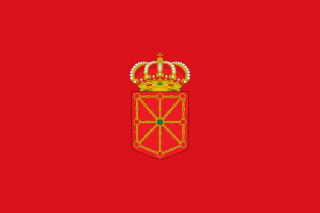
Navarre, officially the Chartered Community of Navarre, is a landlocked foral autonomous community and province in northern Spain, bordering the Basque Autonomous Community, La Rioja, and Aragon in Spain and New Aquitaine in France. The capital city is Pamplona. The present-day province makes up the majority of the territory of the medieval Kingdom of Navarre, a long-standing Pyrenean kingdom that occupied lands on both sides of the western Pyrenees, with its northernmost part, Lower Navarre, located in the southwest corner of France.
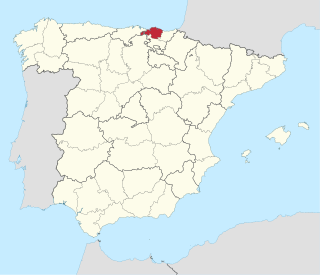
Biscay or Bizkaia, is a province of the Basque Autonomous Community, heir of the ancient Lordship of Biscay, lying on the south shore of the eponymous bay. The capital and largest city is Bilbao.
La Güera is a ghost town on the Atlantic coast at the southern tip of Western Sahara, on the western side of the Ras Nouadhibou peninsula which is split in two by the Mauritania–Western Sahara border, 15 kilometres (9.3 mi) west of Nouadhibou. It is also the name of a daira at the Sahrawi refugee camps in south-western Algeria.

The Basque Country is the name given to the home of the Basque people. The Basque Country is located in the western Pyrenees, straddling the border between France and Spain on the coast of the Bay of Biscay.

The Kingdom of Navarre, originally the Kingdom of Pamplona occupied lands on both sides of the western Pyrenees, with its northernmost areas originally reaching the Atlantic Ocean, between present-day Spain and France.
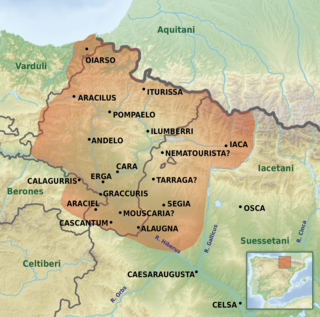
The Vascones were a pre-Roman tribe who, on the arrival of the Romans in the 1st century, inhabited a territory that spanned between the upper course of the Ebro river and the southern basin of the western Pyrenees, a region that coincides with present-day Navarre, western Aragon and northeastern La Rioja, in the Iberian Peninsula. The Vascones are often considered ancestors of the present-day Basques to whom they left their name.

Fuero, Fur, Foro or Foru is a Spanish legal term and concept. The word comes from Latin forum, an open space used as a market, tribunal and meeting place. The same Latin root is the origin of the French terms for and foire, and the Portuguese terms foro and foral; all of these words have related, but somewhat different meanings.

Gipuzkoa is a province of Spain and a historical territory of the autonomous community of the Basque Country. Its capital city is Donostia-San Sebastián. Gipuzkoa shares borders with the French department of Pyrénées-Atlantiques at the northeast, with the province and autonomous community of Navarre at east, Biscay at west, Álava at southwest and the Bay of Biscay to its north. It is located at the easternmost extreme of the Cantabric Sea, in the Bay of Biscay. It has 66 kilometres of coast land.

Getaria is a town on the Urola coast, in the province of Gipuzkoa, in the autonomous community of the Basque Country, in northern Spain. It borders Zarautz to the east and Zumaia to the west.

The Varduli were a pre-Roman tribe settled in the north of the Iberian Peninsula, in what today is the western region of the Basque Country.
The Basques are an indigenous ethno-linguistic group mainly inhabiting the Basque Country. Their history is therefore interconnected with Spanish and French history and also with the history of many other past and present countries, particularly in Europe and the Americas, where a large number of their descendants keep attached to their roots, clustering around Basque clubs which are centers for Basque people.
The Basque Autonomous Community [ A.C.], also officially called Euskadi [], is an autonomous community in northern Spain. It includes the Basque provinces of Araba, Bizkaia, and Gipuzkoa. It also surrounds an enclave called Treviño.
EH Bildu, short for Euskal Herria Bildu, is a left-wing, Basque nationalist and pro-independence federation of political parties in Spain. It is the main political force of the abertzale left in Spain. EH Bildu is active in the Spanish Basque Country, that is, in the Basque Autonomous Community and Chartered Community of Navarre, as well as in the Treviño enclave of the Burgos Province. In the French Basque Country, it has an alliance with the party Euskal Herria Bai, with the goal of establishing a state for the Basque Country across the Spanish-French border.

The autonomous community of the Basque Country within Spain contains several comarcas or eskualdeak in the Basque language, referring to local districts, grouped into its three long-established provinces.

In the Spanish public discourse the territory traditionally inhabited by the Basques was assigned a variety of names across the centuries. Terms used might have been almost identical, with hardly noticeable difference in content and connotation, or they could have varied enormously, also when consciously used one against another. The names used demonstrate changing perceptions of the area and until today the nomenclature employed could be battleground between partisans of different options.
The Carlist Party of Euskal Herria, before 2000 known as the Carlist Party of Euskadi, is a left-wing Carlist Basque political party with presence in the Spanish Basque Country. The party was historically part of the pro-Carlos Hugo wing of the Carlist movement. The party was not legalized until late 1977.

Navarra Arena is an indoor sporting arena and fronton located in Pamplona, Spain. Its capacity is 9,808 people in the main court and 3,000 in the fronton.
The term Basque derbies refers to the various local derbies between the football teams based in the Basque Country, Spain. This can also include the province of Navarre outside of the autonomous community. It specifically refers to individual matches between the teams, but can also be used to describe the general ongoing rivalry between the clubs and fans.

Ander Barrenetxea Muguruza, commonly known mononymously as Barrene, is a Spanish professional footballer who plays for Real Sociedad as a forward or left winger.