Related Research Articles

Khiva is a district-level city of approximately 93,000 people in Khorazm Region, Uzbekistan. According to archaeological data, the city was established around 1,500 years ago. It is the former capital of Khwarezmia, the Khanate of Khiva, and the Khorezm People's Soviet Republic. Itchan Kala in Khiva was the first site in Uzbekistan to be inscribed on the World Heritage List (1991). The astronomer, historian and polymath, Al-Biruni was born in either Khiva or the nearby city of Kath.

Itchan Kala is the walled inner town of the city of Khiva, Uzbekistan. Since 1990, it has been protected as a World Heritage Site.
The Pahlavon Mahmud complex, Pahlavon Mahmud mausoleum or Polvon ota mausoleum is a memorial monument in Khiva, Khorezm. The mausoleum complex has a total area of 50x30m, and was originally built in 1664 as a miraculous dome over the grave of Pahlavon Mahmud. Pahlavon Mahmud (1247-1326) was a local poet who emerged from humble craftsmen, and was also famous for his heroic strength as an unbeatable wrestler, and his ability to heal people. His tomb has been and is still considered a sacred place by representatives of Uzbeks, Turkmens, Karakalpaks and other peoples. This complex is also known in Khiva as “Hazrati Pahlavon Pir”.

The Polvon Gate is the eastern gate of the Itchan Kala fortress in Khiva (1806). The people also call it Poshshob (Jallod) Gate or Slave Gate. This gate is the main entrance to Khiva, Uzbekistan.
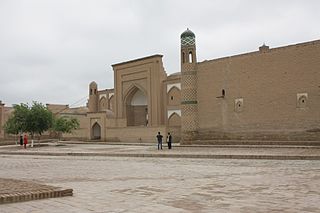
Arab Muhammadhan Madrasah is an architectural monument, part of Itchan Kala, in Khiva, Khorazm Region, Uzbekistan. Today, the monument is located at 27 Zargarlar Street, Itchan-Kala neighborhood.
Yusuf Yasovulboshi Madrasah is an architectural monument in Khiva, Khorezm region. The madrasa was built in 1906, and today it is located at 30, Zargarlar Street, Itchan Kala neighborhood.
Matrasulboy Mirzaboshi Madrasah is a historical site in Khiva, Khorezm region. The madrasah founded in 1905. It is located today at 7 Pahlavon Mahmud street, "Itchan Kala" neighborhood, Khiva. The madrasa was built by Muhammad Matrasulboy Mirzaboshi, the son of poet and composer Muhammad Niyaz Mirzaboshi from Khiva. Matrasulboy Mirzaboshi was born in 1839 and received his primary education from his father, Kamil Khorazmi. He also learned foreign languages from Qazi Abdullah. In particular, he knew the Arabic and Persian languages well, and was familiar with oriental poetry. In 1906, with the support of his father, Matrasulboy founded the first musical score for percussion instruments in Central Asia.
Shergazikhan Madrasah is an architectural monument in Khiva (1719-1726). It is one of the many buildings in the Itchan Kala. According to the sources, it was built in 1719–1726 with the funds and decree of the Uzbek ruler Shergazikhan (Shir Ghazi Khan). It is located in the center of Itchan Kala, at the entrance to the Pahlavon Mahmud complex. The construction of the structure began during Shergozikhan's campaign to Khurasan. Khan's body was buried in a small room built in the west of the madrasah.
Matniyoz Devonbegi Madrasah is an architectural monument in the city of Khiva, Khorazm Region. The madrasah was built in 1871, and today it is located at 19, Pahlavon Mahmud Street, "Itchan Kala" neighborhood of Khiva. The historical object "Itchan Kala" state museum-reserve belongs to the state property based on the right of operational management.
Abdullakhan Madrasah is an architectural monument in Khiva. It is located between Olloquli Khan and Kutlugmurad Inak madrasas in Itchan Kala. It was built in memory of Abdulla Khan by his mother after his death at age 17 in 1855 in a battle with Turkmen Yavmuts. It is located west of the White Mosque.
Abdurasulboy Madrasah is a former madrasa in Khiva, Uzbekistan. It was built according to the order of Mirzabashi Abdurasulboy in 1906. In 1990, it was included in the list of UNESCO World Heritage Sites as a part of Itchan Kala. Currently, it is used as a sozana embroidery workshop and exhibition space.
Yunuskhan Mausoleum is an architectural monument in the city of Khiva, Khorazm Region of the Republic of Uzbekistan. The mausoleum was built in 1559. Today, the mausoleum is located at 13, Pahlavon Mahmud street, Itchan Kala, next to the Pahlavon Mahmud complex.

Khojamberdibi Madrasah is an architectural monument in the city of Khiva, Khorazm Region of the Republic of Uzbekistan. The monument, was originally built in 1688; it was rebuilt in 1834 and got its present appearance. Today, the madrasah is located at 22, Zargarlar street, Itchan Kala neighborhood.
Khorezmshakhs' Madrasah is a cultural heritage object in Uzbekistan. The madrasa was built in 1915. It is located at 51 Mevaston Street, Mevaston neighborhood, Khiva, Khorazm Region. According to the decision of the Cabinet of Ministers of the Republic of Uzbekistan No. 100 dated February 24, 2021 on additional measures for the development of domestic and pilgrimage tourism, the Khorezmshakhs Madrasah was included in the priority restoration program of cultural heritage objects used in tourism routes in 2021–2025. The madrasah is in the possession of the Department of Cultural Heritage of Khorezm region.
Talib Makhsum Madrasah is an architectural monument in Khiva, Khorazm Region, Republic of Uzbekistan. The madrasa was built in 1910 at the expense of Talib Makhsum (Makhdum), a member of khan family of Khiva Khanate. Today, the monument is located at 22 Islam Khoja Street, "Itchan Kala" neighborhood.
Sheikh Kalandar Bobo Complex is an architectural monument in Khiva, Khorazm Region, Republic of Uzbekistan. The construction of the complex began in the 16th century and was completed in 1894. Today the complex is located at 36, Ismailov Street, "New Life" neighborhood.
Polvonqori madrasah is an architectural monument in Khiva, Khorazm Region of the Republic of Uzbekistan. The madrasa was built in 1905 with the funds of Khiva merchant Polvonqori. Today, the monument is located at 24, Polvonqori street, "Kumyaska" neighborhood.
Otajonboy Madrasah is an architectural monument in Khiva, Khorazm Region of the Republic of Uzbekistan. The madrasa was built in 1884 at the expense of Otajonboy, a rich man from Khiva. Today it is located at 23, Pahlavon Mahmud street, "Itchan Kala" neighborhood.
Musa Tora Madrasah is an architectural monument in the city of Khiva, Khorazm Region of the Republic of Uzbekistan. Today, the madrasa is located at 8, Boyochchilar Street, "Itchan Kala" neighborhood, in the central part of Itchan Kala. The monument was built in 1841 at the expense of funds of Musa Tora, the grandson of Olloquli Khan.

Matpanoboy Madrasah is an architectural monument in the city of Khiva, Khorazm Region of the Republic of Uzbekistan. The madrasa was built in 1905 with the funds of Matpanoboy, a rich merchant from Khiva. Khudoibergan Haji and Qalandar Kochim, the masters from Khiva, took part in its construction. Today, the madrasah is located at 25 Zargarlar street, "Itchan Kala" neighborhood.
References
- ↑ "The list of objects that cannot be pledged and mortgaged due to their historical, artistic or other cultural value (Appendix to the decision of the Cabinet of Ministers of Uzbekistan dated 05.12.2014 No. 335)". nrm.uz. Retrieved October 26, 2023.
- ↑ "LAW ON THE APPROVAL OF THE NATIONAL LIST OF REAL ESTATE OBJECTS OF TANGIBLE CULTURAL HERITAGE" . Retrieved October 11, 2023.
- ↑ "Khojash Mahram Madrasah". Xiva (in Uzbek). Retrieved October 24, 2023.
- ↑ OʻzME. 1st Volume. Tashkent, 2000