Rudolf Dölling was a politician in Czechoslovakia and in East Germany. He later trained for military service and was made a Major-General in the National People's Army of East Germany.

Horst Brünner (1929–2008) was deputy Defense Minister in the East German Council of Ministers and chief of the Central Political Administration of the National People's Army.

Heiko Gentzel is a German politician (SPD).

Herbert Scheibe was an East German Generaloberst and, between 1967 and 1972, Commanding general of the country's Airforce.

Jürgen Schmieder is a politician, originally from East Germany, who came to prominence during the months immediately preceding German reunification.
Kurt Wagner was a German soldier and politician who between 1959 and 1967 served as the German Democratic Republic's Deputy Defence Minister.
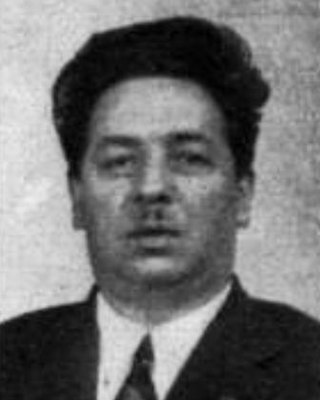
Hugo Gräf was a German Communist politician.
Karl Linke was an officer in the East German army. Between 1952 and 1957 he was head of the country's Military Intelligence service.
Hartmut Sieckmann is a German engineer and regional politician (FDP).
Karl-Hermann Steinberg was an eminent German university lecturer in Chemistry who became a politician (CDU) and briefly, in 1990 a deputy party chairman, and a Government Minister during the final months of the German Democratic Republic.
Eberhard Heinrich was a German journalist.
Ferdinand Jung was a German Communist activist who resisted the Nazi government in the 1930s and spent a good deal of time in prisons and concentration camps. In later life he found himself in the political mainstream in his country's second one-party dictatorship and became a senior politician.

Wolfgang Reinhold was a German Colonel General. He was a Deputy Minister of Defence and, between 1972 and 1989, head of the Kommando LSK/LV of the National People's Army in the German Democratic Republic.
Michael Schumann was a German philosophy professor who became an East German advocate for reform and a politician during the build-up to German reunification. He is widely seen as a pioneer of the Party of Democratic Socialism which superseded the Socialist Unity Party in the German Democratic Republic in 1989/90.
Johannes "Hannes" Hörnig was an East German politician.
Manfred Döring was a Major general (Generalmajor) with the East German Ministry for State Security (Stasi). He also served, between 1987 and 1990, as a commander of the elite motorised rifles regiment, the Felix Dzerzhinsky Guards.
Bertram Wieczorek is a German physician and former politician (CDU).
Heinz Gronau was a communist resistance activist during the Hitler years. He was transferred to Buchenwald concentration camp in 1938. At the concentration camp he became a leading figure in the "International Buchenwald Military Organisation" . He survived the war and in 1946 joined the (semi-militarised) police service in the Soviet occupation zone of Germany. A succession of promotions followed. In 1966 he was promoted to the rank of Major general in the East German Felix Dzerzhinsky Guards Regiment. During the final years of his career he combined his overtly military posting with command of the National Department I at the Ministry for State Security ("Stasi"). The department was a specialist intelligence section of the ministry, tasked with attending to the intelligence needs of the ministry's armed units.
Gerd Schuchardt is an electrical engineer who built his career and reputation in East Germany before 1990 in microprocessor technology and related forward-looking branches of science. He was interested in politics, but had avoided involvement in the country's ruling SED (party) or any of the various so-called "bloc parties" which it controlled. In January 1990, with the winds of political change - somewhat implausibly, as many still thought at the time - blowing across from the Kremlin in Moscow, the party leaders in East Berlin no longer felt able to stand against domestic pressures for a return to democratic politics after more than half a century of one-party dictatorship. Gerd Schuchardt became an activist member of the re-awakening Social Democratic Party. After reunification in October 1990 state-level democratic politics returned to Thuringia: Schuchardt became a leading figure in Thuringian state politics, selected by party members as the Social Democratic Party's lead candidate in the 1994 Thuringian state election. He led his party to what turned out to be its best electoral result in Thuringia to date. In the resulting "Grand coalition" government that ensued he served as vice-minister-president until 1999 under the leadership of Bernhard Vogel (CDU) and as Minister for the Sciences, Research and the Arts.
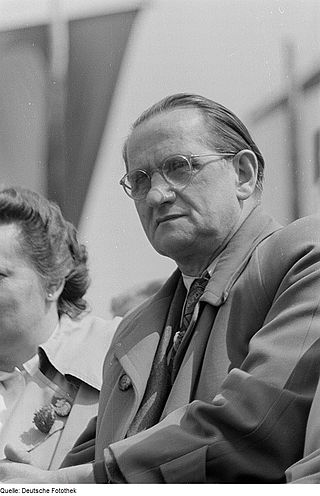
Max Ernst Opitz was a German politician and Holocaust survivor.

 GDR
GDR  NPA
NPA  NPA Land Forces