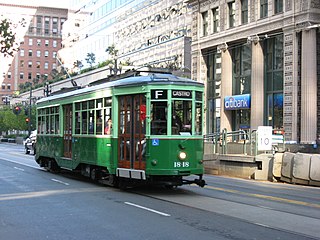
The Peter Witt streetcar was introduced by Cleveland Railway commissioner Peter Witt (1869–1948) who led the transit agency from 1911–1915 and designed a model of streetcar known by his name that was used in many North American cities, most notably in Toronto and Cleveland.

The LM-49 is the Soviet motor four-axle tramcar. The first prototype of this vehicle was built in 1949 at the Leningrad Wagon Repair Plant. "LM" means Leningrad Motor tramcar. These tramcars were utilized in Leningrad itself and some other Soviet cities such as Minsk, Gorky, Novokuznetsk and Magnitogorsk. VARZ produced in total 287 LM-49s for Leningrad and 113 for other cities.
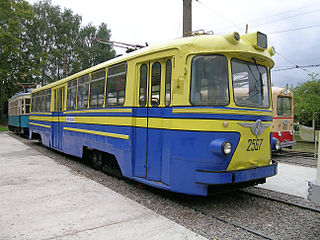
The LM-57 is the Soviet motor four-axle tramcar. First prototype of this vehicle was built in 1957 at the Leningrad Wagon Repair Plant. "LM" means Leningrad Motor tramcar. The VARZ produced nearly 800 LM-57s in 1957–1968.
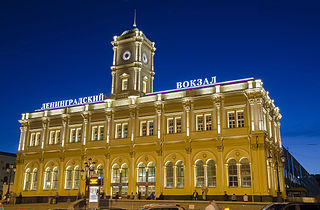
Moscow Leningradsky railway terminal also known as Moscow Passazhirskaya station is the oldest of Moscow's nine railway terminals. Situated on Komsomolskaya Square, the station serves north-western directions, notably Saint Petersburg. International services from the station include Tallinn, Estonia, operated by GoRail, and Helsinki, Finland.

Trams in Saint Petersburg are a major mode of public transit in the city of Saint Petersburg, Russia. Saint Petersburg once had the second-largest tram network in the world, consisting of about 340 kilometres (210 mi) of unduplicated track in the late 1980s. However, since 1995 the tramway network has declined sharply in size as major portions of track were removed, particularly in the city centre. Saint Petersburg lost its record to Melbourne, Australia. While it still had 285 kilometres (177 mi) of length in 2002, by early 2007 the tram network's had declined to just over 220 kilometres (140 mi), and by the 2010s operated on just 205.5 kilometres (127.7 mi) of network.
Administratively, Leningrad Oblast is divided into seventeen districts and a town of oblast significance, Sosnovy Bor. Lomonosovsky District is the only one in Russia which has its administrative center located in the area of a different subject of Russian Federation.

Leningradsky Prospekt, or Leningrad Avenue, is a major arterial avenue in Moscow, Russia. It continues the path of Tverskaya Street and 1st Tverskaya-Yamskaya Street north-west from Belorussky Rail Terminal, and changes the name once again to Leningradskoye Highway past the Sokol metro station. The Highway continues its way to Saint Petersburg via Tver.
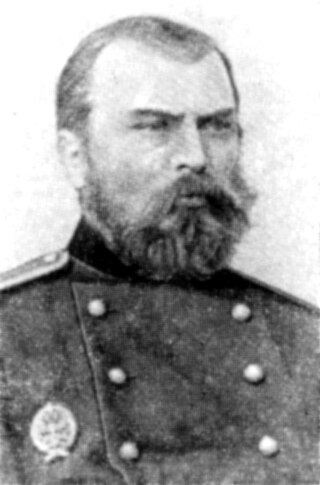
Fyodor Apollonovich Pirotsky, or Fedir Apollonovych Pirotskyy was a Russian engineer of Ukrainian ancestry, inventor of the world's first railway electrification system and electric tram While the commercialization of his inventions in the Russian Empire was relatively slow, Pirotsky is known to have met with Carl Heinrich von Siemens and influenced Siemens' eventual introduction of the first regular electric tram line.

LM-68M is a Soviet-made four axle tram (streetcar). LM stands for «Ленинградский Моторный», which is a motor car made in Leningrad. LM68M is a further development of an LM-68 tram. Production began in 1974 and continued until 1988.

LVS-86 is a model of tramcar developed at the Leningrad Tram Manufacturing Plant in the former Soviet Union. LVS stands for "Leningrad-made articulated tram" in Russian, and 86 refers to the model year. The design was based on the LVS-80 tramcar. 473 LVS-86s were built from 1987 until 1997. LVS-86s currently run in Saint Petersburg and formerly in Arkhangelsk. Tram operation in Arkhangelsk ceased in July 2004.

Vsevolozhsky District is an administrative and municipal district (raion), one of the seventeen in Leningrad Oblast, Russia. It is located in the central northwestern part of the oblast on the Karelian Isthmus and borders with Priozersky District in the north, Kirovsky District in the south, Vyborgsky District in the northwest, Nevsky, Krasnogvardeysky, Kalininsky, Vyborgsky, and Kurortny Districts of the federal city of St. Petersburg in the west, and is washed by Lake Ladoga in the east. The area of the district is 3,036.4 square kilometers (1,172.4 sq mi). Its administrative center is the town of Vsevolozhsk. Population : 153,045 (2010 Census); 131,233 ; 135,318 (1989 Census).
Petersburg Tram Mechanical Factory (PTMF) was one of the leading manufacturers of tramcars in Russia and the CIS-countries located in Saint Petersburg. As the only tram manufacturing plant in Russia for several decades, it was the sole supplier of rolling stock for the tram system in St. Petersburg.
Trams of Putilov plant - wagons of series F (Fonarniy), MS and PS, made by Putilov plant in Saint Petersburg.

Evgeny Mikhailovich Pozdniakov was a Soviet, Russian painter, lived and worked in Leningrad, member of the Leningrad branch of Union of Artists of Russian Federation), regarded as one of representatives of the Leningrad school of painting, most known for his landscape paintings.

Lomonosovsky District is an administrative and municipal district (raion), one of the seventeen in Leningrad Oblast, Russia. It is located in the west of the oblast and borders with Petrodvortsovy and Krasnoselsky Districts of the Federal city of Saint Petersburg in the east, Gatchinsky District in the southeast, Volosovsky District in the south, Kingiseppsky District in the southwest, and the city of oblast significance of Sosnovy Bor in the west. In the north, the district is bounded by the Gulf of Finland. The area of the district is 1,919 square kilometers (741 sq mi). Its administrative center is the town of Lomonosov. Population: 70,245 (2010 Census); 65,297 ; 66,104 (1989 Census).
Semion Lvovich Abugov was a Russian and Soviet painter and art educator, who lived and worked in Leningrad, a member of the Leningrad Union of Artists, professor of the Repin Institute of Arts, regarded as one of the leading art educator of the Leningrad school of painting,

Genrikh Osipovich Graftio was a Russian and Soviet engineer credited as a pioneer of the hydroelectric station construction, as one of the founders of the GOELRO plan, and notable for the construction of the first hydroelectric stations in the Soviet Union, the Volkhov Hydroelectric Station in Volkhov and the Lower Svir Hydroelectric Station in Svirstroy.

The production of urban electric transport is a branch of Russian engineering. Russia has the largest number of trolley (85) and tram systems (86) in the world.

The KTM-5, later known as the 71-605, is a Soviet tram model manufactured by UKVZ. First introduced in 1963, the KTM-5 was mass-produced between 1969 and 1992, with a total of 14,991 tramcars being made. KTM-5 trams were built exclusively for the Soviet Union, and therefore are currently only operating in post-Soviet states.

The 71-628 is a Russian fully low-floor tram model built by Ust-Katav Wagon-Building Plant since 2020. The tram is based on the unrealised 71-625 project and is a development of the partially low-floor 71-623 tram.

