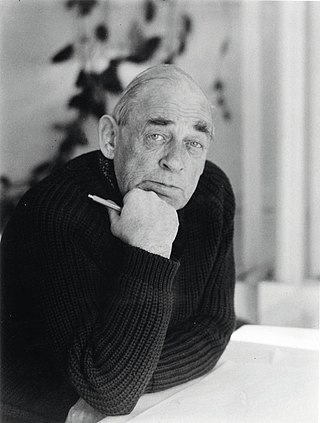
Hugo Alvar Henrik Aalto was a Finnish architect and designer. His work includes architecture, furniture, textiles and glassware, as well as sculptures and paintings. He never regarded himself as an artist, seeing painting and sculpture as "branches of the tree whose trunk is architecture." Aalto's early career ran in parallel with the rapid economic growth and industrialization of Finland during the first half of the 20th century. Many of his clients were industrialists, among them the Ahlström-Gullichsen family, who became his patrons. The span of his career, from the 1920s to the 1970s, is reflected in the styles of his work, ranging from Nordic Classicism of the early work, to a rational International Style Modernism during the 1930s to a more organic modernist style from the 1940s onwards.

Finland attracted over 6.8 million foreign tourists in 2018, with 53 percent coming from other European Union states. In 2017, the value added by tourism was about 4.6 billion euros, or 2.6% of the Finnish GDP, providing approximately 140,200 jobs.

Rovaniemi is a city and municipality of Finland. It is the administrative capital and commercial centre of Finland's northernmost province, Lapland, and its southern part Peräpohjola. The city centre is situated about 6 kilometres south of the Arctic Circle and is between the hills of Ounasvaara and Korkalovaara, at the confluence of the river Kemijoki and its tributary, the Ounasjoki. It is the second-largest city of Northern Finland after Oulu, and, together with the capital city Helsinki, it is one of Finland's most significant tourist cities in terms of foreign tourism.

Lapland is the largest and northernmost region of Finland. The 21 municipalities in the region cooperate in a Regional Council. Lapland borders the region of North Ostrobothnia in the south. It also borders the Gulf of Bothnia, Norrbotten County in Sweden, Troms and Finnmark County in Norway, and Murmansk Oblast and the Republic of Karelia in Russia. Topography varies from vast mires and forests of the South to fells in the North. The Arctic Circle crosses Lapland, so polar phenomena such as the midnight sun and polar night can be viewed in Lapland.
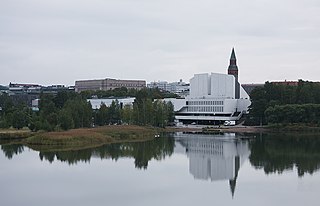
The Finlandia Hall is a congress and event venue in the centre of Helsinki on the Töölönlahti Bay, owned by the City of Helsinki. The building, which was designed by architect Alvar Aalto, was completed in 1971. Every detail in the building is designed by Aalto. The designs were completed in 1962, with building taking place between 1967 and 1971. The Congress Wing was designed in 1970 and built in 1973–1975. In 2011, the building was expanded with new exhibition and meeting facilities. Finlandia Hall is known as the venue for the OSCE Summit held in August 1975, attended by 35 world leaders, including the leader of the Soviet Union, Leonid Brezhnev, and the President of the United States, Gerald Ford.
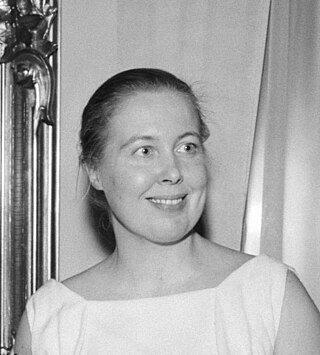
Elissa Aalto was a Finnish architect.

Aalto Center is the administrative and cultural center of the City of Seinäjoki, Finland. It comprises six buildings, designed by Alvar Aalto and mainly completed between 1960 and 1968. The center represents one of Aalto's most important works and is notable in Finland and even internationally as an architectural whole. The wooden plan of the center is in the collections of the Museum of Modern Art in New York.

The Alajärvi city library is the main municipal library of the city of Alajärvi in Finland.

Rovaniemi library is the main municipal public library of the city of Rovaniemi, Finland. The library building is notable for having been designed by the renowned Finnish architect Alvar Aalto.

Rovaniemi city hall is the main municipal administrative building of the city of Rovaniemi, Finland.
The Aalto Centre is an urban area milieu in the city of Rovaniemi, in the Finnish Lapland, designed by the renowned Finnish architect Alvar Aalto, comprising the city's key administrative and cultural buildings.

The Alajärvi administrative centre is a buildings complex in the city of Alajärvi, Finland, comprising the city hall and related offices, health centre, parish hall and other buildings. It was designed by Finnish architect Alvar Aalto, who also designed the adjacent library building.
The Seinäjoki City Hall is the main municipal administrative building in the city of Seinäjoki, Finland. It is notable for having been designed by the renowned Finnish architect Alvar Aalto.

The Seinäjoki City Theatre is the municipal theatre of the city of Seinäjoki, Finland.

Seinäjoki Library is the municipal public library of the city of Seinäjoki, in Finland.
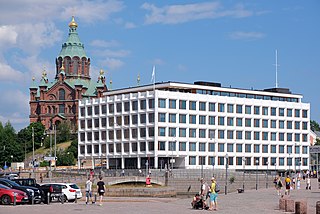
The Stora Enso headquarters is an office building located in the Katajanokka neighbourhood of central Helsinki, Finland, completed in 1962. It is notable for having been designed by the Finnish architect Alvar Aalto.

Rautatalo is an office building in central Helsinki, Finland, completed in 1955, and notable for having been designed by the Finnish architect Alvar Aalto.

The Seinäjoki Civil Guard House is a building located in Seinäjoki, Finland. It is notable for being one of the first public buildings designed entirely by the Finnish architect Alvar Aalto, and is considered one of his breakthrough works.

Villa Tammekann is a residential building located in Tartu, Estonia, notable for being one of few private residences designed by the Finnish architect Alvar Aalto, his first design to be realised outside Finland, and the only one located in Estonia or anywhere in the Baltic states.
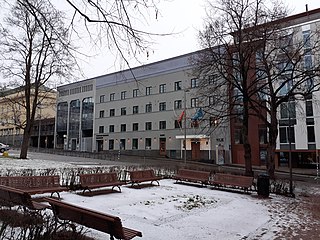
The Defence Corps Building, also known as the Government Building, is a public building located in central Jyväskylä, Finland, designed by the Finnish architect Alvar Aalto, and completed in 1929.


