
Lincoln Cathedral, Lincoln Minster, or the Cathedral Church of the Blessed Virgin Mary of Lincoln and sometimes St Mary's Cathedral, is a church building in Lincoln, Lincolnshire, England. It is a Grade I listed cathedral and is the seat of the Anglican Bishop of Lincoln. Construction commenced in 1072 and continued in several phases throughout the High Middle Ages. Like many of the medieval cathedrals of England, it was built in the Early Gothic style.
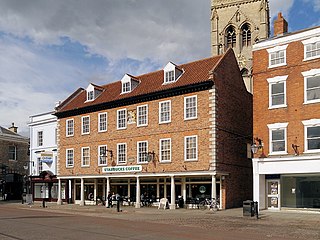
Newark-on-Trent or Newark is a market town and civil parish in the Newark and Sherwood district in Nottinghamshire, England. It is on the River Trent, and was historically a major inland port. The A1 road bypasses the town on the line of the ancient Great North Road. The town's origins are likely to be Roman, as it lies on a major Roman road, the Fosse Way. It grew up round Newark Castle, St Mary Magdalene church and later developed as a centre for the wool and cloth trades.

Frampton is a village and civil parish in the Borough of Boston, Lincolnshire, England. The village is situated approximately 3 miles (5 km) south from the town of Boston and to the east of the A16, which runs along the townlands. The village lies on the edge of one of the great marine creek levees formed during the Bronze Age, 2 to 2.5 miles from the modern salt marsh. The population of the civil parish at the 2011 census was 1,299.

Hemingby is a dispersed village and civil parish in the East Lindsey district of Lincolnshire, England. It is situated approximately 3 miles (5 km) north from the market town of Horncastle and just west from the junction of the B1225 and A158 roads. It is surrounded by the villages of Baumber, Goulceby and West Ashby. The River Bain and its tributary, the Hemingby Beck, flow through the village.

Huttoft is a village in the East Lindsey district of Lincolnshire, England, about 4 miles (6 km) east of the market town of Alford, on the A52 road between Ingoldmells and Sutton-on-Sea. John Betjeman, later England's Poet Laureate, visited Huttoft in the 1940s and devoted a poem to its parish church.

Heighington is a village and civil parish in the North Kesteven district of Lincolnshire, England. It is situated about 4 miles (6 km) south-east of Lincoln.
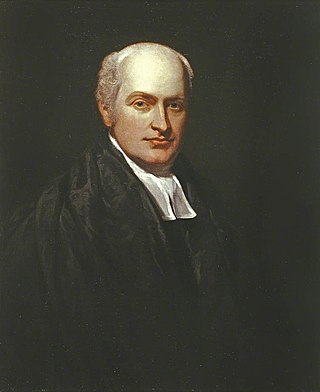
Edward Maltby was an English clergyman of the Church of England. He became Bishop of Durham, controversial for his liberal politics, for his ecumenism, and for the great personal wealth that he amassed.

Goltho is a hamlet in the West Lindsey district of Lincolnshire, England. The population was 157 at the 2011 census. It is situated 1 mile (1.6 km) south-west from Wragby, and 0.5 miles (0.8 km) south from the A158 road.

High Street in Lincoln, England extends from the St Catherine's roundabout and ends approximately 1.2 miles further north at The Strait. The historic High Street has evolved through many changes over its 2000 year history, encompassing Roman roads and settlement, medieval buildings, markets, places of worship, civic buildings, bridges, the arrival of the railways and heavy industry.

Chowbent Chapel is an active Unitarian place of worship in Atherton, Greater Manchester, England. It was built in 1721 and is the oldest place of worship in the town. It is a member of the General Assembly of Unitarian and Free Christian Churches, the umbrella organisation for British Unitarians. The chapel was granted Grade II* Listed status in 1966.

The Upper Brook Street Chapel, also known as the Islamic Academy, the Unitarian Chapel and the Welsh Baptist Chapel, is a former chapel with an attached Sunday School on the east side of Upper Brook Street, Chorlton-on-Medlock, Greater Manchester, England. It is said to be the first neogothic Nonconformist chapel, having been constructed for the British Unitarians between 1837 and 1839, at the very beginning of the reign of Queen Victoria. It was designed by Sir Charles Barry, later architect of the Palace of Westminster.
George Pike England was an English organ builder who was among the most prominent in England during the late 18th and early 19th centuries.

Horsham Unitarian Church is a Unitarian chapel in Horsham in the English county of West Sussex. It was founded in 1719 to serve the large Baptist population of the ancient market town of Horsham—home of radical preacher Matthew Caffyn—and the surrounding area. The chapel's congregation moved towards Unitarian beliefs in the 19th century, but the simple brick building continued to serve worshippers drawn from a wide area of Sussex. It is one of several places of worship which continue to represent Horsham's centuries-old tradition of Protestant Nonconformism, and is the town's second oldest surviving religious building—only St Mary's, the parish church, predates it. English Heritage has listed the chapel at Grade II for its architectural and historical importance.

Langton by Spilsby, sometimes called Langton by Partney, is a village and civil parish in the East Lindsey district of Lincolnshire, England. It is situated approximately 4 miles (6 km) north from the town of Spilsby, Lincolnshire. The civil parish includes the hamlet of Sutterby. From the 2011 census the population is included in the civil parish of Sausthorpe.
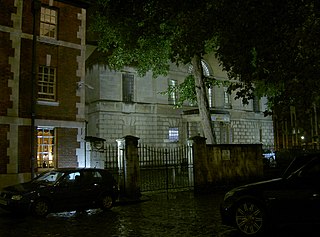
Lewin's Mead Unitarian meeting house is a former Unitarian church in Bristol, England.

William Adams Nicholson (1803–1853) was an English architect who worked in Lincoln and was a founding member of the Royal Institute of British Architects.

Mill Hill Chapel is a Unitarian church in Leeds, West Yorkshire, England. It is a member of the General Assembly of Unitarian and Free Christian Churches, the umbrella organisation for British Unitarians. The building, which stands in the centre of the city on City Square, was granted Grade II* listed status in 1963.

Withham Preceptory, one of the smallest Knights Templar preceptories in England, was founded, before 1164, at Temple Hill, near South Witham, Lincolnshire, and was abandoned in the early 14th century. The site of the former preceptory at Temple Hill, South Witham. It 'has been largely under pasture' since the Knights Templar left in 1308.

The Thomas Cooper Memorial Baptist Church also known as the Thomas Cooper Memorial Church or Chapel, Thomas Cooper Church and TCM Baptist Church, is a Baptist church in the city of Lincoln in Lincolnshire, England. The church is an active church on the High Street of Lincoln and was named in memory of Thomas Cooper.


