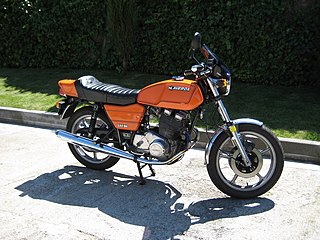
This is a list of motorcycles manufactured by Italian manufacturer Laverda.
During this period Laverda was under the control of the Laverda family. [1]
| Engine Size | Model | Production | Notes | Image |
|---|---|---|---|---|
| 50 cc | Laverdino | 1959- | 50 cc 4 stroke moped. [2] | |
| 49 Mini | 1960- | 49 cc 4 stroke scooter fitted with 2 speed gearbox and single seat. 3 speeds and dualseat fitted from 1962. [3] | ||
| LZ 50 Pippo | 1981-1983 | Zündapp engined 2 stroke. [4] | ||
| LZ 50 Sport | 1981-1983 | Sports version of the Pippo with nose fairing. [4] | ||
| OR 50 Atlas | 1985-1990 | Cagiva/Minarelli engined 2 stroke enduro. [4] | ||
| 60 cc | 60 Mini | 1962- | Enlarged version of the 49 Mini. [3] | |
| 75 cc | Motoleggera 75 | 1949-1960 | Introduced in 1949 with a 75 cc ohv engine, 3 speed gearbox, pressed steel frame and cantilever leaf-spring rear suspension. In 1950 a pressed steel spine frame was fitted and 1952 the model gained a tubular frame, swinging arm rear suspension and a 4 speed gearbox. [5] | |
| Milan Taranto 75 | 1952-1960 | Tuned version of the Motoleggera following success in the Giro d’Italia. [5] | | |
| 100 cc | Tip Sport 100 | 1953-1960 | Enlarged engine capacity version of the Milan Taranto 75. [5] | |
| Tip Tourismo 100 | 1953-1960 | Touring version of the Tip Sport 100. [5] | ||
| 125 cc | 125 Sport | 1965- | Ohv single with near horizontally inclined cylinder. [6] | |
| 125 Trail | 1965- | Off-Road version of the 125 Sport. [6] | ||
| 125CR | 1975-1976 | Off road bike with air cooled Husqvarna 2 stroke engine | ||
| LH 125 | 1976-1979 | Off road bike evolved from the 125CR. 3 generations of the model produced: LH1 - LH3 [7] | ||
| LZ 125 | 1977-1983 | Road bike powered by Zündapp water cooled 2 stroke engine. [4] | | |
| LZ 125 Sport | 1980-1983 | Sports version of LZ 125 with nose fairing. [4] | ||
| LZ 125 Elegant | 1981-1983 | Custom version of the LZ 125 finished in black and gold. [4] | ||
| LZ 125 Elegant | 1981-1983 | Chopper styled version of the LZ 125. [4] | ||
| LB 125 Sport | 1983-1985 | Following the demise of Zündapp, Laverda started to produce its own engines based on the Zündapp design. [4] | ||
| LB 125 Uno | 1984-1986 | Updated version of the sport with square-section frame, 16" front wheel and oil injection. [4] | ||
| LB 125 Lesmo | 1986-1989 | Replacement of the Uno with full fairing and increased power. [4] | ||
| LB 125 Sabbia | 1986-1987 | Touring version with rack and saddlebags. [8] | ||
| 175 cc | LZ 175 | 1977-1983 | Road bike powered by Zündapp water cooled 2 stroke engine. [4] | |
| 200 cc | 200 Bicilindrico | 1962-1976 | 200cc 4 stroke twin | |
| 250 cc | 250 Chott | 1974-1976 | 2 stroke off-road model. [9] | |
| 250 2T/R | 1976-1977 | Revamp of the Chott with more power and a stronger frame. [9] | ||
| 250 Enduro | 1977-1979 | Replacement for the 2T/R using a Husqvarna 2 stroke engine. [10] | ||
| 350 cc | 350 | 1978-1981 | DOHC twin derived from the 500T. Introduced after Italy raised sales tax on motorcycles over 350 cc. | |
| GS Lesmo 350 | 1986 | 350 water cooled v-3 2 stroke prototype that was never put into production. [11] | ||
| 500 cc | 500T | 1977-1978 | Air cooled DOHC 4 stroke parallel twin. Known as Alpino in the UK and Zeta in the US. | |
| 500S | 1978-1983 | Updated and restyled version of the 500T with engine balance shaft. Known as Alpino S in the UK. | | |
| Formula 500 | 1978-1980 | Track racing version of the 500S. | | |
| Montjuic | 1979-1984 | UK only high performance version of the 500S. | | |
| 500SFC | 1981 | Germany only cafe racer version of the 500S. | ||
| 600 cc | OR600 Atlas | 1986-1989 | On/off-road machine using a 571 cc DOHC twin derived from the 500T. [12] | |
| CR600 Cruiser | 1986-1989 | Roadster using the same engine as the OR600 Atlas. | ||
| 650 cc | 650 GT | 1968 | 650 cc SOHC twin | |
| 668 cc | CR668 Cruiser | 1986 | Prototype using a development of the 600 cc twin with oil cooling, Weber-Marelli fuel injection and enlarged to 668 cc. [1] | |
| 750 cc | 750 GT | 1968-1974 | 750 cc SOHC twin | |
| 750 S | 1969-1970 | Sporting version of the 750GT | ||
| 750 SF | 1970-1973 | Developed from the 750S | | |
| SF1 | 1973 | Updated SF | | |
| SF2 | 1974-1975 | Updated SF1 | ||
| SF3 | 1976 | Updated SF2 | ||
| SFC | 1971-1976 | Hand-built production racer developed from the SF | | |
| 750 GTL | 1974-1977 | Updated version of the 750GT | | |
| 1000 cc | 1000 | 1973-1974 | 981 cc DOHC triple | |
| 3C | 1974-1975 | Updated version of the 1000 with disc brakes | | |
| 3CL | 1975-1981 | Updated version of the 3C with cast wheels. US version had left hand gear changed and designated Jarama. | | |
| Jota | 1976-1982 | High performance version of the 1000 cc triple | | |
| 1000 V6 | 1977 | V6 endurance racer. A single machine was built which raced in the 1978 Bol d'Or. The following year endurance racers were limited to four cylinders so the project was terminated. A second machine was built from spares in 1991 ahead of a planned production of 25 road bikes which was subsequently cancelled. [13] | | |
| Jota 120 | 1982-1984 | 120° crankshaft development of the Jota | ||
| RGS | 1982-1985 | Development of the 1000 cc triple with 120° crankshaft | ||
| RGS Executive | 1982-1983 | Upmarket version of the RGA | ||
| RGS Corsa | 1984-1986 | High performance version of the RGS | ||
| RGA | 1984-1985 | Cut down version of the RGS | ||
| RGA Jota | 1984-1985 | Sports styled version of the RGA | ||
| RGA Jota Special | 1984-1985 | High performance version of the RGA produced by the UK importers, Three Cross Motorcycles, the model had an RGS Corsa specification engine | ||
| 1000SFC | 1985-1988 | High performance replacement of the RGS | ||
| 1200 cc | 1200T | 1977-1979 | 1,116 cc triple developed from the 981 cc 3CL. | |
| Jota America | 1977-1979 | US version of the 1200T complying with noise and emission regulations and with left hand gearchange. | ||
| Mirage | 1978-1982 | UK high performance version of the 1200T. | | |
| Formula Mirage | 1981 | Limited production version of the Mirage with higher performance. | ||
| 30th Anniversary 1200 | 1979 | Limited edition to celebrate Laverda's 30th anniversary. Finished in gold and black. | | |
| 1200TS | 1979-1982 | Gran Turismo replacement of the 1200T and Jota America. | ||
| 1200TS Mirage | 1979-1982 | Higher performance version of the 1200TS. | |
From 1968 to 1970 Laverdas were imported to the US by John McCormack under the American Eagle brand. [14]
| Engine Size | Model | Production | Notes | Image |
|---|---|---|---|---|
| 150 cc | 150 Renegade | 1968-1970 | Based on the European 125 Trail with enlarged engine and bodywork by UNICON. [14] | |
| 750 cc | 750 Classic | 1968 | Based on the European 750GT with buckhorn handlebars, restyled seat and tank, [15] crash bars and luggage rack. [14] | |
| 750 Road Sport | 1969-1970 | Updated version of the 750 Classic. [15] | ||
| 750 Super Sport | 1969-1970 | Higher performance version of the Road Sport with higher compression ratio and sportier camshaft. [16] |
Laverda was run as a government backed worker's cooperative. The company name was changed to Nuova Moto Laverda in 1989. [1]
| Engine Size | Model | Production | Notes | Image |
|---|---|---|---|---|
| 125 cc | 125 Toledo | 1989 | Chopper styled water cooled 2 stroke. [17] | |
| 125 GSR | 1989 | Prototype replacement for the 125 Lesmo that never reached production. [18] | ||
| 125 GP racer | 1990 | Disc-valve 2 stroke single racer. Its only appearance was at the 1990 Mugello GP. [19] | ||
| 668 cc | 700 El-Cid | 1989 | Enduro prototype using the 668 cc engine first shown in the CR 668 Cruiser prototype. [1] | |
| 700 Hidalgo | 1989 | Cruiser prototype using the 668 cc engine. [1] | ||
| 650 Sport | 1989 | Fully faired sports bike prototype using the 668 cc engine and an aluminium twin-spar frame designed by Nico Bakker. [1] |
Laverda was taken in 1990 over by Gruppo Zanini, who formed a partnership with the Japanese Shinken corporation. Zanini were in financial trouble by 1983 and the Italian government intervened. [1]
| Engine Size | Model | Production | Notes | Image |
|---|---|---|---|---|
| 125 cc | 125 Navarro | 1990-1992 | Sports bike with the same engine as the Cagiva Freccia. | |
| 668 cc | 650 Sport | 1992-1994 | Fully faired sports bike using the Bakker chassis and an updated version of the 668 cc engine. [1] |
Laverda was taken over by a group of investors headed by Francesco Tognon and the company was renemed I.Mo.La. SpA (International Moto Laverda). Production was moved from Breganze to Zanè, 6 miles to the west. [1]
| Engine Size | Model | Production | Notes | Image |
|---|---|---|---|---|
| 668 cc | 650 Kevlar | 1994 | Limited edition model based on the 650 Sport with Kevlar fairing. [1] | |
| 650 Iniezione Elettronica (I.E.) Sport | 1995-1996 | 650 Sport with new engine casings. [1] | ||
| 650 Sport Formula | 1995-1993 | Updated 650 Sport with hotter camshafts, better brakes and carbon fibre parts. [1] | | |
| 650 Ghost | 1995-1996 | Naked bike with steel trellis frame. [1] | ||
| 650 Ghost Legend | 1995-1996 | Cosmetic upgrade of the Ghost with carbon fibre accessories and orange frame. [1] | ||
| 650 Ghost Strike | 1995-1996 | 650 Ghost with the Bakker aluminium spar frame and a bikini fairing. [1] | | |
| 668 Sport | 1996-2000 | Cosmetic upgrade of the 650 Sport. [1] | | |
| 668 Ghost | 1996-1998 | Updated 650 Ghost. [20] | ||
| 668 Diamante | 1997-1998 | Updated version of the Ghost with half fairing. US models used the Bakker frame, other market were fitted with the steel frame. [1] | ||
| Black Strike 668 Café Racer | 1998 | Limited edition of the Ghost Strike finished in black and without a fairing. [1] | ||
| 750 cc | 750S | 1997-2000 | Updated version of the 668 Sport with a new water cooled engine evolved from the 668. Using the Bakker frame, the model was initial fitted with the half fairing of the Diamante, [1] a full fairing was fitted from 1998. [21] | |
| 750 Diamante | 1998- | Steel frame with half fairing. [1] | ||
| 750 Ghost Strike | 1998- | Bakker frame with bikini fairing. [1] | | |
| 750S Caraneta | 1998- | Bakker frame with full fairing. [1] | ||
| 750 Sport Formula | 1998-1999 | Higher performance version of the 750S. [1] | ||
| 750 Sport Formula II | 1999- | Updated version of the 750 Sport Formula. [1] | | |
| PRC 750 Cup | 1999 | Prototype production racer which was a stripped down version of the 750S. [1] | ||
| 750 Super Sport | 2000-2001 | Updated version of the 750S fitted with the Sport Formula engine. [1] | ||
| 750 Black Strike | 2000-2001 | Updated version of the 668 Black Strike fitted with the 750 Sport Formula engine. [1] | ||
| 790 cc | TTS800 | 1998 | Enduro prototype with an enlarged 790 cc engine. [1] | |
| 1000 cc | 1000 Super Sport | 1999 | Prototype 1000 cc 12 valve triple. [20] The engine design was later used as the basis for the engine in the 900 cc Benelli Tornado Tre. [22] |
Aprilia purchased Laverda in 2000. Whilst there was some production of Laverda motorcycles, the brand was mainly used on brought in scoters and quads. Aprilia was purchased in 2004 by Piaggio who dropped the brand. [23]
| Engine Size | Model | Production | Notes | Image |
|---|---|---|---|---|
| 650 cc | 650 Lynx | 2000 | Prototype using a Suzuki SV650 engine. [1] | |
| 1000 cc | SFC 1000 | 2002 | Prototype using an Aprilia RSV Mille derived engine. [24] | |

Aprilia is an Italian motorcycle manufacturer founded immediately after World War II in Noale, Italy, by Alberto Beggio. The company started as a manufacturer of bicycles and moved on to manufacture scooters and small-capacity motorcycles. In more recent times Aprilia has produced large sportbikes such as the 1,000 cc V-twin RSV Mille and the V4 RSV4.
Moto Guzzi is an Italian motorcycle manufacturer and the oldest European manufacturer in continuous motorcycle production.
FB Mondial is a motorcycle manufacturer, founded in 1929, in Milan, Italy. They are best known for their domination of Motorcycle World Championships between 1949 and 1957. The firm produced some of the most advanced and successful Grand Prix road racers of the time, winning five rider and five manufacturer World Championships in that short period.

Laverda was an Italian manufacturer of high performance motorcycles. The motorcycles in their day gained a reputation for being robust and innovative.

SV.VM was an Italian motorcycle manufacturer founded in 1971 by Piero Sironi and Fausto Vergani. Based in Milan, SWM manufactured Observed Trials, Enduro, Motocross and off-road motorcycles in the 1970s and 1980s. They started with small capacity Sachs engined enduro bikes and began making Rotax engined trials bikes in 1977. The other main manufacturers at this time included Fantic Motor, Bultaco and Montesa.
Michel Fabrizio is a former professional motorcycle road racer. From 2006 to 2015, he raced in the Superbike World Championship. In 2021 he competed in the Supersport World Championship aboard a Kawasaki ZX-6R, before retiring on September 26 from motorsport as a sign of protest after Dean Berta Viñales fatal crash in Jerez.
Jeremy McWilliams is a motorcycle road racer from Northern Ireland. McWilliams became ineligible for mainstream racing after the 2014 season due to his age exceeding the 50-year-old cutoff point, but has continued to ride occasionally in fringe events not controlled by the FIM.
Husqvarna Motorcycles GmbH is an Austrian company which designs, engineers, manufactures and distributes motocross, enduro, supermoto and street motorcycles.
The Aprilia RSV4 is a super bike manufactured by Aprilia. The RSV4 is Aprilia's flagship model. Aprilia offers two models of the bike: the RSV4 Factory and RSV4 R limited edition. For 2016 it is offered in two models the RSV4 RR and RSV4 RF. The 2016 updated bike was made to take advantage of and comply with that year's Superbike rules which allow fewer modifications for production bikes. It has more power, is lighter, and has improved handling and electronics.
The Aprilia RS4 125 is a 125 cc class sportbike manufactured by Italian motorcycle firm Aprilia. The four-stroke RS4 125 replaces the extremely popular RS125 two-stroke race replica in Aprilia's lineup. The bike is based on the four-stroke version of the Derbi GPR125.
The John Player Norton, also referred to as JPN and JPS Norton, were a series of Formula 750 racers manufactured by Norton Motorcycle Company from 1972 to 1974 and sponsored by cigarette manufacturer John Player. The engine for these machines was derived from the unit used in the Norton Commando, which was a development of the 1948 Bert Hopwood designed 500 cc Dominator. The lack of power from the engine, compared with other manufacturers, led designer and rider Peter Williams to a adopt a radical approach to chassis design. Riders of the bikes included Williams, Phil Read, Tony Rutter, Mick Grant, John Cooper, Dave Aldana and Dave Croxford.
The Benelli 254, originally known as the Benelli 250 Quatro, is a 250 cc (15 cu in) inline four motorcycle produced by the Italian manufacturer Benelli from 1977 to 1984. It was at the time the smallest production four. The model was also badge engineered as the Moto Guzzi 254.
The Benelli 650 Tornado is a 650 cc (40 cu in) parallel twin motorcycle produced by the Italian manufacturer Benelli from 1970 to 1975. The model was intended to compete with the British big twins in the lucrative American Market but by the time the model was introduced the market had changed following the launch of multi-cylinder bikes by the Japanese manufacturers, most notably the Honda CB750. The Tornado was also badge engineered as a Motobi, Benelli's sister company. Around 3,000 Tornados were produced with half being sold in Italy.
The Laverda 1000 is a series of 981 cc (59.9 cu in) air cooled DOHC triple motorcycles produced by the Italian manufacturer Laverda between 1973 and 1988. The high-performance variant, the Jota, was the fastest production motorcycle from 1976 to 1981. Approximately 7,100 triples of the various models were produced.
The Laverda 650GT is an 654 cc (39.9 cu in) air cooled SOHC 4 stroke parallel twin motorcycle produced by the Italian manufacturer Laverda in 1968. Only around 50 machines were produced before it was superseded by an enlarged 750 cc version. The engine design drew heavily from the Honda CB77.
The Laverda 750 is a 744 cc (45.4 cu in) air cooled SOHC 4 stroke parallel twin motorcycle produced by the Italian manufacturer Laverda from 1968 to 1976. Developed from the company's 650, the engine's design drew heavily from the Honda CB77. Around 18,000 machines were produced.
The Laverda 750SFC is a hand-built 744 cc (45.4 cu in) air cooled SOHC 4 stroke parallel twin production racing motorcycle produced by the Italian manufacturer Laverda from 1971-1976. It was developed from the company's 750SF and drew from the racers used at the 1970 Bol d'Or. Finished in orange with a distinctive half-fairing, the machine was made in batches, with each batch identified by the frame number range. In total 549 SFCs were manufactured.
The Laverda 350/500 is a series of 345 cc (21.1 cu in) and 497 cc (30.3 cu in) air cooled DOHC 4 stroke parallel twin motorcycles produced by the Italian manufacturer Laverda from 1977 to 1983. The engine was used as the basis of future 650, 650, 668 and 750 cc models. Around 5,000 of these models were produced in total.
The Laverda 200 Bicilindrico is a 199.5 cc (12.17 cu in) air cooled ohv 4 stroke parallel twin motorcycle produced by the Italian manufacturer Laverda from 1962 to 1976. It was the company's first twin machine and the time of introduction it was Laverda's largest displacement model. Around 4,500 machines were produced, 2,000 of which were sold on the home market. Most of the remainder were exported to the UK and US as the 200 Gemini. The 14 year production run made it one of Laverda's longest running models.