
Duke of Marlborough is a title in the Peerage of England. It was created by Queen Anne in 1702 for John Churchill, 1st Earl of Marlborough (1650–1722), the noted military leader. In historical texts, unqualified use of the title typically refers to the 1st Duke. The name of the dukedom refers to Marlborough in Wiltshire.
Earl of Denbigh is a title in the Peerage of England. It was created in 1622 for William Feilding, 1st Viscount Feilding, a courtier, admiral, adventurer, and brother-in-law of the powerful Duke of Buckingham. The title is named after the Welsh town of Denbigh in the county of Denbighshire. Since the time of the third earl (1640), the Earl of Denbigh has also held the title of Earl of Desmond, in the Peerage of Ireland.
Earl of Guilford is a title that has been created three times in history. The title was created for the first time in the Peerage of England in 1660 for Elizabeth Boyle. She was a daughter of William Feilding, 1st Earl of Denbigh, and the widow of Lewis Boyle, 1st Viscount Boyle of Kinalmeaky. The title was for life only and became extinct on her death in 1667. The title was created for a second time in the Peerage of England in 1674 for John Maitland, 1st Duke of Lauderdale. For more information on this creation, see the article on him as well as the Earl of Lauderdale.

Richard Lumley, 1st Earl of Scarbrough, was an English soldier and statesman best known for his role in the Glorious Revolution.
This is a list of people who served as Lord Lieutenant of Sussex. From 1677 until 1974, all Lord Lieutenants were also Custos Rotulorum of Sussex.
This is an incomplete list of people who have served as Lord Lieutenant of Warwickshire. Since 1728, all Lord Lieutenants have also been Custos Rotulorum of Warwickshire.
This is a list of people who have served as Custos Rotulorum of Somerset.
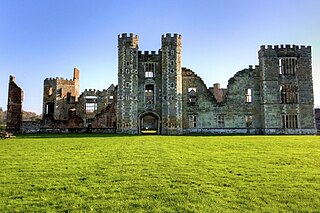
Anthony-Maria Browne was an English peer during the Tudor and Stuart period.
Gentleman of the Bedchamber was a title in the royal household of the Kingdom of England from the 11th century, later used also in the Kingdom of Great Britain. A Lord of the Bedchamber was a courtier in the Royal Household; the term being first used in 1718. The duties of the Lords and Gentleman of the Bedchamber originally consisted of assisting the monarch with dressing, waiting on him when he ate, guarding access to his bedchamber and closet and providing companionship. Such functions became less important over time, but provided proximity to the monarch; the holders were thus trusted confidants and often extremely powerful. The offices were in the gift of The Crown and were originally sworn by Royal Warrant directed to the Lord Chamberlain.
Baptist Noel, 3rd Viscount Campden was an English politician. He was Lord Lieutenant of Rutland, Custos Rotulorum of Rutland and the Member of Parliament for Rutland.
Villiers is an aristocratic family in the United Kingdom. Over time, various members of the Villiers family were made knights, baronets, and peers. Peerages held by the Villiers family include the dukedoms of Buckingham (1623–1687) and Cleveland (1670–1709), as well as the earldoms of Anglesey (1623–1661), Jersey, and Clarendon. Perhaps the most prominent members of the family were those who received the two dukedoms: George Villiers, 1st Duke of Buckingham (1592–1628) rose to fame and influence as favourite of King James I of England, while Barbara Villiers, Duchess of Cleveland (1640–1709) became a mistress of King Charles II of England, by whom she had five children.

Anne Finch, Countess of Nottingham, formerly Anne Hatton, was the second wife of Daniel Finch, 2nd Earl of Nottingham, and the mother of Daniel Finch, 8th Earl of Winchilsea and 3rd Earl of Nottingham.
