 | This article needs additional citations for verification .(May 2013) |
This is a list of battles involving the Kingdom of Castile , organized by date.
| | This article needs additional citations for verification .(May 2013) |
This is a list of battles involving the Kingdom of Castile , organized by date.

Year 1309 (MCCCIX) was a common year starting on Wednesday of the Julian calendar.

The Battle of Río Salado also known as the Battle of Tarifa was a battle of the armies of King Afonso IV of Portugal and King Alfonso XI of Castile against those of Sultan Abu al-Hasan 'Ali of the Marinid dynasty and Yusuf I of Granada.
This is a timeline of notable events during the period of Muslim presence in Iberia, starting with the Umayyad conquest in the 8th century.

Abu Abdullah Muhammad ibn Yusuf ibn Nasr, also known as Ibn al-Ahmar and by his honorific al-Ghalib billah, was the first ruler of the Emirate of Granada, the last independent Muslim state on the Iberian Peninsula, and the founder of its ruling Nasrid dynasty. He lived during a time when Iberia's Christian kingdoms—especially Portugal, Castile and Aragon—were expanding at the expense of the Islamic territory in Iberia, called Al-Andalus. Muhammad ibn Yusuf took power in his native Arjona in 1232 when he rebelled against the de facto leader of Al-Andalus, Ibn Hud. During this rebellion, he was able to take control of Córdoba and Seville briefly, before he lost both cities to Ibn Hud. Forced to acknowledge Ibn Hud's suzerainty, Muhammad was able to retain Arjona and Jaén. In 1236, he betrayed Ibn Hud by helping Ferdinand III of Castile take Córdoba. In the years that followed, Muhammad was able to gain control over southern cities, including Granada (1237), Almería (1238), and Málaga (1239). In 1244, he lost Arjona to Castile. Two years later, in 1246, he agreed to surrender Jaén and accept Ferdinand's overlordship in exchange for a 20-year truce.
Muhammad II was the second Nasrid ruler of the Emirate of Granada in Al-Andalus on the Iberian Peninsula, succeeding his father, Muhammad I. Already experienced in matters of state when he ascended the throne, he continued his father's policy of maintaining independence in the face of Granada's larger neighbours, the Christian kingdom of Castile and the Muslim Marinid state of Morocco, as well as an internal rebellion by his family's former allies, the Banu Ashqilula.
Nasr, full name Abu al-Juyush Nasr ibn Muhammad, was the fourth Nasrid ruler of the Emirate of Granada from 14 March 1309 until his abdication on 8 February 1314. He was the son of Muhammad II al-Faqih and Shams al-Duha. He ascended the throne after his brother Muhammad III was dethroned in a palace revolution. At the time of his accession, Granada faced a three-front war against Castile, Aragon and the Marinid Sultanate, triggered by his predecessor's foreign policy. He made peace with the Marinids in September 1309, ceding to them the African port of Ceuta, which had already been captured, as well as Algeciras and Ronda in Europe. Granada lost Gibraltar to a Castilian siege in September, but successfully defended Algeciras until it was given to the Marinids, who continued its defense until the siege was abandoned in January 1310. James II of Aragon sued for peace after Granadan defenders defeated the Aragonese siege of Almería in December 1309, withdrawing his forces and leaving the Emirate's territories by January. In the ensuing treaty, Nasr agreed to pay tributes and indemnities to Ferdinand IV of Castile and yield some border towns in exchange for seven years of peace.

Abu al-Hajjaj Yusuf ibn Ismail, known by the regnal name al-Muayyad billah, was the seventh Nasrid ruler of the Emirate of Granada on the Iberian Peninsula. The third son of Ismail I, he was Sultan between 1333 and 1354, after his brother Muhammad IV was assassinated.

The Emirate of Granada, also known as the Nasrid Kingdom of Granada, was an Islamic polity in the southern Iberian Peninsula during the Late Middle Ages, ruled by the Nasrid dynasty. It was the last independent Muslim state in Western Europe.

The Granada War was a series of military campaigns between 1482 and 1492 during the reign of the Catholic Monarchs, Isabella I of Castile and Ferdinand II of Aragon, against the Nasrid dynasty's Emirate of Granada. It ended with the defeat of Granada and its annexation by Castile, ending the last remnant of Islamic rule on the Iberian peninsula.
Muhammad VII, reigned 3 October 1392 – 13 May 1408, was the twelfth Nasrid ruler of the Muslim Emirate of Granada in Al-Andalus on the Iberian Peninsula. He was the son of Yusuf II and grandson of Muhammad V. He came to the throne upon the death of his father. In 1394, he defeated an invasion by the Order of Alcántara. This nearly escalated to a wider war, but Muhammad VII and Henry III of Castile were able to restore peace.

The Battle of Collejares also known as the Battle of los Collejares was a battle of the Spanish Reconquista that took place in 1406 at Collejares nearby the towns of Úbeda and Baeza in Granada, Spain. The battle was fought between the Kingdom of Castile, whose forces were commanded by Henry III of Castile, and the Emirate of Granada, whose troops were commanded by Sultan Muhammad VII.

The siege of Algeciras was a battle of the Spanish Reconquista that occurred between July 1309 and January 1310. The battle was fought between the forces of the Kingdom of Castile, commanded by King Ferdinand IV of Castile and his vassals, and the Emirate of Granada commanded by Sultan Abu'l-Juyush Nasr. The battle resulted in a humiliating defeat for the Kingdom of Castile whose army was obliged to lift the siege due to the atrocious conditions of life in the Castilian camp and the desertion of Infante John of Castile. The battle marked one of the many battles fought at Algeciras where the Christian forces would try to take the city unsuccessfully from the Muslims.
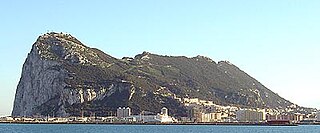
The first siege of Gibraltar was a battle of the Spanish Reconquista that took place in 1309. The battle pitted the forces of the Crown of Castile under the command of Juan Núñez II de Lara and Alonso Pérez de Guzmán, against the forces of the Emirate of Granada who were under the command of Sultan Muhammed III and his brother, Abu'l-Juyush Nasr.
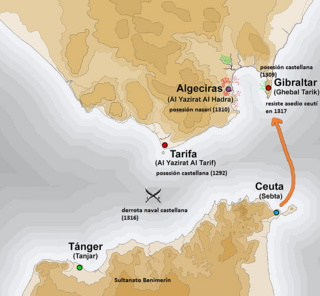
The second siege of Gibraltar was an abortive attempt in 1316 by the forces of the Azafid Ceuta and the Nasrid Emirate of Granada to recapture Gibraltar, which had fallen to the forces of Ferdinand IV of Castile in 1309.
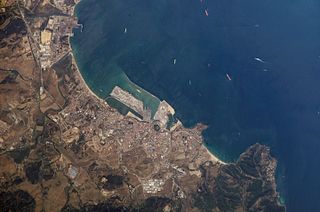
The siege of Algeciras (1342–1344) was undertaken during the Reconquest of Spain by the Castillian forces of Alfonso XI assisted by the fleets of the Kingdom of Aragon and the Republic of Genoa. The objective was to capture the Muslim city of Al-Jazeera Al-Khadra, called Algeciras by Christians. The city was the capital and the main port of the European territory of the Marinid Empire.

The siege of Jaén was one of many sieges on the city during the long Spanish Reconquista. The siege, which was carried out by the combined allied forces of the Kingdom of Castile and the Taifa of Baeza, commanded by Ferdinand III of Castile and Abd Allah Ibn Muhammad Al-Bayyasi of Baeza against the defending Taifa of Jayyān (جيان) whose forces were commanded by the notable Christian knight, Álvaro Pérez de Castro. The battle resulted in a Jayyānese victory as the Castilian forces did not capture the city. Areas around the city were totally devastated as a result of the siege. The siege occurred as a part of Ferdinand III's first campaign which occurred roughly from 1224 to 1230 and was undertaken before the siege of Andújar that same year.

The siege of Jaén was one of many sieges on that city during the Spanish Reconquista. The siege was carried out from 24 June through September, 1230 by forces of the Kingdom of Castile commanded by Ferdinand III of Castile against the defending Taifa of Jayyān (جيان). The battle resulted in a Jayyānese victory after the Castilian withdrawal and abandonment of the siege immediately following the death of King Alfonso IX of León.

The siege of Jaén was the final siege on the city during the Spanish Reconquista. The siege, was carried out from 1245 through 28 February 1246 by forces of the Kingdom of Castile and the Order of Santiago commanded by Ferdinand III of Castile and the Grand Master of the Order of Santiago, Pelayo Pérez Correa, against a combined defending force of the local Taifa of Jaén (جيان) and the Emirate of Granada under Muhammad I. The battle resulted in a Castilian victory with the city of Jaén being handed over to the Kingdom of Castile and Leon after the signing of the Treaty of Jaén.
The Battle of Guadix was an engagement between Castilian and Granadan forces at Guadix, then in the Emirate of Granada and now in Spain, that took place in January 1362. The Castilians were routed by forces loyal to Muhammed VI, Sultan of Granada. Despite his victory, Muhammed VI soon after sued for peace. He was murdered on the orders of King Peter of Castile.
The siege of Almería was an unsuccessful attempt by Aragon to capture the city of Almería from the Emirate of Granada in 1309. Almería, a Mediterranean port in the southeast of the emirate, was the initial Aragonese target in a joint Aragonese-Castilian campaign aimed at conquering Granada. The Aragonese troops led by their King James II arrived on 11 August, blockading the city and employing siege engines. The city, led by governor Abu Maydan Shuayb and naval commander Abu al-Hasan al-Randahi, prepared for the siege by strengthening its defenses and stockpiling food. Throughout the siege, both sides exchanged shots from siege engines and engaged in fields battles and skirmishes with varying results. James ordered multiple unsuccessful assaults. A Granadan relief column under Uthman ibn Abi al-Ula arrived nearby in September and harassed the besiegers.
