Related Research Articles

John William Strutt, 3rd Baron Rayleigh, was a British mathematician and physicist who made extensive contributions to science. He spent all of his academic career at the University of Cambridge. Among many honours, he received the 1904 Nobel Prize in Physics "for his investigations of the densities of the most important gases and for his discovery of argon in connection with these studies." He served as president of the Royal Society from 1905 to 1908 and as chancellor of the University of Cambridge from 1908 to 1919.
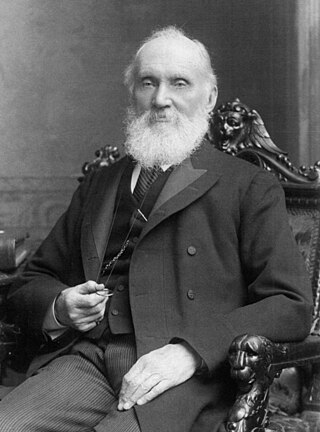
William Thomson, 1st Baron Kelvin, was a British mathematician, mathematical physicist and engineer born in Belfast. Professor of Natural Philosophy at the University of Glasgow for 53 years, he did important work in the mathematical analysis of electricity and formulation of the first and second laws of thermodynamics, and did much to unify the emerging discipline of physics in its contemporary form. He received the Royal Society's Copley Medal in 1883, was its president 1890–1895, and in 1892 was the first British scientist to be elevated to the House of Lords.

James Prescott Joule was an English physicist, mathematician and brewer, born in Salford, Lancashire. Joule studied the nature of heat, and discovered its relationship to mechanical work. This led to the law of conservation of energy, which in turn led to the development of the first law of thermodynamics. The SI derived unit of energy, the joule, is named after him.

Mare Humorum is a lunar mare. The impact basin it is located in is 425 kilometers across.

Montes Haemus is a mountain range that forms the southwestern edge of the Mare Serenitatis basin on the Moon. They form a less prominent mirror image of the Montes Apenninus range to the west, and curve up to nearly join at the northern end. The eastern edge terminates with the Promontorium Archerusia, to the northwest of the crater Plinius. This end reaches a gap where the Mare Serenitatis to the north joins the Mare Tranquillitatis to the south.
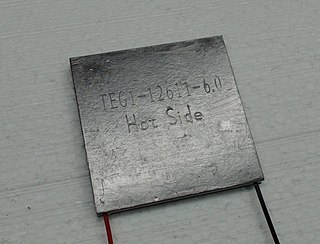
The thermoelectric effect is the direct conversion of temperature differences to electric voltage and vice versa via a thermocouple. A thermoelectric device creates a voltage when there is a different temperature on each side. Conversely, when a voltage is applied to it, heat is transferred from one side to the other, creating a temperature difference. At the atomic scale, an applied temperature gradient causes charge carriers in the material to diffuse from the hot side to the cold side.
This is a list of scientific phenomena and concepts named after people. For other lists of eponyms, see eponym.
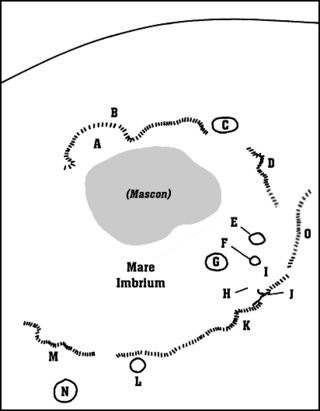
Montes Jura is a mountain range in the northwest part of the near side of the Moon. The selenographic coordinates of this range are 47.1° N 34.0° W. It has a diameter of 422 km, with mountains rising to approximately 3800m above the level of Sinus Iridum. They were named after the Jura Mountains in eastern France / western Switzerland.
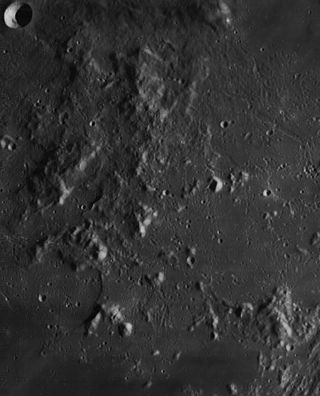
Montes Archimedes is a mountain range on the Moon. It is named after the nearby crater Archimedes, which in turn is named after the ancient Greek mathematician Archimedes.
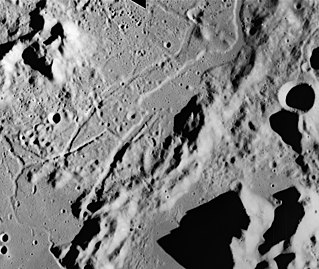
Rimae Fresnel is a 90km-long arcuate escarpment on the Moon at 28.0°N 4.0°E. Both the escarpment and the nearby Promontorium Fresnel were named after the French physicist Augustin-Jean Fresnel.

Rupes Kelvin is an escarpment near Promontorium Kelvin on the near side of the Moon, at 27.3°S 33.1°W. It is 86 km long. It takes its name from Promontorium Kelvin, which was named after the Irish scientist, physicist and engineer William Thomson, 1st Baron Kelvin.
11573 Helmholtz, provisional designation 1993 SK3, is a Zhongguo asteroid from the outermost region of the asteroid belt, approximately 13 kilometers (8 miles) in diameter. It was discovered on 20 September 1993, by German astronomers Freimut Börngen and Lutz Schmadel at the Karl Schwarzschild Observatory in Tautenburg, Germany. It is one of few asteroids located in the 2:1 resonance with Jupiter. The asteroid was named for German physicist Hermann von Helmholtz.

Promontorium Laplace is a raised mountainous cape situated at the end of Montes Jura in Mare Imbrium on the near side of the Moon. Its selenographic coordinates are 46.8° N, 25.5° W and it is 2600 meters high. It forms the northeast boundary of the bay of Sinus Iridum.
Promontorium Heraclides is a raised mountainous cape situated in Mare Imbrium on the near side of the Moon. Its selenographic coordinates are 40.3° N, 33.2° W and it is 50 km in diameter. It marks the western edge of the bay of Sinus Iridum. Promontorium Heraclides is named after Heraclides Ponticus, a Greek philosopher and astronomer. The Soviet lunar probe Luna 17 landed about 30 km from Promontorium Heraclides on November 17, 1970. The land form is depicted as the face of a woman looking across Sinus Iridum in a 1679 lunar map by Giovanni Domenico Cassini; this depiction, of disputed origin, is known as the "Moon Maiden".

Promontorium Agarum is a raised mountainous cape protruding into the southeast of Mare Crisium on the near side of the Moon. It protrudes into the mare up to 40 km and its width is about 80 km. Its coordinates are 13.87°N 65.73°E.

Poona is an impact crater in Chryse Planitia in the Lunae Palus quadrangle of Mars. It measures 19.87 kilometers in diameter and was named after the city of Pune, Maharashtra, India.

Promontorium Taenarium is a headland on the near side of the Moon. It is located in the eastern end of Mare Nubium. Its length is about 70 km. Its coordinates are 18°39′0″S7°28′24″W.

Promontorium Archerusia is a headland on the near side of the Moon. It separates the lunar mares of Mare Serenitatis and Mare Tranquilitatis. Its coordinates are 16.8°N 21.9°E.

Promontorium Fresnel is a headland on the near side of the Moon. It is located at the northern end of the Montes Apenninus and separates the lunar mares of Mare Serenitatis and Mare Imbrium. Just west of the mountainous cape is Rimae Fresnel. Both features were named after the French physicist Augustin-Jean Fresnel. Its coordinates are 28.63°N 4.75°E.

Promontorium Kelvin is a headland on the near side of the Moon. It is located in the southeast of the Mare Humorum. It is close to Rupes Kelvin. Its length is about 45 km. Its coordinates are 26.95°S 33.45°W. It was named after the British scientist, physicist and engineer William Thomson, 1st Baron Kelvin.
References
- ↑ "Explain Origin of All County Towns". Turtle Mountain Star. September 5, 1940. p. 7. Retrieved 2 May 2015.
- ↑ "Promontorium Kelvin". Gazetteer of Planetary Nomenclature. USGS Astrogeology Research Program., accessed September 23, 2017
- ↑ "Promontorium Kelvin". Gazetteer of Planetary Nomenclature. USGS Astrogeology Research Program.
- ↑ Sessional Papers of the Dominion of Canada. Vol. 53. Parliament of Canada. 1918. p. 133. Retrieved 2013-10-31.