Related Research Articles

Shropshire is a landlocked historic county in the West Midlands region of England. It is bordered by Wales to the west and the English counties of Cheshire to the north, Staffordshire to the east, Worcestershire to the southeast, and Herefordshire to the south. A unitary authority of the same name was created in 2009, taking over from the previous county council and five district councils, now governed by Shropshire Council. The borough of Telford and Wrekin has been a separate unitary authority since 1998, but remains part of the ceremonial county.
Shropshire was established during the division of Saxon Mercia into shires in the 10th century. It is first mentioned in 1006. After the Norman Conquest it experienced significant development, following the granting of the principal estates of the county to eminent Normans, such as Roger De Montgomery and his son Robert de Bellême.

Ludlow is a constituency represented in the House of Commons of the UK Parliament since 2005 by Philip Dunne, a Conservative.
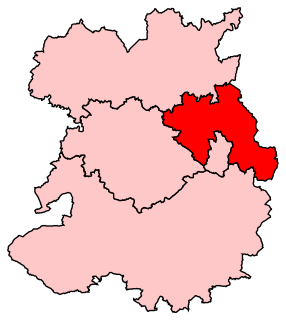
The Wrekin is a constituency in the House of Commons of the British Parliament, located in the county of Shropshire in the West Midlands of England. It has existed continuously since its creation by the Representation of the People Act 1918, and is named after a prominent landmark hill in the area, The Wrekin. The constituency has periodically swung back and forth between the Labour and Conservative parties since the 1920s, and has been held since 2005 by a Conservative MP, Mark Pritchard.
Shropshire's Geology is very diverse and most geological periods of time, and most rock types, can be found within the county. There is also a large amount of mineral wealth in the county, including lead, barytes, limestone, coal and iron, which helped the area develop the industrial revolution west of Clee Hill and, later, in the Ironbridge Gorge area. Quarrying is still active, with limestone for cement manufacture and concrete aggregate, sandstone, greywacke and dolerite for road aggregate, and sand and gravel for aggregate and drainage filters. Groundwater is an equally important economic resource.

The Diocese of Hereford is a Church of England diocese based in Hereford, covering Herefordshire, southern Shropshire and a few parishes within Worcestershire in England, and a few parishes within Powys and Monmouthshire in Wales. The cathedral is Hereford Cathedral and the bishop is the Bishop of Hereford. The diocese is one of the oldest in England and is part of the Province of Canterbury.
The Shropshire County Football League, currently known as the Salop Leisure Football League for sponsorship reasons, is an English football league. The league has two divisions, which stand at levels 11 and 12 of the English football league system).
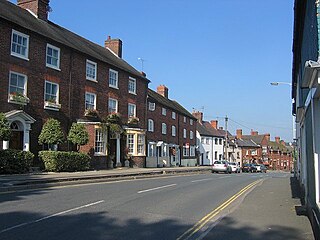
The Jack Mytton Way is a long distance footpath and bridleway for horseriders, hillwalkers and mountain bikers in mid and south Shropshire, England. It typically takes a week to ride on horseback.
This is a list of sheriffs and high sheriffs of Shropshire
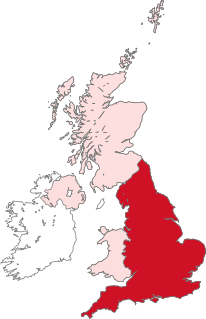
This is an as yet incomplete list of listed buildings in England, which are the majority of the listed buildings of the United Kingdom.
The Archdeacon of Salop is a senior ecclesiastical officer in the Church of England Diocese of Lichfield. The incumbent is Paul Thomas.

Shropshire is a county in the West Midlands region of England. In 2009 the historic county was divided into two unitary authorities, Shropshire and Telford and Wrekin. These two unitary authorities constitute the ceremonial county of Shropshire, which forms the basis for this list. The county's economy is largely agricultural. Until the creation of the new town of Telford in the 1960s, the largest town was its county town, Shrewsbury. Shropshire is the largest entirely inland county in England. Its churches are mainly constructed from local stone. This is mainly sandstone, although there are limestone deposits in the northeast of the county. The Triassic sandstone from quarries at Grinshill is considered to be one of the finest types of stone in the county for building.

Munslow is a hundred of Shropshire, England. It was formed with the amalgamation of the Anglo-Saxon hundreds of Patton and Culvestan during the reign of Henry I. Hundreds in England had various judicial, fiscal and other local government functions, their importance gradually declining from the end of manorialism to the latter part of the 19th century.
The Marches Local Enterprise Partnership is one of 39 Local Enterprise Partnerships set up by the UK Government to drive economic development in England.

Shropshire is a district with the status of a unitary authority in the ceremonial county of Shropshire, in the West Midlands region of England. It is named after the historic county of Shropshire. It covers the former districts of Bridgnorth, North Shropshire, Oswestry, Shrewsbury and Atcham and South Shropshire. These were merged into the modern-day unitary authority of Shropshire. The large town of Telford was not affected by this as it has been a unitary authority since 1996 under Telford and Wrekin borough. It contains 188 civil parishes.
References
- ↑ "Listed Buildings". Historic England . Retrieved 26 April 2015.