
Picasso's African Period, which lasted from 1906 to 1909, was the period when Pablo Picasso painted in a style which was strongly influenced by African sculpture, particularly traditional African masks and art of ancient Egypt, in addition to non-African influences including Iberian sculpture, and the art of Paul Cézanne and El Greco. This proto-Cubist period following Picasso's Blue Period and Rose Period has also been called the Negro Period, or Black Period. Picasso collected and drew inspiration from African art during this period, but also for many years after it.
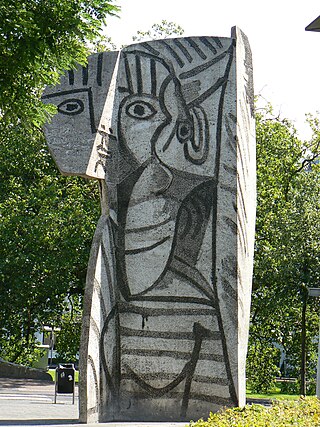
Sylvette is a large concrete sculpture created by Pablo Picasso and the Norwegian artist Carl Nesjar, which was erected in the city of Rotterdam in 1970. It is located on the corner of Westersingel next to the Museum Boijmans Van Beuningen. The sculpture portrays a young woman with a ponytail. The model for the sculpture was Sylvette David, whom Picasso met in 1953 when she was 19. The sculpture was produced following the creation of a series of artworks, known as the Sylvette series, that Picasso made of his muse in a variety of artistic styles.
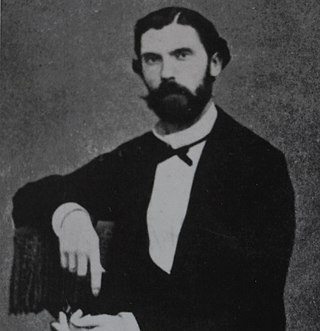
José Ruiz y Blasco was a Spanish painter, an art teacher, and the father of artist Pablo Ruiz Picasso (1881–1973).

The Weeping Woman is a series of oil on canvas paintings by Pablo Picasso, the last of which was created in late 1937. The paintings depict Dora Maar, Picasso's mistress and muse. The Weeping Woman paintings were produced by Picasso in response to the bombing of Guernica in the Spanish Civil War and are closely associated with the iconography in his painting Guernica. Picasso was intrigued with the subject of the weeping woman, and revisited the theme numerous times that year. The last version, created on 26 October 1937, was the most elaborate of the series and is in the Tate collection. Its currently on loan to Kaohsiung Museum of Fine Arts in Taiwan and is part of the Capturing the Moment exhibition there until November 17th 2024. Another Weeping Woman painting created on 18 October 1937 is housed at the National Gallery of Victoria and was involved in a high-profile political art theft.
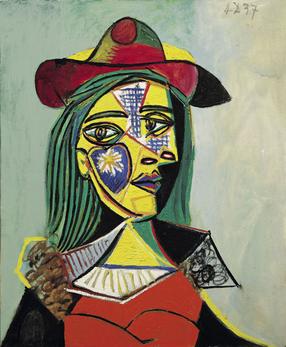
The Woman in Hat and Fur Collar is a painting by Pablo Picasso executed in 1937 and exhibited at the National Art Museum of Catalonia in Barcelona, Spain.

Massacre in Korea is an expressionist painting completed on 18 January 1951 by Pablo Picasso. Picasso's third anti-war painting after Guernica and The Charnel House, Massacre depicts a scene of a massacre of a group of naked women and children by a firing squad. It has been considered to be a condemnation of American intervention in the Korean War. The painting was exhibited in the Musée Picasso in Paris.

The Actor is an oil-on-canvas painting by Spanish painter Pablo Picasso, created from 1904 to 1905. The painting dates from the artist's Rose Period. It is housed in the collection of the Metropolitan Museum of Art in New York City.

Le pigeon aux petit pois, sometimes referred to as Dove with green peas, is a 1911 oil on canvas painting by Pablo Picasso. It is an example of Picasso's Cubist works and has an estimated value of €23 million. The painting was one of five artworks stolen from the Musée d'Art Moderne de la Ville de Paris on 20 May 2010, which together are valued at €100 million. It has so far not been recovered and its whereabouts remain unknown.

Bull's Head is a found object artwork by Pablo Picasso, created in 1942 from the seat and handlebars of a bicycle. It is described by Roland Penrose as Picasso's most famous discovery, a simple yet "astonishingly complete" metamorphosis.
Head of a Young Woman is a 1906 oil painting by Pablo Picasso. It depicts the portrait of a young woman with long, dark hair. The painting dates from Picasso's Rose Period, during a trip that he made to the Catalan village of Gósol. It was owned by Spanish banker Jaime Botín until it was seized by the Spanish state in 2015. It is now housed at the Museo Nacional Centro de Arte Reina Sofía in Madrid.
La Coiffeuse is an oil on canvas painting by Pablo Picasso that he created in 1911. It was painted in the early Cubist style, known as Analytical Cubism, which Picasso pioneered. The painting has been valued at $15m (£10m). It was reported as stolen from Paris' Centre Georges Pompidou in 2001, but then recovered in a shipment from Belgium to Newark, New Jersey, in December 2014. It was returned to Centre Pompidou in 2015.
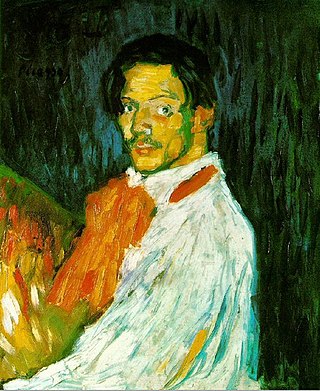
Yo, Picasso, is an oil-on-canvas painting by Pablo Picasso, which he painted in 1901. It is a self-portrait of the artist that depicts him in his youth, aged 19. The painting was created at the beginning of Picasso's Blue Period. On 9 May 1989, the painting sold at Sotheby's, achieving a price of $47.85 million, making it one of the most expensive paintings sold up to that date.
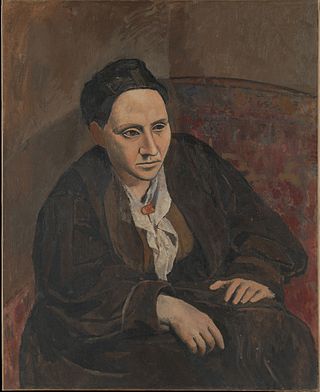
Portrait of Gertrude Stein is an oil-on-canvas painting of the American writer and art collector Gertrude Stein by Pablo Picasso, which was begun in 1905 and finished the following year. The painting is housed in the Metropolitan Museum of Art in New York. It is considered one of the important works of Picasso's Rose Period. The portrait has historical significance, due to the subject's role in Picasso's early life as a struggling artist and eventual commercial success. It also represents a significant transitional step in the artist's move towards Cubism.
Picasso. In the heart of darkness (1939–1945) was an exhibition presented October 5, 2019 through January 5, 2020, at the Musee de Grenoble. Presented with the help of the Musée Picasso, the Centre Pompidou, and the Kunstsammlung Nordrhein-Westfalen, it was the first exhibition in France featuring the creative process of Pablo Picasso during the Second World War.

Portrait of Ambroise Vollard is an oil-on-canvas painting by Pablo Picasso, which he painted in 1910. It is now housed in the Pushkin Museum in Moscow. The painting is a representation of the influential art dealer Ambroise Vollard, who played an important role in Picasso's early career as an artist. It is painted in the style of Analytical Cubism, which Picasso pioneered.

Le Repos is an oil-on-canvas painting created by Pablo Picasso in 1932. It depicts a portrait of Marie-Thérèse Walter, the artist's lover and muse, in a sleeping pose. The painting was produced in the midst of their relationship and is a demonstration of Picasso's love for his mistress. Le Repos was one of a series of sleeping portraits of Walter that Picasso created in 1932. On 14 May 2018, the painting achieved a value of $36.9 million when it was sold at Sotheby's auction.

Portrait of Pablo Picasso is an oil on paper mounted on card painting by Italian artist Amedeo Modigliani created in 1915.