Related Research Articles
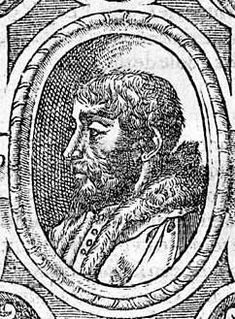
Maurice Scève, was a French poet active in Lyon during the Renaissance period. He was the centre of the Lyonnese côterie that elaborated the theory of spiritual love, derived partly from Plato and partly from Petrarch. This spiritual love, which animated Antoine Héroet's Parfaicte Amye (1543) as well, owed much to Marsilio Ficino, the Florentine translator and commentator of Plato's works.

Louise Charlin Perrin Labé,, also identified as La Belle Cordière, was a feminist French poet of the Renaissance born in Lyon, the daughter of wealthy ropemaker Pierre Charly and his second wife, Etiennette Roybet.
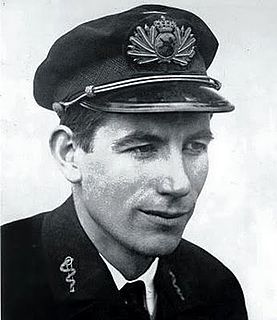
Jan Jacob Slauerhoff, who published as J. Slauerhoff, was a Dutch poet and novelist. He is considered one of the most important Dutch language writers.

Karel van Mander (I) or Carel van Mander I was a Flemish painter, poet, art historian and art theoretician, who established himself in the Dutch Republic in the latter part of his life. He is mainly remembered as a biographer of Early Netherlandish painters and Northern Renaissance artists in his Schilder-boeck. As an artist and art theoretician he played a significant role in the spread and development of Northern Mannerism in the Dutch Republic.
Sydney Goodsir Smith was a New Zealand-born Scottish poet, artist, dramatist and novelist. He wrote poetry in literary Scots often referred to as Lallans, and was a major figure of the Scottish Renaissance.

Herman Gorter was a Dutch poet and socialist. He was a leading member of the Tachtigers, a highly influential group of Dutch writers who worked together in Amsterdam in the 1880s, centered on De Nieuwe Gids.
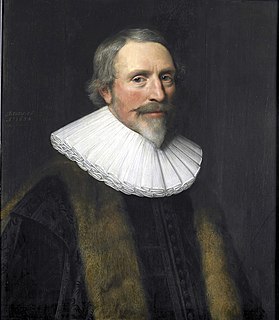
Jacob Cats was a Dutch poet, humorist, jurist and politician. He is most famous for his emblem books.

Simon Vinkenoog was a Dutch poet, spoken word poet and writer. He was the editor of the anthology Atonaal (Atonal), which launched the Dutch "Fifties Movement".
Nationality words link to articles with information on the nation's poetry or literature.
Nationality words link to articles with information on the nation's poetry or literature.
George Rolfe Humphries was a poet, translator, and teacher.

Pieter Cornelis Boutens was a Dutch poet, classicist, and mystic.
Jacob Jacobsz Steendam was a Dutch poet and a minister. He collaborated with Pieter Corneliszoon Plockhoy.
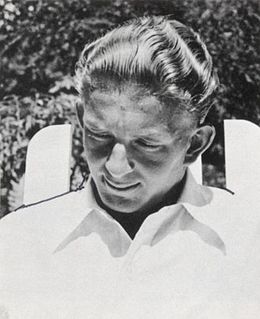
Hans Lodeizen, born Johannes August Frederik Lodeizen, was a Dutch poet. He was the author of one book of poems and a quantity of miscellaneous work. Despite his short life and modest output, his minimalist lyrics, which are generally constituted of short, unrhymed lines without capitals or punctuation, strongly influenced a post-war generation of Dutch poets, including Gerard Reve.

The Pan Poëticon Batavum was a collection of small portraits of poets mounted on plates that were kept in a curiosity cabinet by the 18th-century Dutch painter Arnoud van Halen.

Cornelis Jan (Kees) Stip was a Dutch epigram poet. He wrote under many pseudonyms, most notably Trijntje Fop and Chronos.

Snikken en grimlachjes is the best-known work of Piet Paaltjens, a fictional poet created by Dutch poet and minister François Haverschmidt (1835–1894). Originally, it contained a collection of 24 poems. It appealed to a large audience, possibly due to its humoristic, melancholic-romantic tone, or maybe due to the poetry missing a "moral purpose", as Haverschmidt himself stated in the preface to the first edition. Typical for Paaltjens' poetry is the combination of romantic clichés, irony, and crude reality.

Marijke Hanegraaf is a Dutch poet. Since 1997, she has lived in Nijmegen; she was the city’s official poet in 2013 and 2014.

Jules Lismonde was a Belgian painter and drawer. He was a member of the Royal Academy of Science, Letters and Fine Arts of Belgium.

Hortensia del Prado was a Dutch noblewoman and horticulturalist whose garden in Middelburg was featured by the poet Jacob Cats.
References
- ↑ "Schrijvers en dichters (DBNL biografieënproject I) · DBNL".
- ↑ K. ter Laan, Letterkundig woordenboek voor Noord en Zuid (1952)
| General | |
|---|---|
| National libraries | |
| Biographical dictionaries | |
| Other | |
