
Louis-Eugène Cavaignac was a French general and politician who served as head of the executive power of France between June and December 1848, during the French Second Republic.

Louis Jean Joseph Charles Blanc was a French socialist politician, journalist and historian. He called for the creation of cooperatives in order to guarantee employment for the urban poor. Although Blanc's ideas of the workers' cooperatives were never realized, his political and social ideas greatly contributed to the development of socialism in France. He wanted the government to encourage cooperatives and replace capitalist enterprises. These cooperatives were to be associations of people who produced together and divided the profit accordingly.

The French Second Republic, officially the French Republic, was the second republican government of France. It existed from 1848 until its dissolution in 1852.

The Luxembourg Socialist Workers' Party, abbreviated to LSAP or POSL, is a social democratic, pro-European political party in Luxembourg. The LSAP sits on the centre-left of the political spectrum.

Gaston Egmond Thorn was a Luxembourgish politician who served in a number of high-profile positions, both domestically and internationally. Amongst the posts that he held were the 20th prime minister of Luxembourg (1974–1979), President of the United Nations General Assembly (1975), and the seventh president of the European Commission (1981–1985).
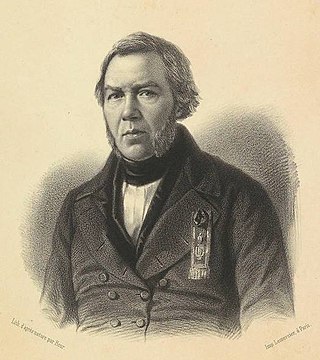
Philippe-Joseph-Benjamin Buchez, more commonly called Philippe Buchez, was a French historian, sociologist, and politician. He was the founder of the newspaper L'Atelier, and he served briefly, in 1848, as the president of the Constituent National Assembly, which was then meeting at the Palais Bourbon in Paris.
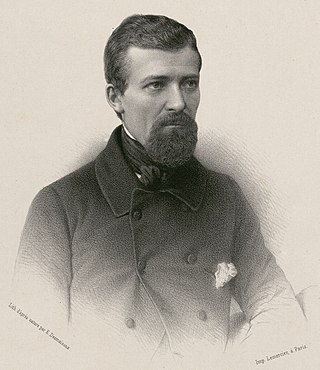
Alexandre Martin, nicknamed Albert l'Ouvrier, was a French socialist statesman of the French Second Republic. He was the first member of the industrial working class to be in French government.
Gaspard-Théodore-Ignace de la Fontaine was a Luxembourgish politician and jurist. He led the Orangist movement and was the first prime minister of Luxembourg, serving for four months, from 1 August 1848 until 6 December of the same year.
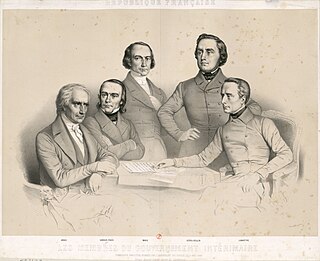
The Executive Commission of 1848 was a short-lived government during the French Second Republic, chaired by François Arago, that exercised executive power from 9 May 1848 to 24 June 1848. It succeeded the Provisional Government of 1848 and was in turn replaced by the Cabinet of General Cavaignac. The members of the Commission acted as collective head of state.

The June Rebellion, or the Paris Uprising of 1832, was an anti-monarchist insurrection of Parisian republicans on 5 and 6 June 1832.

The Santer-Poos III Government was the government of Luxembourg between 13 July 1994 and 26 January 1995. It was the third of three led by, and named after, Prime Minister Jacques Santer. Throughout the ministry, the Deputy Prime Minister was Jacques Poos.
The Constituent Assembly of Luxembourg was a constituent assembly called in 1848 in Luxembourg to write and pass a new national constitution.

The French demonstration of 15 May 1848 was an event played out, mostly, in the streets of Paris. It was intended to reverse the results of a Second Republic election of deputies to the Constituent Assembly. It is difficult to say, with any precision, whether this phenomenon should be called a demonstration, a riot, an invasion, a rebellion, or an attempted coup d'état. Nonetheless, it seems to have been largely unplanned, not particularly bloody, and indisputably a failure.
The following lists events that happened during 1958 in the Grand Duchy of Luxembourg.

The French Revolution of 1848, also known as the February Revolution, was a period of civil unrest in France, in February 1848, that led to the collapse of the July Monarchy and the foundation of the French Second Republic. It sparked the wave of revolutions of 1848.

Charles Constantin Pecqueur was a French economist, socialist theoretician and politician. He participated in the Revolution of 1848 and influenced Karl Marx.
The Luxembourgish government in exile, also known as the Luxembourgish government in London, was the government in exile of Luxembourg during the Second World War. The government was based in London between 1940 and 1944, while Luxembourg was occupied by Nazi Germany. It was led by Pierre Dupong, and also included three other Ministers. The head of state, Grand Duchess Charlotte, also escaped from Luxembourg after the occupation. The government was bipartite, including two members from both the Party of the Right (PD) and the Socialist Workers' Party (LSAP).
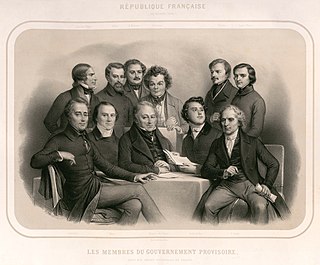
The Provisional government was the first government of the French Second Republic, formed on 24 February 1848 following the abolition of the July Monarchy by the February Revolution. The provisional government was succeeded on 9 May 1848 by the Executive Commission.
The Revolution of 1848 in Luxembourg was part of the revolutionary wave which occurred across Europe in 1848. The Grand-Duchy of Luxembourg at that time was in personal union with the Kingdom of the Netherlands.

Ploughing in the Nivernais, also known as Oxen ploughing in Nevers or Plowing in Nivernais, is an 1849 painting by French artist Rosa Bonheur. It depicts two teams of oxen ploughing the land, and expresses deep commitment to the land; it may have been inspired by the opening scene of George Sand's 1846 novel La Mare au Diable. Commissioned by the government and winner of a First Medal at the Salon in 1849, today it is held in the Musée d'Orsay in Paris.
