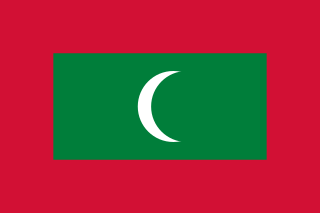
The history of the Maldives is intertwined with the history of the broader Indian subcontinent and the surrounding regions, comprising the areas of South Asia and Indian Ocean; and the modern nation consisting of 28 natural atolls, comprising 1194 islands. Historically, the Maldives had a strategic importance because of its location on the major marine routes of the Indian Ocean. The Maldives' nearest neighbours are Sri Lanka and India, both of which have had cultural and economic ties with Maldives for centuries. The Maldives provided the main source of cowrie shells, then used as a currency throughout Asia and parts of the East African coast. Most probably Maldives were influenced by Kalingas of ancient India who were earliest sea traders to Sri Lanka and Maldives from India and were responsible for the spread of Buddhism. Hence ancient Hindu culture has an indelible impact on Maldives' local culture.
The politics of the Maldives takes place in the framework of a presidential representative democratic republic, whereby the President is the Head of Government. Executive power is exercised by the government. The President heads the executive branch and appoints the Cabinet; Like many presidential democracies, each member of the cabinet need to be approved by the Parliament. The President, along with the Vice President, is directly elected by the people to a five-year term by a secret ballot. He could be re-elected to second 5-year term, the limit allowed by the Constitution. The current President of the Maldives is Ibrahim Mohamed Solih, who was sworn into office on November 17, 2013 when his predecessor, Yaameen abdul gayoom, following his predecessor Mohamed Nasheed's forced resignation in a coup led by the police. Nasheed reportedly resigned involuntarily to forestall an escalation of violence, and was placed in jail, before being forced into exile.

Maumoon Abdul Gayoom is a Maldivian politician and an Islamic scholar who ruled the country as the President of Maldives from 1978 to 2008. After serving as Minister of Transport, he was nominated as President by the Majlis (Parliament) of the Maldives and succeeded Ibrahim Nasir in 1978. He was defeated in the October 2008 presidential election. In opposition, he continued to serve as leader of the Dhivehi Rayyithunge Party until January 2010, when he retired from active politics.

The Maldivian Democratic Party is the first political party formed in the Republic of Maldives with a total membership of 29277 individuals. It is a party with its stated goal being the promotion of human rights and democracy in the Maldives. This party won the first ever multi-party elections in the Maldives with the support from all the other political parties in the 2008 elections against the former dictator Maumoon Abdul Gayoom. The Maldivian Democratic Party failed in the first two rounds of the 2008 presidential elections and called for a coalition for change against the then-dictator Abdul Gayoom. All the Political Parties joined the alliance of national unity and won the election.
Elections in Maldives gives information on election and election results in the Maldives.
The Constitution of the Maldives is the supreme law of the country of Maldives. It provides the legal foundation for the existence of the Republic of Maldives, sets out the rights and duties of the citizens of Maldives, and defines the structure of the Government of the Maldives. The current Constitution of Maldives was ratified by President Maumoon Abdul Gayyoom on 7 August 2008, and came into effect immediately, replacing and repealing the Constitution of 1998.

Mohamed Nasheed, GCSK is a Maldivian politician, who served as the fourth President of the Maldives from 2008 to 2012. He was the first democratically elected president of the Maldives and one of the founders of the Maldivian Democratic Party.
Ahmed Thasmeen Ali, leader of Dhivehi Rayyithunge Party is a Maldivian MP, philanthropist and a businessman. Thasmeen started his career as a civil servant and after venturing into politics he was elected to Peoples Majlis from Baa Atoll and later he served in Maldives President Maumoon Abdul Gayoom’s cabinet and was his running mate in the first multiparty election held in the Maldives in 2008.
Dr. Hassan Saeed was Attorney General of the Maldives from 11 November 2003 to 5 August 2007. He ran as an independent candidate for the Presidency of the Maldives, and placed third of six candidates. Saeed was appointed as the Attorney-General at the age of 33 by President Maumoon Abdul Gayoom on 11 November 2003. He is a scholar on Islam and wrote about liberal Islam in his book Freedom of Religion, Apostasy, and Islam published in 2004.

Mohammed Waheed Hassan Manik was the 5th President of the Maldives from 7 February 2012 to 17 November 2013, having succeeded to office following the disputed resignation of President Mohamed Nasheed, under whom Waheed had served as the Maldives' first Vice President in over half a century since 2008. He had previously worked as a news anchor, a United Nations official with UNICEF, UNDP and UNESCO, and a member of the Maldivian Parliament. Waheed was the first citizen of the Maldives to receive a Ph.D., having received it at Stanford University in the U.S., and reportedly the first person to appear on Maldivian Television.
Presidential elections were held in the Maldives in two rounds on 8 and 28 October. No candidate gained more than 50% of the vote in the first round on 8 October; incumbent president Maumoon Abdul Gayoom fared best with about 40%. A runoff was thus held on 28 October between Gayoom and second-placed Mohamed Nasheed. Nasheed won the election, unseating longtime incumbent Gayoom.
New Maldives began as a group of young ministers who supported the dictatorship of President Gayoom and claimed to be working to usher in liberal democracy to the Maldives. Its most public proponent is Ahmed Shaheed, supported by Hassan Saeed and Mohamed Jameel Ahmed, who were serving as Foreign Minister, Attorney-General and Justice Minister, respectively. The New Maldives was launched in December 2005 in Colombo, Sri Lanka, and was initially used by the media as a pejorative term.
Mohamed Jameel Ahmed is a Maldivian lawyer and politician who was the fourth Vice President of the Maldives from 2013 to 2015. He previously served as Minister of Justice from July 2005 to August 2007, as Minister of Civil Aviation and Communication from November 2008 to May 2009 and as Minister of Home Affairs from February 2012 to May 2013. He was once a member of the New Maldives group. In 2015, he was impeached by the parliament and removed from office.
Parliamentary elections were held in the Maldives on 9 May 2009.

Presidential elections were held in the Maldives under a two-round system. The result of the initial vote held on 7 September 2013 was annulled by the Supreme Court and the election was re-run on 9 November. As no candidate achieved majority support, a run-off election was held on 16 November. Abdulla Yameen was elected President.
The 2011–2012 Maldives political crisis began as a series of peaceful protests that broke out in the Maldives on 1 May 2011. They would continue, eventually escalating into the resignation of President Mohamed Nasheed in disputed circumstances in February 2012. Demonstrators were protesting what they considered the government's mismanagement of the economy and were calling for the ouster of President Mohamed Nasheed. The main political opposition party in the country, the Dhivehi Rayyithunge Party led by the former president of the country Maumoon Abdul Gayoom accused President Nasheed of "talking about democracy but not putting it into practice." The protests occurred during the Arab Spring.
Abdulla Yameen Abdul Gayoom is a Maldivian politician who was the 6th President of the Maldives from 2013 to 2018. He left office on 17 November 2018 following his defeat in the 2018 presidential election, in which he sought to win a second 5-year term.
Presidential elections were held in the Maldives on 23 September 2018. Incumbent president Abdulla Yameen of the Progressive Party of Maldives was seeking re-election for a second five-year term. His only challenger was Ibrahim Mohamed Solih of the Maldivian Democratic Party, who was nominated as the joint candidate of a coalition of opposition parties.

Ibrahim Mohamed Solih, better known as Ibu (އިބޫ), is a Maldivian politician who is the current President of the Maldives and assumed office on 17 November 2018.

Parliamentary elections were held in the Maldives on 6 April 2019. The result was a landslide victory for the Maldivian Democratic Party, which won 65 of the 87 seats in the People's Majlis.