Related Research Articles

Rouben Zachary Mamoulian was an American film and theater director.

Sarah Blanche Sweet was an American silent film actress who began her career in the early days of the motion picture film industry.
James Anthony FitzPatrick was an American producer, director, writer and narrator known from the early 1930s as "The Voice of the Globe" for his Fitzpatrick's Traveltalks.

Wanderer of the Wasteland is a 1924 American silent Western film directed by Irvin Willat and starring Jack Holt, Noah Beery, and Billie Dove. It was the second feature film to be photographed entirely in two-color Technicolor.

The Mysterious Island is a 1929 American sound part-talkie science fiction film directed by Lucien Hubbard, based on Jules Verne's 1874 novel L'Île mystérieuse. The film was photographed largely in two-color Technicolor. In addition to sequences with audible dialogue or talking sequences, the film features a synchronized musical score and sound effects along with English intertitles. The sound was recorded via the Western Electric sound-on-film process. The film was released by Metro-Goldwyn-Mayer.

Lights of Old Broadway is a 1925 American silent drama film directed by Monta Bell, produced by William Randolph Hearst's Cosmopolitan Productions, and released by Metro-Goldwyn-Mayer. The film stars Marion Davies in a dual role and Conrad Nagel, and is an adaptation of the play The Merry Wives of Gotham by Laurence Eyre (USA). The film has color sequences using tinting, Technicolor, and the Handschiegl color process.

The Flag: A Story Inspired by the Tradition of Betsy Ross is a 1927 MGM silent fictionalized film short in two-color Technicolor, about the making of the U.S. flag by Betsy Ross. It was the first of the "Great Events" series co-produced by Technicolor and Colorcraft Pictures Inc., and distributed by Metro-Goldwyn-Mayer. The basically true story is combined with a completely fictional subplot in which a British soldier crosses enemy lines to visit his wife, a friend of Betsy Ross.
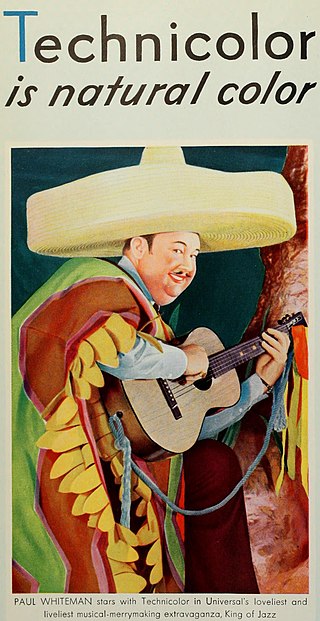
Technicolor is a series of color motion picture processes, the first version dating back to 1916, and followed by improved versions over several decades.
Climbing the Golden Stairs is an American 2-reel musical fantasy short released in 1929. It was produced in 2-color Technicolor dye-transfer process.
Buffalo Bill's Last Fight is a 1927 MGM silent fictionalized film short in two-color Technicolor. It was the second short film produced as part of Metro-Goldwyn-Mayer's "Great Events" series. As with the first film in the series, The Flag: A Story Inspired by the Tradition of Betsy Ross, this film continued the series' original intent to focus on events from American history. Ultimately, only one other short was shot which stuck to this format; the other films in the series featured historical events with a European or Asian focus.
The Lady of Victories is a 1928 MGM silent fictionalized film short in two-color Technicolor. It was the third short film produced as part of Metro-Goldwyn-Mayer's "Great Events" series.
The Czarina's Secret is a 1928 MGM silent fictionalized film short in two-color Technicolor. It was the fourth film produced as part of Metro-Goldwyn-Mayer's "Great Events" series.
The Virgin Queen is a 1928 MGM silent fictionalized film short in two-color Technicolor. It was the third short film produced as part of Metro-Goldwyn-Mayer's "Great Events" series.
Cleopatra is a 1928 MGM silent fictionalized film, shot in two-color Technicolor. It was the sixth short produced as part of Metro-Goldwyn-Mayer's "Great Events" series.
The Heart of General Robert E. Lee is a 1928 MGM short silent fictionalized film short in two-color Technicolor. It was the seventh film produced as part of Metro-Goldwyn-Mayer's "Great Events" series.
Madame du Barry is a 1928 MGM short silent fictionalized film short in two-color Technicolor. It was the eighth film produced as part of Metro-Goldwyn-Mayer's "Great Events" series, and the last to be released before the new year.
Light of India is a 1929 MGM short silent film short in two-color Technicolor. It was the tenth film produced as part of Metro-Goldwyn-Mayer's "Great Events" series.
A Princess of Destiny is a 1929 MGM short silent film short in two-color Technicolor. It was the eleventh and penultimate film produced as part of Metro-Goldwyn-Mayer's "Great Events" series.
Frontier Romance is a 1929 MGM short silent film short in two-color Technicolor. It was the twelfth and final film produced as part of Metro-Goldwyn-Mayer's "Great Events" series. A romantic historical drama, the film depicts George Rogers Clark and other American colonists as they interact with Native American tribespeople.
References
- ↑ Layton, James and David Pierce. The Dawn of Technicolor: 1915-1935. George Eastman House, 2015, p. 339.
- ↑ Slide, Anthony. The New Historical Dictionary of the American Film Industry. Lanham, MD: Scarecrow Press, 1998. p. 87. Accessed 19 May 2021.
- ↑ Slide, Anthony. "The 'Great Events' Series". Silent Topics: Essays on Undocumented Areas of Silent Film. Scarecrow Press, 2005, p. 38.
- ↑ Layton, James. "Manchu Love (Technicolor Motion Picture Corporation, US 1929)".
- ↑ Layton and Pierce 342
- ↑ The Dawn of Technicolor: The Silent Era. Museum of Modern Art. Accessed April 12, 2020.

