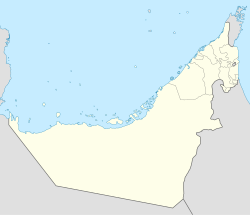
The Emirate of Ajman is one of the seven emirates (states) of the United Arab Emirates. It has an area of a mere 260 square kilometres, which makes it the smallest of the emirates in terms of area. It is named after the city of Ajman, which is its seat of government. The main landmass of the emirate is bordered on the north, east, and south by the Emirate of Sharjah. It has a population of some 240,000.
The Bani Kaab is an Arab tribe in Oman and the United Arab Emirates, also evident in other Gulf countries.

Hatta is the inland exclave of the emirate of Dubai in the United Arab Emirates.
The Shihuh is a tribe of the United Arab Emirates (UAE), and Oman. In the singular, the name is Al Shehhi, a common family name in the UAE and Oman today. Inhabiting the northern part of the Hajar Mountain range, the tribe has long been influential in the affairs of both the east and west coast settlements of the northern UAE and Oman and has fiercely maintained both its identity and independence.
The Al Nuaimi family is the ruling royal family of Ajman, one of the seven emirates that together comprise the United Arab Emirates (UAE).
Hasher bin Maktoum acceded to become the Ruler of Dubai in 1859, following the unexpected death of natural causes of his uncle, Sheikh Saeed bin Butti.

Al Falayah fort is an 18th-century fort in Ras Al Khaimah, United Arab Emirates (UAE). Traditionally the summer residence of the ruling Al Qasimi family, the fort was used as a rest house.
Sheikh Maktoum bin Hasher Al Maktoum was the Ruler of Dubai from April 1894–February 1906. The fifth Maktoum Ruler since the establishment of the dynasty in 1833. Maktoum's short but 'liberal and enlightened' reign was to transform the coastal port. He was responsible for the establishment of the trading community of Dubai, encouraging disaffected merchants from Lingeh to bring their businesses to Dubai after the Persian government had introduced unpopular taxes.
Sheikh Khalid bin Ahmad Al Qasimi was the Ruler of Sharjah from 1914–1924 and Ras Al Khaimah from 1914–1921. He acceded on the death of Saqr bin Khalid Al Qasimi. His rule was tumultuous and unpopular, marked by internecine conflicts and public discontent and saw the final disintegration of the Al Qasimi's joint rule over Sharjah and Ras Al Khaimah. Deposed as Ruler of Sharjah in 1924, he went on to become ruler of Dhaid and Kalba and a highly influential figure in the Shamaliyah.
Sheikh Rashid bin Ahmad Al Mualla (1876–1922) was the Ruler of Umm Al Quwain from 1904–1922, one of the Trucial States and today one of the seven emirates forming the United Arab Emirates (UAE). He gained influence over the tribes of the interior at the expense of the pre-eminent Trucial Ruler of the time, Sheikh Zayed bin Khalifa Al Nahyan.
Sheikh Rashid bin Humaid Al Nuaimi was the Ruler of Ajman, one of the Trucial States which today form the United Arab Emirates (UAE), from 1816–1838, leading a force of 50 men to take control of the town from members of the Al Bu Shamis tribe who had settled there and also at Al Heera. At the time, Ajman was a dependency of Sharjah. Five years after his establishment at Ajman, the fort was taken by the Darawisha Bedouin who were removed by the action of the Ruler of Sharjah, Sheikh Saqr bin Sultan Al Qasimi.
The Bani Qitab is a tribe of the United Arab Emirates (UAE). The singular form of the name, Al Ketbi, is a common family name in the Northern UAE today. Consisting of a settled southern section and a nomadic northern section, the tribe was long influential in the conduct of affairs in the interior of the Trucial States. The Northern branch mostly settled in the inland towns of Dhaid and Al Falayah.
The Na'im is an Arab tribe in the United Arab Emirates. The tribe is also present in other gulf countries.
Abdulaziz bin Humaid Al Nuaimi was Ruler of Ajman, one of the Trucial States, which today form the United Arab Emirates (UAE), from 1900–1910. He steered Ajman through a period in which tribal conflicts triggered instability throughout the coast but was to ultimately meet the fate he had himself engineered for his predecessor.
Sheikh Saeed bin Tahnun Al Nahyan was the Ruler of Abu Dhabi, one of the Trucial States which today form the United Arab Emirates (UAE), from 1845–1855.
The Manasir is a tribe of the United Arab Emirates (UAE). Nomadic, warlike and fiercely independent, they roamed between Buraimi and Qatar, the Persian Gulf coast to Liwa and also settled in the Northern emirates. They subsisted through date farming, pearling and moving goods with their camel trains, as well as camel breeding.
The Mazari is a tribe of the United Arab Emirates (UAE). The Mazari settled throughout the Trucial States but principally in Abu Dhabi. They are considered a subsection of the Bani Yas and formed the majority of the Bedouin component of that federation of tribes.
The Dhawahir is a tribe of the United Arab Emirates (UAE). The tribe's main centre was the Buraimi Oasis and the village, then town of Al Ain. They have long had a strong alliance with the Ruling family of Abu Dhabi, the Bani Yas.
The Awamir is a Bedouin Arab tribe in the United Arab Emirates (UAE) and Oman. Warlike, fiercely independent and frequently murderous, they were camel breeders, raiders and occasionally date farmers before settling in the 1960s.
The Duru is a tribe of the United Arab Emirates (UAE). A relatively small tribe, they nevertheless managed to intersperse themselves in a number of territorial conflicts which broke out throughout the Trucial States in the 20th Century.