| Dayah | |
|---|---|
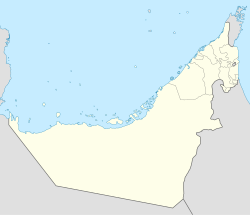  Dayah | |
| Coordinates: 25°53′N56°03′E / 25.883°N 56.050°E Coordinates: 25°53′N56°03′E / 25.883°N 56.050°E | |
| Country | United Arab Emirates |
| Emirate | Ras al-Khaimah |
Dayah is a settlement in Ras al-Khaimah.
| Dayah | |
|---|---|
| Dayah | |
| Coordinates: 25°53′N56°03′E / 25.883°N 56.050°E Coordinates: 25°53′N56°03′E / 25.883°N 56.050°E | |
| Country | United Arab Emirates |
| Emirate | Ras al-Khaimah |
Dayah is a settlement in Ras al-Khaimah.

The United Arab Emirates (UAE) is a country in the eastern part of the Arabian Peninsula located on the southeastern coast of the Persian Gulf and the northwestern coast of the Gulf of Oman. The UAE consists of seven emirates and was founded on 2 December 1971 as a federation. Six of the seven emirates combined on that date. The seventh, Ras al Khaimah, joined the federation on 10 February 1972. The seven sheikdoms were formerly known as the Trucial States, in reference to the treaty relations established with the British in the 19th Century.

Ras Al Khaimah (RAK), to an extent identified with the historical area of Julfar, is one of the seven emirates that make up the United Arab Emirates (UAE). The capital city and home of most residents is also called "Ras Al Khaimah", sometimes abbreviated to "RAK City".
HMS Liverpool was a Royal Navy Endymion-class frigate, reclassified as a fourth rate. She was built by Wigram, Wells and Green and launched at Woolwich on 21 February 1814. She was built of pitch-pine, which made for speedy construction at the expense of durability.
Sheikh Sultan bin Saqr Al Qasimi (1781–1866) was the Sheikh of the Al Qasimi and ruler variously of the towns of Sharjah and Ras Al Khaimah, Jazirah Al Hamra and Rams. A dependent of the first Saudi Kingdom, his rule over Ras Al Khaimah ran from 1803–1809, when he was deposed by order of the Saudi Amir and restored in 1820, going on to rule until his death in 1866 at the age of 85. He was Ruler of Sharjah from 1814–1866, with a brief disruption to that rule in 1840.

Rams is a suburb of Ras Al Khaimah in the United Arab Emirates (UAE). Once a pearl diving and fishing community which frequently disputed the rule of Ras Al Khaimah, today it forms the northern coastal settlement of the city.
The Shihuh is a tribe of the United Arab Emirates (UAE), and Oman. In the singular, the name is Al Shehhi, a common family name in the UAE and Oman today. Inhabiting the northern part of the Hajar Mountain range, the tribe has long been influential in the affairs of both the east and west coast settlements of the northern UAE and Oman and has fiercely maintained both its identity and independence.
Abu Hail is a neighbourhood in Dubai, United Arab Emirates (UAE), located in Deira. The locality is largely residential and is bordered by the localities of Al Waheda on the east, Hor Al Anz in the south and Al Baraha on the west.
The Naqbiyin ) is a tribe of the United Arab Emirates (UAE). They are mostly settled within the emirates of Sharjah and Ras Al Khaimah and have long been influential in the tribal politics of both emirates.

The Al Qasimi royal family are one of the six ruling families of the United Arab Emirates (UAE) and rule two of the seven emirates: Sharjah and Ras Al Khaimah.
The Za'ab is a Arab tribe in the United Arab Emirates (UAE).

The General Maritime Treaty of 1820 was a treaty initially signed between the rulers of Abu Dhabi, Sharjah, Ajman, Umm al-Quwain and Ras Al Khaimah and the British in January 1820, with the nearby island state of Bahrain acceding to the treaty in the following February. Its full title was, "General Treaty for the Cessation of Plunder and Piracy by Land and Sea, Dated February 5, 1820".

The Trucial Coast were a group of tribal confederations in the south-eastern Persian Gulf, previously known to the British as the "Pirate Coast", which were signatories to treaties with the British Government. These treaties established an informal protectorate by the United Kingdom, and the sheikhdoms, or emirates, were a British protectorate from 1820 until 1 December 1971, when the seven principal trucial sheikhdoms became independent. Six were to form the United Arab Emirates the next day; the seventh – Ras Al Khaimah – joined the Federation on 10 February 1972.
Sheikh Abdullah bin Rashid Al Mualla was the Ruler of Umm Al Quwain from 1820–1853. The head of the Al Ali tribe, he was signatory to both the 1820 General Maritime Treaty with the British and the 1853 Perpetual Maritime Truce, making Umm Al Quwain a Trucial State. Today it is one of the seven United Arab Emirates (UAE).

Piracy in the Persian Gulf was prevalent until the 19th century. It was perceived as one of the primary threats to global maritime trade routes, particularly those with significance to British India and Iraq. Many of the most notable historical instances of piracy, referred to as 'resistance' by modern Emirati historians, were perpetrated by the Al Qasimi tribe. This led to the British mounting the Persian Gulf campaign of 1809, a major maritime action launched by the British to bombard Ras Al Khaimah, Lingeh and other Al Qasimi ports. The current ruler of Sharjah, Sultan bin Muhammad Al Qasimi argues in his book The Myth of Piracy in the Gulf that the allegations of piracy were simply excuses used by the British to impose imperialism.
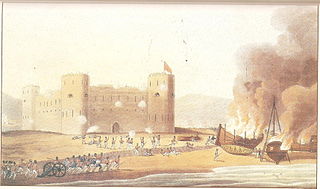
The Persian Gulf campaign of 1819 was a British punitive expedition, principally against the Arab maritime force of the Al Qasimi in the Persian Gulf, which embarked from Bombay, India in November 1819 to attack Ras Al Khaimah. The campaign was militarily successful for the British and led to the signing of the General Maritime Treaty of 1820 between the British and the Sheikhs of what was then known as the 'Pirate Coast', would become known as the 'Trucial Coast' after this treaty and the territory that today comprises the United Arab Emirates.
Hassan bin Rahma Al Qasimi was the Sheikh (ruler) of Ras Al Khaimah from 1814–1820. He was accused by the British of presiding over a number of acts of maritime piracy, an assertion he denied. Despite signing a treaty of peace with the British in October 1814, a punitive expeditionary force was mounted against Ras Al Khaimah in December 1819 and Hassan bin Rahma was removed as Sheikh of Ras Al Khaimah, which he ceded to the British in a preliminary agreement to the General Maritime Treaty of 1820.
Sheikh Ahmad bin Abdullah Al Mualla was the Ruler of Umm Al Quwain from 1873–1904. He led Umm Al Quwain through a turbulent period in the Trucial Coast's history, with conflicts against neighbouring emirates and almost constantly shifting alliances. On two occasions these conflicts led to him being found to breach the terms of the 1853 Perpetual Maritime Truce with the British. This notwithstanding, he was a signatory to the 1892 Exclusive Agreement, which bound the Trucial Sheikhs and the British together in a protectorate.
Sheikh Rashid bin Humaid Al Nuaimi was the Ruler of Ajman, one of the Trucial States which today form the United Arab Emirates (UAE), from 1816–1838, leading a force of 50 men to take control of the town from members of the Al Bu Shamis tribe who had settled there and also at Al Heera. At the time, Ajman was a dependency of Sharjah. Five years after his establishment at Ajman, the fort was taken by the Darawisha Bedouin who were removed by the action of the Ruler of Sharjah, Sheikh Saqr bin Sultan Al Qasimi.
Sheikh Hamad bin Abdullah Al Sharqi is the first recognised leader of the Al Sharqi Ruling family of Fujairah, one of the Trucial States and today one of the United Arab Emirates (UAE). He led Fujairah in a number of insurrections against Al Qasimi rule, presiding over a turbulent time when the emirate was practically independent but denied recognition of status as a Trucial State in its own right by the British.
Sheikh Tahnun bin Shakhbut Al Nahyan was the Ruler of Abu Dhabi from 1818–1833. Having deposed his brother Muhammad bin Shakhbut Al Nayhan with his father's support, he ruled in his father's name. Under Tahnun, Abu Dhabi became a Trucial State in 1820, eventually becoming the capital of the United Arab Emirates (UAE).
 | |
|---|---|
| Abu Dhabi | |
| Dubai | |
| Sharjah | |
| Ajman | |
| Umm al-Quwain | |
| Ras Al-Khaima | |
| Al-Fujairah | |
 | This United Arab Emirates location article is a stub. You can help Wikipedia by expanding it. |