| Bani Shutayr | |
|---|---|
  Bani Shutayr | |
| Coordinates: 25°58′N56°07′E / 25.967°N 56.117°E Coordinates: 25°58′N56°07′E / 25.967°N 56.117°E | |
| Country | United Arab Emirates |
| Emirate | Ras al-Khaimah |
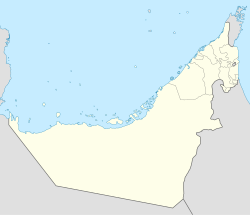
Bani Shutayr is a tribal area in Ras al-Khaimah.
| Bani Shutayr | |
|---|---|
| Bani Shutayr | |
| Coordinates: 25°58′N56°07′E / 25.967°N 56.117°E Coordinates: 25°58′N56°07′E / 25.967°N 56.117°E | |
| Country | United Arab Emirates |
| Emirate | Ras al-Khaimah |
Bani Shutayr is a tribal area in Ras al-Khaimah.

Rams is a suburb of Ras Al Khaimah in the United Arab Emirates (UAE). Once a pearl diving and fishing community which frequently disputed the rule of Ras Al Khaimah, today it forms the northern coastal settlement of the city.
The Bani Kaab is an Arab tribe in Oman and the United Arab Emirates, also evident in other Gulf countries.
The Tunaij, also spelled as Tanaij, is an Arab tribe in the United Arab Emirates (UAE). The Tunaij have mostly settled in Dhaid, the inland oasis town of Sharjah, and the Ras Al Khaimah town of Rams. A small number of Tunaij also settled at Hamriyah.
The Shihuh is a tribe of the United Arab Emirates (UAE), and Oman. In the singular, the name is Al Shehhi, a common family name in the UAE and Oman today. Inhabiting the northern part of the Hajar Mountain range, the tribe has long been influential in the affairs of both the east and west coast settlements of the northern UAE and Oman and has fiercely maintained both its identity and independence.
Al Fahlain is the name of a suburb of the city of Ras Al Khaimah in the United Arab Emirates (UAE), traditionally mostly settled by members of the Naqbiyin tribe.
Sha'am is the name of a village in Northern Ras Al Khaimah, in the United Arab Emirates (UAE).
The Naqbiyin ) is a tribe of the United Arab Emirates (UAE). They are mostly settled within the emirates of Sharjah and Ras Al Khaimah and have long been influential in the tribal politics of both emirates.
Maktoum bin Butti was the joint founder and first ruler of the Dubai sheikdom, alongside Obeid bin Said bin Rashid, with whom he led a migration of the Al Bu Falasah from Abu Dhabi, seceding from the Bani Yas. He was a signatory to the second treaty made with the British and the rulers of the Trucial Coast, abolishing the slave trade.

Al Falayah fort is an 18th-century fort in Ras Al Khaimah, United Arab Emirates (UAE). Traditionally the summer residence of the ruling Al Qasimi family, the fort was used as a rest house.
Sheikh Salim bin Sultan Al Qasimi was Ruler of Sharjah from 1868–1883. His rule was unusually tumultuous and marked by intrigue, the secession of Sharjah's dependencies and constant conflict. He was also briefly the Ruler of Ras Al Khaimah from 1868–1869 and its wali, or governor, from 1908–1919.
Sheikh Humaid bin Abdullah Al Qasimi was Ruler of Ras Al Khaimah from 1869–1900. He survived an attempt to unseat him by the Ruler of Sharjah, with whom he later allied. He re-united Ras Al Khaimah with its secessionist dependencies.
Sheikh Sultan bin Salim Al Qasimi was Ruler of Ras Al Khaimah from 1921–1948. His long and turbulent rule was characterised by internecine family and tribal disputes and he was finally removed as Ruler in a 1948 coup.
Sheikh Rashid bin Ahmad Al Mualla (1876–1922) was the Ruler of Umm Al Quwain from 1904–1922, one of the Trucial States and today one of the seven emirates forming the United Arab Emirates (UAE). He gained influence over the tribes of the interior at the expense of the pre-eminent Trucial Ruler of the time, Sheikh Zayed bin Khalifa Al Nahyan.
The Na'im is an Arab tribe in the United Arab Emirates. The tribe is also present in other gulf countries.
The Jiri plain is an area of gravel plain extending across areas of Southern Ras Al Khaimah, Eastern Sharjah and Western Fujairah, United Arab Emirates (UAE). The area, some 15 miles in length and 8 miles in breadth, is triangulated with the villages of Khatt and Habhab to the North; Adhen to the East and Dhaid to the South. To the West the plain is enclosed by sand dunes.
The Manasir is a tribe of the United Arab Emirates (UAE). Nomadic, warlike and fiercely independent, they roamed between Buraimi and Qatar, the Persian Gulf coast to Liwa and also settled in the Northern emirates. They subsisted through date farming, pearling and moving goods with their camel trains, as well as camel breeding.
The Mazari is a tribe of the United Arab Emirates (UAE). The Mazari settled throughout the Trucial States but principally in Abu Dhabi. They are considered a subsection of the Bani Yas and formed the majority of the Bedouin component of that federation of tribes.
The Sharqiyin is a tribe of the United Arab Emirates (UAE).
The Dhawahir is a tribe of the United Arab Emirates (UAE). The tribe's main centre was the Buraimi Oasis and the village, then town of Al Ain. They have long had a strong alliance with the Ruling family of Abu Dhabi, the Bani Yas.
Bani Hadiyah is a tribal name, originating in Ras Al Khaimah, in the United Arab Emirates (UAE) and in areas of Northern Oman.
 | This United Arab Emirates location article is a stub. You can help Wikipedia by expanding it. |