Matej Accetto

Last updated

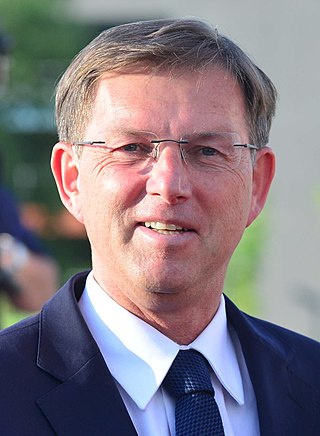
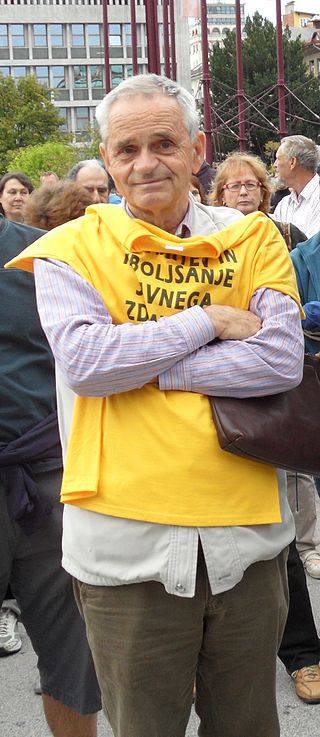
Matej Accetto is a Slovenian judge and president of the Constitutional Court of Slovenia.

Contents

Education

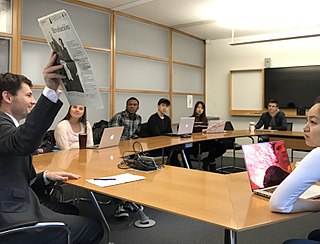
Accetto graduated from the University of Ljubljana Faculty of Law in 2000 and received an LL.M. degree from Harvard University in 2001. [1] He completed this Ph.D. degree at the University of Ljubljana Faculty of Law. Since then, he was employed at the same institution. [1] Currently he is an Associate Professor of European law. He was ranked 24th on the list of Slovenian law professors based on the number of citations in the academic literature, published in January 2018. [2]

Career

Accetto was appointed a member of the Constitutional Court in March 2017, and became its vice president in September 2019. [1]

Above: The 2018 Constitutional Court decision, in which Accetto explains that he had not participated in Cerar's political party agenda, and that he only vaguely knew Cerar. Below: Excerpt from one of the 2014 emails by Accetto, revealed in 2019, showing his active involvement in party's agenda development, and his suggestion that he would serve as a "silent supporter". Matej Accetto judicial misconduct.jpg
Above: The 2018 Constitutional Court decision, in which Accetto explains that he had not participated in Cerar's political party agenda, and that he only vaguely knew Cerar. Below: Excerpt from one of the 2014 emails by Accetto, revealed in 2019, showing his active involvement in party's agenda development, and his suggestion that he would serve as a "silent supporter".

Accetto was appointed to the Constitutional Court based on the "explicit request by Prime Minister Miro Cerar" [3] who taught at the same faculty of law. In two separate procedures at the Constitutional Court, an activist Vili Kovačič challenged decisions of Cerar and his government. Kovačič asked Accetto to recuse himself, or that the court should recuse him, because he had actively participated in the formation of Cerar's political party, and had contributed in writing of the party's agenda before the party was formally established. Accetto explained that he had never participated in any such activity, and that besides professional academical engagement he had no connections to Cerar or his political party. The Constitutional Court published Accetto's statements in two separate decisions, and based on these statements the court let Accetto be a judge on these cases. [4] [5] His judgment in both decisions was against the position of the government led by Miro Cerar and his political party. On October 14, 2019, in the morning, a website Pozareport.si published scanned copies of email correspondence between Accetto, Cerar, and some other founders of Cerar's political party. [4] In these emails, Accetto extensively suggests political agenda for Cerar's party, and states that he would serve as a "silent supporter" of the group. [4] On the same day, a few hours later, Constitutional Court published a judgment, in which judge Jaklič disclosed that Accetto had several times pressured other judges to decide cases in favour of the Cerar government's decisions or legislation. [6] Several journalists and politicians, and former European Court of Human Rights judge and Constitutional Court judge Bostjan M. Zupančič, stated that Accetto should resign. [7] [8] Former president of the Constitutional Court Ernest Petrič commented that the court should be without a stain and that judge's lying to other judges "the worst thing possible." [9] Constitutional Court judge Marko Šorli confirmed that judges had not known about Accetto's correspondence with Cerar and that Accetto had not informed judges about it. Former judge of the Constitutional Court Matevž Krivic said at first that the accusations were unfounded, damaging and "unacceptable", [10] and three days later informed the public that he expects Accetto's resignation, if the allegations are proven to be true. [11] Accetto called claims "an attack on me and my integrity" and the president of the Constitutional Court Rajko Knez called them "unsubstantiated". [12] Vili Kovačič held asked for resignation of three judges, namely Accetto, Knez, and Špelca Mežnar. [13]

On October 22, 2019, media reported that criminal procedure against Accetto was initiated for unfair, subverted, and skewed decisionmaking. According to the copy of the criminal charge, published first by Požareport.si, Accetto was accused of hiding the true relationship with the Cerar's political party, and deceiving the court, in order to be able to judge on a case concerning a prohibited music concert. [14] The case was on lower levels decided by Ksenija Klampfer, then the Head of the Administrative Unit Maribor, and currently a minister belonging to the Cerar's political party, and Vesna Gjerkeš Žnidar, then a Minister of Interior belonging to the Cerar's political party. [15] Accetto had refused to deal with the case expeditiously, and had dismissed the appeal against Klapmfer's and Gjerkeš Žnidar's decisions as unfounded, but the Administrative Court had later found that the concert was prohibited illegally. [16]

On November 12, 2019, Vili Kovačič filed another set of criminal charges against Accetto for subverted and skewed decision making in 22 of Constitutional Court decisions involving Cerar’s party candidates or projects.

Under the constitution, the State Prosecutors’ Office is needs a Parliament’s permission to prosecute a judge and as of November 2019, it has not yet asked the National Assembly to approve the prosecution of Accetto.

Related Research Articles

Same-sex marriage has been legal in Slovenia since 9 July 2022 in accordance with a ruling from the Constitutional Court of Slovenia. The court had ruled that the ban on same-sex marriages violated the Constitution of Slovenia and gave the Parliament six months to amend the law to align with the ruling, although the decision took effect immediately after publication. The National Assembly passed legislation to align with the court ruling on 4 October 2022, which was vetoed by the National Council one week later, but the veto was then overridden by the National Assembly on 18 October 2022.

<span class="mw-page-title-main">LGBTQ rights in Slovenia</span>

Lesbian, gay, bisexual, transgender, and queer (LGBTQ) rights in Slovenia have significantly evolved over time, and are considered among the most advanced of the former communist countries. Slovenia was the first post-communist country to have legalised same-sex marriage, and anti-discrimination laws regarding sexual orientation and gender identity have existed nationwide since 2016.

<span class="mw-page-title-main">Constitutional Court of Slovenia</span> National constitutional court

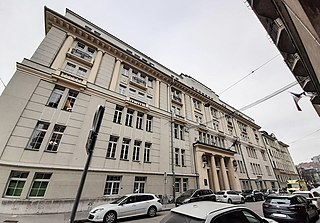
The Constitutional Court of Slovenia is a special court established by the Slovenian Constitution. Since its inception, the Court has been located in the city of Ljubljana. It is the highest court in the country for reviewing the constitutionality and protection of human rights and fundamental freedoms, otherwise the highest court in the country is the Supreme Court of the Republic of Slovenia. The constitutional court is not part of any branch of government and is an independent state body.

Mladina is a Slovenian weekly left-wing political and current affairs magazine. Since the 1920s, when it was first published, it has become a voice of protest against those in power. Today, Mladina's weekly issues are distributed throughout the country. Mladina is considered one of the most influential political magazines in Slovenia.

<span class="mw-page-title-main">Boštjan Zupančič</span> Slovenian judge

Boštjan M. Zupančič is a former Judge at the European Court of Human Rights in Strasbourg, France (1998–2016) and also the President of the Third Chamber at this Court from November 2004 to January 2008.

<span class="mw-page-title-main">2014 Slovenian parliamentary election</span>

Parliamentary elections were held in Slovenia on 13 July 2014 to elect the 90 deputies of the National Assembly. The early election, less than three years after the previous one, was called following the resignation of Alenka Bratušek's government in May. Seventeen parties participated, including seven new parties, some of which formed only months before the election took place. Party of Miro Cerar (SMC), a new party led by lawyer and professor Miro Cerar, won the election with over 34% of the vote and 36 seats. Seven political parties won seats in the National Assembly. Three political parties left the Assembly, including Zoran Janković's Positive Slovenia, the winner of the 2011 election, and the Slovenian People's Party, which failed to win a seat for the first time since the first elections in 1990. A leftist United Left party entered the Assembly for the first time, winning six seats.

<span class="mw-page-title-main">Miro Cerar</span> Slovenian lawyer and politician

Miroslav Cerar Jr. is a Slovenian law professor and politician. He was Prime Minister of Slovenia, leading the 12th Government. He served as Deputy Prime Minister and Minister of Foreign Affairs in the 13th Government. He is a full professor at the Chair of Theory and Sociology of Law at the University of Ljubljana Faculty of Law.

<span class="mw-page-title-main">Modern Centre Party</span> Social-liberal political party in Slovenia

The Modern Centre Party was a social-liberal political party in Slovenia led by Minister of Economical Development and Technology Zdravko Počivalšek, who succeeded former Prime Minister and former Minister of Foreign Affairs Miro Cerar as the party president. It formed in 2014 and merged with Economic Active Party in 2021, to form a party Concretely.

<span class="mw-page-title-main">Vesna Györkös Žnidar</span> Slovenian politician (born 1977)

Vesna Györkös Žnidar is a Slovenian politician who was Minister of Interior in the Cabinet of Miro Cerar between 18 September 2014 and 13 September 2018. She is a member of the Modern Centre Party.

<span class="mw-page-title-main">2018 Slovenian parliamentary election</span>

Parliamentary elections were held in Slovenia on 3 June 2018. The elections were originally expected to be held later in June 2018, but after the resignation of Prime Minister Miro Cerar on 14 March 2018 all parties called for snap elections. They were the third consecutive snap elections after 2011 and 2014.

<span class="mw-page-title-main">2017 Slovenian presidential election</span>

Presidential elections were held in Slovenia on 22 October 2017. Nine candidates ran in the first round of the elections, in which the incumbent independent President Borut Pahor placed first and Marjan Šarec of the List of Marjan Šarec (LMŠ) placed second. No candidate received a majority of the vote in the first round, resulting in a run-off between Pahor and that was held on 12 November 2017. Pahor won the run-off with 53% of the vote; voter turnout in the second round was 42.13%, the lowest in any presidential election since independence.

A referendum on a law governing the Divača-Koper rail upgrade was held in Slovenia on 24 September 2017. The referendum was marked by a low turnout; a majority of voters voted in favour of the proposed law. The results were annulled by the Supreme Court in March 2018, resulting in a new referendum being held in 13 May 2018.

A referendum on a law governing the Divača-Koper rail upgrade was held in Slovenia on 13 May 2018. It followed the annulment of the results of a 2017 referendum on the same subject by the Supreme Court in March 2018. The result saw just 309 more votes cast against the law (50.06%) than in favour (49.94%). Voter turnout was even lower than in 2017, at around 15%, meaning that the requirement of 20% of the electorate casting a "no" vote to validate the referendum outcome was not met. As a result, the law remained in force.

<span class="mw-page-title-main">Jurij Toplak</span> Slovenian jurist

Jurij Toplak is a constitutional scholar, university administrator, election law, and human rights expert. He is professor at University of Maribor and the head of the Cultural Formations research group at the Alma Mater Europaea University, and recurring visiting professor at the Fordham University School of Law in New York. Since 2016, he has served as the provost and vice-president of the Alma Mater Europaea university. The Washington Post, The Guardian, The Wall Street Journal, Financial Times, The New York Times, and The Boston Globe published his legal comments. Toplak is a member of the European Academy of Sciences and Arts and serves as the co-chair of the International Association of Constitutional Law (IACL) Freedom of Expression research group.

<span class="mw-page-title-main">8th National Assembly of Slovenia</span>

The 8th National Assembly of the Republic of Slovenia was elected in the 3 June 2018 Slovenian parliamentary elections. At the order of President Borut Pahor, it first convened on 22 June 2018. The assembly was in session during the outgoing 12th Government of Prime Minister Miro Cerar and elected the 13th and 14th governments. It was the fourth consecutive time in which centre-left and left-wing parties had a majority.

<span class="mw-page-title-main">Ministry of Justice (Slovenia)</span>

The Minister of Justice of the Republic of Slovenia is the political leader of the Ministry of Justice of the Republic of Slovenia, proposed by the prime minister of the Republic of Slovenia and appointed by the National Assembly of the Republic of Slovenia and is a member of the Government of the Republic of Slovenia under the Government of the Republic of Slovenia Act.

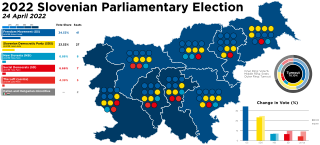
<span class="mw-page-title-main">2022 Slovenian parliamentary election</span>

Parliamentary elections were held in Slovenia on 24 April 2022 to elect all 90 members of the National Assembly.

<span class="mw-page-title-main">Vili Kovačič</span> Slovenian activist

Vili Kovačič is a Slovenian impact litigation activist and blogger, who was the first in Europe to successfully challenge a referendum result based on a campaign finance violation. His challenge resulted in the resignation of Prime Minister Miro Cerar and early parliamentary elections in 2018. His successful challenges to elections and referendums resulted in Constitutional Court reforming Slovenian electoral laws and practices.

A referendum on amendments to the Waters Act was held in Slovenia on 11 July 2021. According to the environmental activists and the domain experts, the provisions of the law would have detrimental effects on the environment and on clean water. With one of the highest turnouts in recent history, the Act was overwhelmingly rejected by the voters.

References

  1. 1 2 3 "Sedanja sestava » us-rs.si". www.us-rs.si. Retrieved 2019-10-14.
  2. "V tujini priznane in prezrte slovenske pravne avtoritete". Spletni časopis (in Slovenian). 2017-12-01. Retrieved 2019-10-14.
  3. "Ustavnosodno nazadovanje". Mladina.si. Retrieved 2019-10-14.
  4. 1 2 3 "Pravna klika SMC. Dokumenti in dokazi: podpredsednik ustavnega sodišča lagal kolegom, strankam postopkov in javnosti". pozareport.si. Retrieved 2019-10-14.
  5. "Sodnik Accetto nepošteno prikrival sodelovanje s SMC, množičnega vračanja migrantov Hrvaški ne bo". Spletni časopis (in Slovenian). 2019-10-14. Retrieved 2019-10-14.
  6. "Odločba Ustavnega sodišča št. U-I-59/17 z dne 18. 9. 2019 » us-rs.si". www.us-rs.si. Retrieved 2019-10-14.
  7. "Nedvomno: ustavni sodnik dr. Matej Acceto mora oditi z ustavnega sodišča! (KOMENTAR)". Revija Reporter. Retrieved 2019-10-15.
  8. [Tema Dneva] 14.10.2019 Nova24TV Gost Boštjan M. Zupančič , retrieved 2019-10-15
  9. "Spopad na ustavnem sodišču: "Javna diskreditacija sodnika ni sprejemljiva"". siol.net (in Slovenian). Retrieved 2019-10-15.
  10. "Krivic: "Pustimo ustavnim sodnikom, da zagotovijo normalno delo sodišča"". RTVSLO.si (in Slovenian). Retrieved 2019-10-16.
  11. "Matevž Krivic: O odgovornosti sodnika Accetta". www.vecer.com (in Slovenian). 2019-10-20. Retrieved 2019-10-20.
  12. "Accetto: Gre za grob napad name in mojo sodniško integriteto". www.24ur.com (in Slovenian). Retrieved 2019-10-15.
  13. "STA: Referendum petitioner wants heads to roll at top court". english.sta.si. Retrieved 2019-10-23.
  14. "Ekskluzivno, začelo se je: na tožilstvu že prva ovadba zoper Accetta. Toda pozor, v Nemčiji takšni sodniki gredo v zapor". pozareport.si. Retrieved 2019-10-23.
  15. "Tožilstvo prejelo kazensko ovadbo proti ustavnemu sodniku Accettu". RTVSLO.si (in Slovenian). Retrieved 2019-10-23.
  16. "Tožilstvo prejelo kazensko ovadbo proti ustavnemu sodniku Accettu". RTVSLO.si (in Slovenian). Retrieved 2019-10-23.