Related Research Articles

Johann George Adam Forster, also known as Georg Forster, was a German naturalist, ethnologist, travel writer, journalist and revolutionary. At an early age, he accompanied his father, Johann Reinhold Forster, on several scientific expeditions, including James Cook's second voyage to the Pacific. His report of that journey, A Voyage Round the World, contributed significantly to the ethnology of the people of Polynesia and remains a respected work. As a result of the report, Forster, who was admitted to the Royal Society at the early age of twenty-two, came to be considered one of the founders of modern scientific travel literature.

Conrad Celtes was a German Renaissance humanist scholar and poet of the German Renaissance born in Franconia. He led the theatrical performances at the Viennese court and reformed the syllabi.

Georg Philipp Harsdörffer was a Jurist, Baroque-period German poet and translator.

Johann Christoph Wagenseil was a German historian, Orientalist, jurist and Christian Hebraist.
A Christian Hebraist is a scholar of Hebrew who comes from a Christian family background/belief, or is a Jewish adherent of Christianity. The main area of study is that commonly known as the Old Testament to Christians, but Christians have occasionally taken an interest in the Talmud, and Kabbalah.
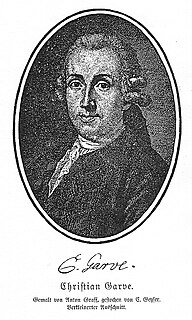
Christian Garve was one of the best-known philosophers of the late Enlightenment along with Immanuel Kant and Moses Mendelssohn.

Christian Adolph Klotz was a German philologist and controversialist. He is a notable representative of the transition period between the Age of Enlightenment and Sturm und Drang.
David Caspari was a German Lutheran theologian. He was the father of Georg Caspari.
Hieronymus Münzer or Monetarius was a Renaissance humanist, physician and geographer who made a famous grand tour of the Iberian peninsula in 1494–5. He was co-author of the Nuremberg Chronicle.

Johann Kaspar Hechtel was a German businessman, owner of a brass factory in Nuremberg, non-fiction writer and designer of parlour games including the prototype for the Petit Lenormand cartomancy deck. According to published biographies, Hechtel also contributed anonymously to some treatises on physics.
Jodok Mörlin, also known in Latin as Jodocus Morlinus or Maurus, was a Professor of Philosophy at the University of Wittenberg, the Lutheran pastor of Westhausen bei Hildburghausen, and a Reformer. He is famed as one of the first witnesses, allies and participants of the Reformation and as the father of two Lutheran theologians, Joachim Mörlin and Maximilian Mörlin.
Friedrich Wilhelm Karl, Ritter von Hegel was a German historian and son of the philosopher Georg Wilhelm Friedrich Hegel. During his lifetime he was a well-known and well-reputed historian who received many awards and honours, because he was one of the major urban historians during the second half of the 19th century.
Johann Gotthelf Lindner was a German university teacher and writer at the time of the eighteenth century Enlightenment.
Georg Lorenz Bauer was a German Lutheran Theologian, and writer on his subject.
Johann Andreas Michael Nagel was a German Hebrew scholar and Orientalist.

Johann Frischmuth was a German Orientalist.

Johann Erhard Kapp was a German rhetorician and historian.
Carl Jonas Pfeiffer was a German merchant, banker, and amateur malacologist.

Daniel Preissler was a German painter, originating from Bohemia.
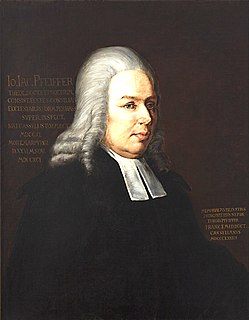
Johann Jakob Pfeiffer was a German evangelical theologian who taught at the University of Marburg.
References
- 1 2 3 4 5 Georg Andreas Will (1806). Georg Andreas Will's Nürnbergisches Gelehrten-Lexicon, oder, Beschreibung aller nürnbergischen Gelehrten beyderley Geschlechts, nach ihrem Leben, Verdiensten und Schriften, zur Erweiterung der gelehrten Geschichtskunde und Verbesserung vieler darinnen vorgefallenen Fehler aus den besten Quellen in alphabetischer Ordnung: fünfterachter Theil oder erster-vierter Supplementband. Beym. pp. 11–14.
