
Recycling is the process of converting waste materials into new materials and objects. This concept often includes the recovery of energy from waste materials. The recyclability of a material depends on its ability to reacquire the properties it had in its original state. It is an alternative to "conventional" waste disposal that can save material and help lower greenhouse gas emissions. It can also prevent the waste of potentially useful materials and reduce the consumption of fresh raw materials, reducing energy use, air pollution and water pollution.

A steel can, tin can, tin, or can is a container made of thin metal, for distribution or storage of goods. Some cans are opened by removing the top panel with a can opener or other tool; others have covers removable by hand without a tool. Cans can store a broad variety of contents: food, beverages, oil, chemicals, etc. In a broad sense, any metal container is sometimes called a "tin can", even if it is made, for example, of aluminium.

Action Man is an action figure launched in Britain in 1966 by Palitoy as a licensed copy of Hasbro's American "movable fighting man", G.I. Joe.

Ship breaking is a type of ship disposal involving the breaking up of ships either as a source of parts, which can be sold for re-use, or for the extraction of raw materials, chiefly scrap. Modern ships have a lifespan of 25 to 30 years before corrosion, metal fatigue and a lack of parts render them uneconomical to operate. Ship-breaking allows the materials from the ship, especially steel, to be recycled and made into new products. This lowers the demand for mined iron ore and reduces energy use in the steelmaking process. Fixtures and other equipment on board the vessels can also be reused. While ship-breaking is sustainable, there are concerns about its use by poorer countries without stringent environmental legislation. It is also labour-intensive, and considered one of the world's most dangerous industries.

Scrap consists of recyclable materials, usually metals, left over from product manufacturing and consumption, such as parts of vehicles, building supplies, and surplus materials. Unlike waste, scrap has monetary value, especially recovered metals, and non-metallic materials are also recovered for recycling. Once collected, the materials are sorted into types — typically metal scrap will be crushed, shredded, and sorted using mechanical processes.

A steel mill or steelworks is an industrial plant for the manufacture of steel. It may be an integrated steel works carrying out all steps of steelmaking from smelting iron ore to rolled product, but may also be a plant where steel semi-finished casting products are made from molten pig iron or from scrap.
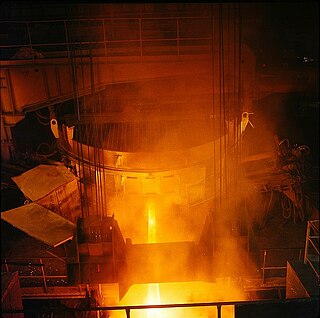
An electric arc furnace (EAF) is a furnace that heats material by means of an electric arc.

The recycling of paper is the process by which waste paper is turned into new paper products. It has a number of important benefits: It saves waste paper from occupying homes of people and producing methane as it breaks down. Because paper fibre contains carbon, recycling keeps the carbon locked up for longer and out of the atmosphere. Around two-thirds of all paper products in the US are now recovered and recycled, although it does not all become new paper. After repeated processing the fibres become too short for the production of new paper, which is why virgin fibre is frequently added to the pulp recipe.

A wrecking yard, scrapyard or junkyard is the location of a business in dismantling where wrecked or decommissioned vehicles are brought, their usable parts are sold for use in operating vehicles, while the unusable metal parts, known as scrap metal parts, are sold to metal-recycling companies. Other terms include wreck yard, wrecker's yard, salvage yard, breaker's yard, dismantler and scrapheap. In the United Kingdom, car salvage yards are known as car breakers, while motorcycle salvage yards are known as bike breakers. In Australia, they are often referred to as 'Wreckers'.

Electronic waste describes discarded electrical or electronic devices. It is also commonly known as waste electrical and electronic equipment (WEEE) or end-of-life (EOL) electronics. Used electronics which are destined for refurbishment, reuse, resale, salvage recycling through material recovery, or disposal are also considered e-waste. Informal processing of e-waste in developing countries can lead to adverse human health effects and environmental pollution. The growing consumption of electronic goods due to the Digital Revolution and innovations in science and technology, such as bitcoin, has led to a global e-waste problem and hazard. The rapid exponential increase of e-waste is due to frequent new model releases and unnecessary purchases of electrical and electronic equipment (EEE), short innovation cycles and low recycling rates, and a drop in the average life span of computers.
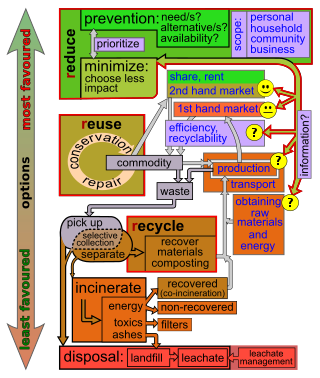
Waste minimisation is a set of processes and practices intended to reduce the amount of waste produced. By reducing or eliminating the generation of harmful and persistent wastes, waste minimisation supports efforts to promote a more sustainable society. Waste minimisation involves redesigning products and processes and/or changing societal patterns of consumption and production.

Aluminium recycling is the process in which secondary commercial aluminium is created from scrap or other forms of end-of-life or otherwise unusable aluminium. It involves re-melting the metal, which is cheaper and more energy-efficient than the production of virgin aluminium by electrolysis of alumina (Al2O3) refined from raw bauxite by use of the Bayer and Hall–Héroult processes.
There is no national law in the United States that mandates recycling. State and local governments often introduce their own recycling requirements. In 2014, the recycling/composting rate for municipal solid waste in the U.S. was 34.6%. A number of U.S. states, including California, Connecticut, Delaware, Hawaii, Iowa, Maine, Massachusetts, Michigan, New York, Oregon, and Vermont have passed laws that establish deposits or refund values on beverage containers while other jurisdictions rely on recycling goals or landfill bans of recyclable materials.

Tire recycling, or rubber recycling, is the process of recycling waste tires that are no longer suitable for use on vehicles due to wear or irreparable damage. These tires are a challenging source of waste, due to the large volume produced, the durability of the tires, and the components in the tire that are ecologically problematic.

Sims Limited (formerly Sims Metal Management Limited) is a global environmental services conglomerate, operating through a number of divisions, with a focus on: (a) Ferrous and Non-ferrous metal recycling, (b) enterprise data destruction and cloud asset management (c) post-consumer electronic goods recycling and reuse, (d) municipal waste recycling, (e) gas to energy, and (f) waste to energy. Founded in 1917, its primary operations are located in the United States, Australia and the UK.

Vehicle recycling or automobile scrapping is the dismantling of vehicles for spare parts. At the end of their useful life, vehicles have value as a source of spare parts and this has created a vehicle dismantling industry. The industry has various names for its business outlets including wrecking yard, auto dismantling yard, car spare parts supplier, and recently, auto or vehicle recycling. Vehicle recycling has always occurred to some degree but in recent years manufacturers have become involved in the process. A car crusher is often used to reduce the size of scrapped vehicles for simplified transportation to a steel mill.
Hairstyling tools may include hair irons, hair dryers, hairbrushes, hair rollers, diffusers and various types of scissors.
Products made from a variety of materials can be recycled using a number of processes.
A scrap metal shredder, also sometimes referred to as a metal scrap shredder, is a machine used for reducing the size of scrap metal. Scrap metal shredders come in many different variations and sizes.

The Villianur Terracotta Works are handicrafts made from fine green clay, fine sand and thennal which are hand made by villagers of Villianur, in the union territory Pondicherry also spelled Pudhucherry, India. It has a history of more than 20 generations.


