
The French National Centre for Scientific Research is the French state research organisation and is the largest fundamental science agency in Europe.

Gilles Kepel, is a French political scientist and Arabist, specialized in the contemporary Middle East and Muslims in the West. He was Professor at Sciences Po Paris, the Université Paris Sciences et Lettres (PSL) and director of the Middle East and Mediterranean Program at PSL, based at Ecole Normale Supérieure. His latest english-translated book, Away from Chaos. The Middle East and the Challenge to the West was reviewed by The New York Times as “an excellent primer for anyone wanting to get up to speed on the region”. His last essay, le Prophète et la Pandémie / du Moyen-Orient au jihadisme d'atmosphère, just released in French, has topped the best-seller lists and is currently being translated into English and a half-dozen languages. The excerpt The Murder of Samuel Paty is presently released in the Issue 3 of Liberties JournalArchived 2021-04-07 at the Wayback Machine.
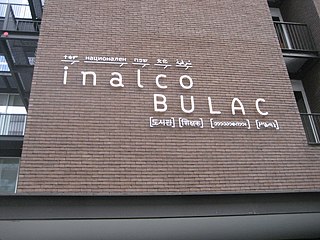
Institut national des langues et civilisations orientales, abbreviated as INALCO, is a French Grand Etablissement with a specializing in the teaching of languages and cultures from the world. Its coverage spans languages of Central Europe, Africa, Asia, America, and Oceania. With 104 languages taught as of 2024, this institution is currently the world's largest provider of language training courses.

The French National Research Institute for Sustainable Development, or Institut de Recherche pour le Développement (IRD), is a French science and technology establishment under the joint supervision of the French Ministries of Higher Education and Research and Foreign Affairs. It operates internationally from its headquarters in Marseille, and two metropolitan centres of Montpellier and Bondy.
Vladimir de Semir is Spanish journalist. He started his career in 1975 and has specialized in science journalism and science popularization since 1982. In 1994 he began teaching and training new journalists and popular science writers at Pompeu Fabra University (Spain) where he directs the Science Communication Observatory. In 1994, the Spanish Scientific Research Council awarded de Semir with the Prize for Scientific Journalism.

Toulouse School of Economics is a school of economics, affiliated with Toulouse 1 Capitole University, a constituent college of the Federal University of Toulouse Midi-Pyrénées. It is located in the city of Toulouse, France.
Paris Sciences et Lettres University is a public research university and Grand établissement based in Paris, France. It was established in 2010 and formally created as a university in 2019. It is a collegiate university with 11 constituent schools, with the oldest founded in 1530. PSL is located in central Paris, with its main sites in the Latin Quarter, at the Montagne Sainte-Geneviève campus, at the Jourdan campus, at Porte Dauphine, and at Carré Richelieu.

Christian H. Jost is a French geographer.
LEPAC was founded by Jean-Christophe Victor and Virginie Raisson in 1992, as a private, independent think tank based in France and specialised in international geopolitical analysis and foresight studies. The acronym LEPAC stands for "Laboratoire d'Etudes Prospectives et d'Analyses Cartographiques", translated in English as "Foresight Studies and Cartographic Analysis Laboratory".

Jacques Émile Blamont was a French astrophysicist, author and the founder scientific and technical director of National Centre for Space Studies, known to have contributed to the development of Veronique, the first rocket launched by France in 1957. He was an elected fellow of the French Academy of Technologies and a professor emeritus of the Pierre and Marie Curie University.

The Association française pour l'information scientifique or AFIS is an association regulated by the French law of 1901, founded under the leadership of Michel Rouzé in November 1968. As a skeptical organisation, it has been a member of the European Council of Skeptical Organisations since 2001, and publishes the magazine Science et pseudo-sciences.
Stéphanie Balme is the Dean of College of Sciences at Sciences Po College. She is a permanent research fellow at CERI and professor at PSIA/Sciences Po and the Euro-Asia Campus/Sciences Po. She has been elected Director of CERI. Stephanie Balme is the first female director of this joint Sciences Po - CNRS - Centre national de la recherche scientifique research unit and took up her post on 2 January 2024, succeeding Alain Dieckhoff (CNRS) who had held the position since 2013.

Esther Benbassa is a French-Turkish-Israeli historian and politician. She specializes in the history of Jews and other minorities. Since 2011, Benbassa has served as a French senator, representing Paris from 2017 onwards and Val-de-Marne from 2011 to 2017.
Pierre Auger is a French bio-mathematician born on March 8, 1953, in Neuilly-sur-Seine. He is a member of the French Academy of sciences and Director of Exceptional Class Research at the Research Institute for Development. Pierre Auger's research field concerns the mathematical modelling of biological systems.
Anne-Marie Devreux is a French sociologist specializing in feminism and the sociology of gender relations.

Robert Chabbal was a French physician and scientific researcher. He was Director General of the French National Centre for Scientific Research (CNRS) from 1976 to 1979.
Pierre Singaravélou is a French Global historian who is a British Academy Global Professor of History at King's College London. He is also full Professor of Modern History at Paris 1 Panthéon-Sorbonne University and director of the Center for Asian History (Sorbonne). Professor Singaravélou is the former director of the Sorbonne University Press and an honorary fellow of the Institut universitaire de France.
Catherine Marry is a French sociologist. Her research concerns the sociology of education, the sociology of work and gender studies. She was awarded an Irène Joliot-Curie Prize in 2008 for her mentorship activities and is a research director emeritus at the French research center, CNRS.
The Institut des mondes africains (IMAF) is a French academic mixed and interdisciplinary research unit for African studies, in which the national research organisation CNRS, three other French national academic research institutions and two universities collaborate. They are the Institut de recherche pour le développement, the École pratique des hautes études (EPHE), the École des hautes études en sciences sociales and the Aix-Marseille University and the Pantheon-Sorbonne University.

Marie-Françoise André, born 21 November 1953 in Paris, is a French geographer and geomorphologist specialized in the study of landscape architecture in the polar regions. She applies her knowledge of stone erosion in the field of heritage preservation, particularly in Angkor. Her research was rewarded with a silver medal from CNRS, the French national center for scientific research.
