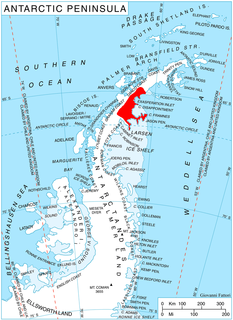
Kohler Glacier is a distributary of the Smith Glacier in Marie Byrd Land, Antarctica, flowing northward through the middle of the Kohler Range into Dotson Ice Shelf. It was mapped by the U.S. Geological Survey from surveys and U.S. Navy air photos, 1959–65, and was named by the Advisory Committee on Antarctic Names in association with the Kohler Range.

Collins Glacier is a glacier about 11 nautical miles (20 km) wide at its confluence with the Mellor Glacier, which it feeds from the southwest, located north of Mount Newton in the Prince Charles Mountains of Antarctica. It was mapped by the Australian National Antarctic Research Expeditions from air photos taken in 1956 and 1960, and named by the Antarctic Names Committee of Australia for Neville Joseph Collins, senior diesel mechanic at Mawson Station, 1960.
Silk Glacier is a glacier, 10 miles (16 km) long, draining the east slopes of the Churchill Mountains between Mount Frost and Mount Zinkovich to enter Nursery Glacier. Named by Advisory Committee on Antarctic Names (US-ACAN) for Cdt. P.R.H. Silk, RNZN, commanding officer of HMNZS Endeavour II in Antarctic waters, 1963-64.

Sabine Glacier is a 13.5 km long glacier on the north side of Detroit Plateau, flowing from Mount Bris and Tsarevets Buttress northwards along the east slopes of Korten Ridge, and terminating at the sea in Jordanoff Bay on Davis Coast in Graham Land, Antarctica. Captain Henry Foster gave the name "Cape Sabine" in 1829 to a feature lying southeast of Cape Kater but it has not been possible to identify that cape. This toponym preserves the early use of Sabine in this area. Sir Edward Sabine (1788-1883), English astronomer and geodesist, was a member of the committee which planned the 1829 voyage of Foster in the Chanticleer.
Meander Glacier is a large meandering tributary to Mariner Glacier in Victoria Land, Antarctica. The glacier emerges in the vicinity of Mount Supernal and Hobbie Ridge and drains generally eastward for 30 nautical miles (56 km) through the Mountaineer Range to join Mariner Glacier just east of Engberg Bluff. The descriptive name was given by the New Zealand Geological Survey Antarctic Expedition, 1962–63.
Haas Glacier is a steep tributary glacier draining northward from Rawson Plateau to enter the south side of Bowman Glacier, in the Queen Maud Mountains of Antarctica. It was mapped by the United States Geological Survey from surveys and U.S. Navy air photos, 1960–64, and was named by the Advisory Committee on Antarctic Names for Charles G. Haas, a meteorologist in the South Pole Station winter party, 1960.
Adams Bluff is a bluff standing 5 miles (8 km) north of Peters Peak in the Holyoake Range of the Churchill Mountains. Mapped by the United States Geological Survey (USGS) from tellurometer surveys and Navy air photos, 1960–62. Named by Advisory Committee on Antarctic Names (US-ACAN) for Paul L. Adams, United States Antarctic Research Program (USARP) meteorologist at Byrd Station, 1961–62, 1962–63, and at McMurdo Station, 1963–64, 1964–65.

Carey Glacier is a glacier on the east side of Miller and Fruzhin Peaks and west of Ruset and Malkoch Peaks in Petvar Heights at the southeast end of the Sentinel Range, Ellsworth Mountains, flowing southeast to Minnesota Glacier. It was mapped by the United States Geological Survey from surveys and from U.S. Navy air photos, 1957–59, and named by the Advisory Committee on Antarctic Names for Lieutenant David W. Carey, pilot with U.S. Navy Squadron VX-6, who was killed in the crash of a P2V Neptune airplane at McMurdo Sound in October 1956.
The Enterprise Hills are a prominent group of largely ice-free hills and peaks in the form of an arc. The feature extends for about 30 nautical miles (60 km) to form the north and northeast boundary of Horseshoe Valley in the Heritage Range of the Ellsworth Mountains. These hills were mapped by the United States Geological Survey from surveys and U.S. Navy air photos, 1961–66; the name was applied by the Advisory Committee on Antarctic Names in association with the name Heritage Range.
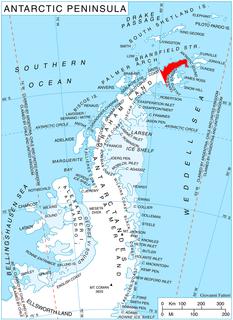
Whitecloud Glacier is a glacier which flows northward between Klokotnitsa Ridge on the east and Tsarevets Buttress on the west to discharge into Charcot Bay just west of Almond Point, Trinity Peninsula. Named by United Kingdom Antarctic Place-Names Committee (UK-APC) in 1960. The name is descriptive of cloud conditions that prevailed at the time of Falkland Islands Dependencies Survey (FIDS) survey of the area in 1948.
Jutland Glacier is a broad tributary glacier, 15 nautical miles (28 km) long and 4 nautical miles (7.4 km) wide, in the Victory Mountains of Victoria Land, Antarctica. It drains northwest from a common divide with Midway Glacier to join the flow of the Greenwell Glacier northwest of Boss Peak. It was mapped by the United States Geological Survey from surveys and U.S. Navy aerial photographs, 1960–63. It was named by the northern party of the New Zealand Federated Mountain Clubs Antarctic Expedition (NZFMCAE) which explored the area in 1962–63, after the Battle of Jutland, to continue the sequence of features in the vicinity named after famous battles.
Johnson Glacier is a glacier flowing north between the McDonald Heights and Bowyer Butte to merge with the Getz Ice Shelf on the coast of Marie Byrd Land, Antarctica. It was mapped by the United States Geological Survey from surveys and U.S. Navy air photos, 1959–65, and was named by the Advisory Committee on Antarctic Names for Roland L. Johnson, Boatswain's Mate, U.S. Navy, a crew member of the USS Glacier (AGB-4) during exploration of this coast in the 1961–62 season.
Ebony Wall is a dark, nearly vertical rock wall in Antarctica, which rises about 400 metres (1,300 ft) at the head of Pettus Glacier. The wall is about 2 nautical miles (4 km) long and forms a part of the western escarpment of Detroit Plateau near the base of Trinity Peninsula. It was charted in 1948 by the Falkland Islands Dependencies Survey who applied the descriptive name.

Edgeworth Glacier is a glacier 12 nautical miles (22 km) long, flowing south-southwestwards from the edge of Detroit Plateau below Wolseley Buttress and Paramun Buttress between Trave Peak and Chipev Nunatak into Mundraga Bay west of Sobral Peninsula, on the Nordenskjöld Coast of Graham Land. It was mapped from surveys by the Falkland Islands Dependencies Survey (1960–61), and was named by the UK Antarctic Place-Names Committee for Richard Lovell Edgeworth, the British inventor of the "portable railway," the first track-laying vehicle, in 1770.
Foolsmate Glacier is a small, heavily crevassed tributary glacier flowing northeast to enter Priestley Glacier, 11 nautical miles (20 km) west of Shafer Peak, in Victoria Land, Antarctica. The name was applied by the Southern Party of the New Zealand Geological Survey Antarctic Expedition, 1962–63.
Goodell Glacier is a glacier about 5 nautical miles long flowing east and north from Fletcher Peninsula into the Williams Ice Stream, Antarctica. It was named by the Advisory Committee on Antarctic Names after Janice G. Goodell of the United States Geological Survey, Woods Hole, Massachusetts, a support member of the Glacier Studies Project Team from the early 1990s onwards.

McCance Glacier is the 30-km long and 5 km wide glacier draining the Hutchison Hill area on the west slopes of Avery Plateau on Loubet Coast in Graham Land, Antarctica. It flows north-northwestwards along the west side of Osikovo Ridge, Kladnitsa Peak and Rubner Peak and enters Darbel Bay.
Reynolds Glacier is a glacier 5 nautical miles (9 km) long, flowing eastward from the Haines Mountains along the south side of Keyser Nunatak to enter the Hammond Glacier, in Marie Byrd Land. Mapped by United States Geological Survey (USGS) from surveys and U.S. Navy air photos, 1959-65. Named by Advisory Committee on Antarctic Names (US-ACAN) for Donald K. Reynolds, ionospheric physicist at Byrd Station, 1967-68 season.
Vaughan Glacier is a tributary glacier, 10 nautical miles (18 km) long, draining eastward from Mount Vaughan to enter Scott Glacier just south of Taylor Ridge, in the Hays Mountains of the Queen Maud Mountains. It was mapped by the United States Geological Survey (USGS) from surveys and U.S. Navy air photos, 1960–64, and was named by the Advisory Committee on Antarctic Names (US-ACAN) in association with Mount Vaughan.