Latin jazz is a genre of jazz with Latin American rhythms. The two main categories are Afro-Cuban jazz, rhythmically based on Cuban popular dance music, with a rhythm section employing ostinato patterns or a clave, and Afro-Brazilian jazz, which includes samba and bossa nova.

Ramón "Mongo" Santamaría Rodríguez was a Cuban percussionist and bandleader who spent most of his career in the United States. Primarily a conga drummer, Santamaría was a leading figure in the pachanga and boogaloo dance crazes of the 1960s. His biggest hit was his rendition of Herbie Hancock's "Watermelon Man", which was inducted into the Grammy Hall of Fame in 1998. From the 1970s, he recorded mainly salsa and Latin jazz, before retiring in the late 1990s.
Afro-Cuban jazz is the earliest form of Latin jazz. It mixes Afro-Cuban clave-based rhythms with jazz harmonies and techniques of improvisation. Afro-Cuban music has deep roots in African ritual and rhythm. The genre emerged in the early 1940s with the Cuban musicians Mario Bauzá and Frank Grillo "Machito" in the band Machito and his Afro-Cubans in New York City. In 1947, the collaborations of bebop trumpeter Dizzy Gillespie and percussionist Chano Pozo brought Afro-Cuban rhythms and instruments, such as the tumbadora and the bongo, into the East Coast jazz scene. Early combinations of jazz with Cuban music, such as "Manteca" and "Mangó Mangüé", were commonly referred to as "Cubop" for Cuban bebop.
A descarga is an improvised jam session consisting of variations on Cuban music themes, primarily son montuno, but also guajira, bolero, guaracha and rumba. The genre is strongly influenced by jazz and it was developed in Havana during the 1950s. Important figures in the emergence of the genre were Cachao, Julio Gutiérrez, Bebo Valdés, Peruchín and Niño Rivera in Cuba, and Tito Puente, Machito and Mario Bauzá in New York. Originally, descargas were promoted by record companies such as Panart, Maype and Gema under the label Cuban jam sessions. From the 1960s, the descarga format was usually adapted by large salsa ensembles, most notably the Fania All-Stars.

Armando Peraza was a Latin jazz percussionist and a member of the rock band Santana. Peraza played congas, bongos, and timbales.
Arturo "Chico" O'Farrill was a Cuban composer, arranger, and conductor, best known for his work in the Latin idiom, specifically Afro-Cuban jazz or "Cubop", although he also composed traditional jazz pieces and even symphonic works.

William Correa, better known by his stage name Willie Bobo, was an American Latin jazz percussionist of Puerto Rican descent. Bobo rejected the stereotypical expectations of Latino music and was noted for combining elements of jazz, Latin and rhythm and blues music.

"Watermelon Man" is a jazz standard written by Herbie Hancock for his debut album, Takin' Off (1962).

Francisco Aguabella was an Afro-Cuban percussionist whose career spanned folk, jazz, and dance bands. He was a prolific session musician and recorded seven albums as a leader.
"Afro Blue" is a jazz standard composed by Mongo Santamaría.
Eddie Allen is an American jazz trumpeter and flugelhornist from Milwaukee.

Steve Berrios was an American jazz drummer and percussionist born in New York City.
Mario Rivera was a Latin jazz saxophonist from the Dominican Republic. Besides saxophone, Rivera played trumpet, flute, piano, vibraphone, congas, and drums.
Carlos Valdés Galán, better known as Patato, was a Cuban conga player. In 1954, he emigrated from La Habana to New York City where he continued his prolific career as a sideman for several jazz and Latin music ensembles, and occasionally as a bandleader. He contributed to the development of the tunable conga drum which revolutionized the use of the instrument in the US. His experimental descarga albums recorded for Latin Percussion are considered the counterpart to the commercial salsa boom of the 1970s. Tito Puente once called him "the greatest conguero alive today".
Bobby Sanabria is an American drummer, percussionist, composer, arranger, documentary producer, educator, activist, radio show host, and writer of Puerto Rican descent who specializes in jazz and Latin jazz.
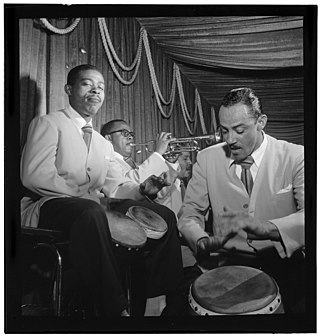
Carlos Vidal Bolado also known as "Vidal Bolado" (1914–1996) was a Cuban conga drummer and an original member of Machito and his Afro-Cubans. Vidal holds the double distinction of being the first to record authentic folkloric Cuban rumba and the first to play congas in Latin jazz.

Afro is an album by trumpeter Dizzy Gillespie, released in 1954 on the Norgran label. Gillespie worked with many Cuban musicians on the album.

Justo Pastor Almario Gómez is a Colombian-born, Los Angeles-based flutist, saxophonist and Latin jazz group leader. He was among several Colombian musicians recruited by Mongo Santamaria for his band in the 1970s, notably on the album, Afro–Indio (1975).
Juan Pablo Torres Morell was a Cuban trombonist, bandleader, arranger and producer. He was the director of Algo Nuevo and a member of Irakere, two of the leading exponents of songo and Afro-Cuban jazz in the 1970s and 1980s. He has also directed various Cuban supergroups such as Estrellas de Areito and Cuban Masters. He has been called "one of the best trombone players in the Latin-jazz community of the 1990s".

Mongo Introduces La Lupe is an album by La Lupe and the Mongo Santamaria Orchestra. It was recorded at the Plaza Sound Studios in New York City and released by Riverside Records in 1963. AllMusic gave the album a rating of four stars. Reviewer Scott Yanow called it "an excellent set of stirring Afro-Cuban jazz."


